


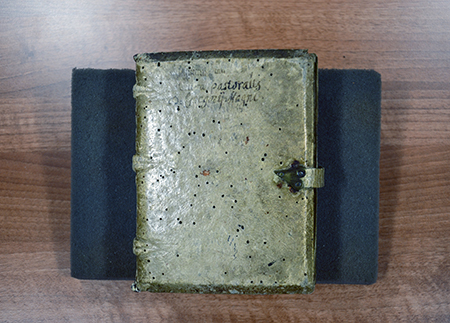
A book in the library at the University of Liverpool was redated by Dr. Erik Kwakkel to the 12th century
Gregorius’ De cura pastorali was until yesterday believed to stem from the 13th century. After a visit by leading scholar, Dr. Erik Kwakkel, the small book was redated to the 12th century using new developments in the field.
Dr Erik Kwakkel, of Leiden University in the Netherlands, was visiting the University’s Special Collections and Archives to deliver a workshop and talk to postgraduate students on medieval manuscripts.
An a expert in the fields of palaeography and codicology, Dr. Kwakkel attempts to uncover what he terms the ‘cultural residue’ of works in order to gain an insight into their age and possible use. He explores manuscripts by examining aspects not central to the text itself, such as book chains, marks from candle wax, reader annotations or the type of material the work is written on etc.
Dr Kwakkel was given the opportunity to explore the extensive collection and determined that a copy held of Gregorius’ De cura pastorali was not made in the 13th Century, as originally thought, but actually dates back an additional 100 years – making it the oldest in the collection. He bases the new date on an examination of the binding.
“When you have the binding, you can see what it looked like in the Middle Ages. We have the full picture and we can see the book like a medieval person did… what makes it significant is that it still has its original bindings. These are extremely rare in the Middle Ages, particularly when we move back in time from the 13th Century to the 12th Century”.

Among those attending the workshop were Medieval and Renaissance Studies MA students, Kate Watkins, Seamus Cartmell and James Duffy. Seamus said: “It’s interesting to think that it’s not necessarily what’s in the document, as much as its physicality – we have to listen to what it says. The book is a silent witness.”
On a mission
Erik told students that the presence of a chain on a book, or even the remnants of a chain, revealed that it was stored in a public place. Any annotations or marginalia were also likely to have been produced by readers across the ages, and not by the monks who originally produced each work.
He added: “I do this because I am on a mission. The medieval manuscript needs a bigger audience, much bigger than it has, and the next generation needs to be inspired. I do feel that graduate students need to feel there is something still to be researched.”
To further this aim, both Erik and Sarah are active on twitter @Erik_Kwakkel and @Sarah_Peverley
Follow the project at Facebook


