


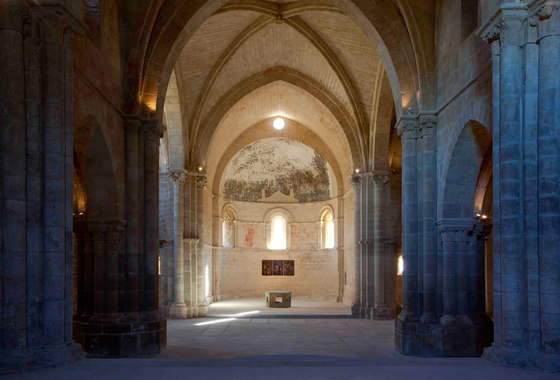
Abadia Retuerta LeDomaine is a romanesque abbey in Northern Spain near Valladolid. It was recently given the prestigious Europa Nostra award for conservation
In 1145 the daughter of the Lord of Valladolid, Doña Mayor donated “terras et vineas” to the church. Immediately afterwards the construction of the grandiose Abbey, Abadía Santa Maria de Retuerta, began. It was built for the Premonstratensian Order. Baroque-Romanesque in style, it has a classic Benedictine layout of church, cloister, refectory, chapterhouse and hospedería. Many building details are Romanesque. It is one of only two such abbeys to have survived the destruction wrought by Napoleon and is a treasured Spanish cultural heritage site. Nevertheless, the Abbey was until recently an empty shell slowly turning into a derelict ruin. Now it functions as a luxurious hotel a couple of hours north of Madrid.

The recent abbey renovation has strived to respect the integrity of 1000 years of history as well as the visions of the ancient founders’ vision and values. The original monastic uses of rooms have been maintained – the refectory functions as the restaurant – while the Romanesque-Baroque architecture has been conserved, not altered. However, added to this have been opulent new furnishings, lightings and climate controls in order to make modern guests feel at home. Nevertheless all has been done without compromising the ancient site. For instance several original artworks were restored, while the river landscape and acres of vineyards were replanted. Abbey, winery, landscape, art, architecture and history have thus been embodied into a new exclusive hotel giving the abbey a vital new role in this century and ensuring its continued safety in the future.
“To alter this ancient edifice was to engage in a 1.000 year-old architectural dialogue. The judicious restraint of my intervention, is my homage to those who spoke before me.” Says Marco Serra, Master Architect
Hence, the twelfth-century building retains enough historic detail—ask to see the jewel box of a chapel—to keep things architecturally interesting. However, at the same time the clean-lined decor is thoroughly contemporary, the large rooms wrapped in soothing beiges and striking contrast colours. According to a review in Condé Nast Traveller: “The staff anticipate every whim, from the hot towels and warm tea cocktail delivered upon arrival to the bottles of mineral water presented for traveling upon departure.
The restoration recently received the prestigious award for restoration by Europa Nostra for its outstanding respect for the traditional visions and values of the original founders and builders. The question is: can this be achieved in a restoration like this? And what should we in general think about such restoration projects?
A presentation of the Abadia and the restoration
The story of the Abbey (in Spanish)


