


Art under Attack: Histories of British Iconoclasm is the first exhibition exploring the history of physical attacks on art in Britain from the 16th century to the present day
Iconoclasm describes the deliberate destruction of icons, symbols or monuments for religious, political or aesthetic motives. The exhibition examines the movements and causes which have led to assaults on art through objects, paintings, sculpture and archival material.
Highlights include Thomas Johnson’s Interior of Canterbury Cathedral 1657– the only painting documenting Puritan iconoclasm in England – exhibited for the first time alongside stained glass removed from the windows of the cathedral. Allen Jones’s Chair 1969 is on display, as well as evidence of statues destroyed in Ireland during the 20th century. The show consides artists such as Gustav Metzger, Yoko Ono and Jake and Dinos Chapman, who have used destruction as a creative force.
Religious iconoclasm of the 16th and 17th centuries is explored with statues of Christ decapitated during the Dissolution, smashed stained glass from Rievaulx Abbey, fragments of the great rood screen at Winchester Cathedral and a book of hours from British Library, impaired by state-sanctioned religious reformers. These works are accompanied by vivid accounts of the destructive actions of Puritan iconoclasts.
Examples of attacks on symbols of authority during periods of political change include a portrait of Oliver Cromwell hung upside down by the staunch monarchist Prince Frederick Duleep Singh (1868–1926). It also shows fragments from statues of William III and Nelson’s Pillar destroyed by blasts during political struggles in Dublin in 1929 and 1966 respectively.
Suffragettes’ targeted attacks on cultural heritage are illustrated with works by Edward Burne-Jones’s Sibylla Delphica 1898, attacked in 1913 in Manchester, the birthplace of Emmeline Pankhurst, as well as John Singer Sargent’s Henry James 1913, slashed at the Royal Academy in 1914. These are accompanied by archival descriptions of the actions carried out and police surveillance photography of the militant Suffragette protagonists.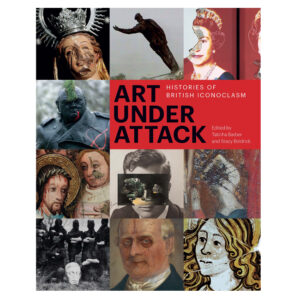

Assaults on art stimulated by moral or aesthetic outrage include those on Carl Andre’s Equivalent III 1966, and Allen Jones’s Chair 1969, damaged on International Women’s Day in the 1980s. The show reveals how for some modern artists destruction has been utilised as a creative force. The piano and chair destroyed by Ralph Ortiz during the 1966 Destruction in Art Symposiusm is on public display for the first time, alongside audio recordings of this action and works by Gustav Metzger, John Latham and Yoko Ono. Portraits from Jake and Dinos Chapman’s One Day You Will No Longer Be Loved series, Mark Wallinger’s Via Dolorosa 2002 and Douglas Gordon’s Self-portrait of you and me 2008 are also be included.
FEATURED PHOTO:
The figure of Christ found in the ruins of the Mercers’ Hall in London @ Tate Gallery
VISIT:
Art under Attack: Histories of British Iconoclasm
Tate Britain, London
2 October 2013 – 5 January 2014
CATALOGUE:
Art Under Attack: Iconoclasm
By Barber & Boldrick
Paperback, 192pp including 136 colour illustrations
Publisher Tate Publishing
ISBN:
978 1 84976 030 0
£24.99
Published to accompany the exhibition at Tate Britain, this fully illustrated catalogue explores the history of attacks on art in Britain, from the reformation of the sixteenth century to the present day, demonstrating how religious, political, moral and aesthetic controversy can become arenas for assaults on art. Through eight essays, the broad subject of iconoclasm is broken into three overarching themes: the state-sanctioned iconoclastic zeal of religious reformers, who aimed to purge both churches and minds of the sin of idolatry; the symbolic statue-breaking that accompanies political change such as the targeted attacks on cultural heritage by the suffragettes; and attacks on art by individuals stimulated by a moral or aesthetic outrage. Importantly, the aim of the study is to present the rationale of iconoclasm, its significance to the history of an object, and how it has become a productive and transformational practice for some modern and contemporary artists. With contributions by Stacy Boldrick, Susan Harrison, Lena Mohamed, Jenny Powell, Greg Sullivan, Richard Williams and Andrew Wilson. Tabitha Barber is Curator, British Art (1550-1750) at Tate.
READ MORE:
A Statue of Christ from the Ruins of Mercers’ Hall
By Joan Evans and Norman Cook
The Mercers’ Christ reexamined
By Kim Woods
In: Richard Marks (ed.), Late Gothic England: Art and Display p. 57-69
Paul Watkins Publishing, 2007


