


During Easter the philologist Malina Molin Pradel recently made a truly amazing discovery – a Greek Manuscript in the Johann Jakob Fuller collection containing a series of hitherto unknown homilies of one of the greatest early theologians, Origen (ca.184–253). Origen, who was an early Christian teacher from Alexandria in Egypt, became controversial during the Arian controversy of the 4th century and his extensive writings were declared heretical in the mid 6th century. Accordingly only fragments of a truly impressive oeuvre have survived. Amongst these have until now been a small sample of the enormous output of sermons, Origin had to preach after he moved to Caesarea in the early 230s and was anointed priest there. It is believed that he was given the responsibility of delivering the homilies in the three-year liturgical cycle of the early Church. This included preaching at a daily-morning Eucharistic service, Monday through Saturday plus preaching in the evenings of Wednesday and Friday as well as of course on Sundays. While the services in the weekly mornings were delivered on the texts from the Old Testament, the others were delivered on Gospel texts. These services were reserved for the baptized, while the weekly morning prayers were open to catechumens. During these services the books of the Old Testament were read consecutively, which meant that the whole was covered in approximately three years.
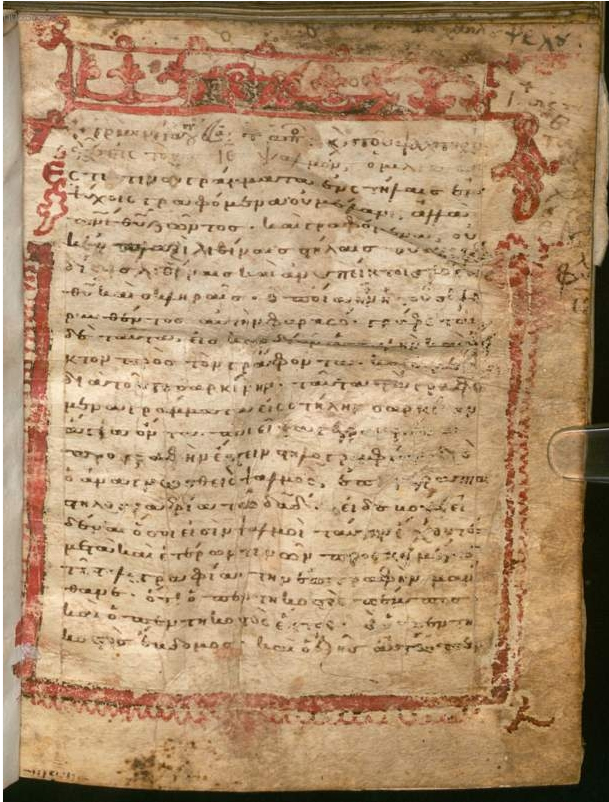
It is in this perspective the newfound manuscript in the Bavarian State Library takes on enormous proportions. And as the head of library, where the manuscript resides, has graciously secured a prompt digital publication of the manuscript, patristic scholars and theologians have started perusing the 28 homilies. Some of these are known in a Latin translation, which makes the identification of the author possible.
As with the corresponding find in Erfurt of six “new” homilies by Augustine in 2008, they are sure to broaden our knowledge of the Early Christian Church and the life, which was lead by the baptized as well as the catechumens. But also, which might be just as important, the knowledge of what was available as inspirational material in the later medieval church, when sermons were to be delivered with a parallel regularity. One might wonder what other hidden gems may be found in the as yet un-catalogued collections in German libraries. The Bavarian State Library has more than 650 Greek manuscripts and is thus the largest collection in Germany. However, the current re-cataloguing is estimated to take at least 15 more years.
Press release by the Bayerische Staats Bibliothek
Homiliae in psalmos – BSB Cod.graec. 314, [S.l.], 12. Jh. [BSB-Hss Cod.graec. 314]
Read more:


