


The continued demographic crisis of 14th and 15th century plague-ridden Europe did not calm the political waters. Arguably, the majority of people got wealthier when they began to pluck off the clothes of the backs of their dead neighbours while stuffing themselves with the fat gees running wild on the abandoned fields. One should have thought that just to have survived might have calmed the waters. Instead, the wars ravaged the continent.
-

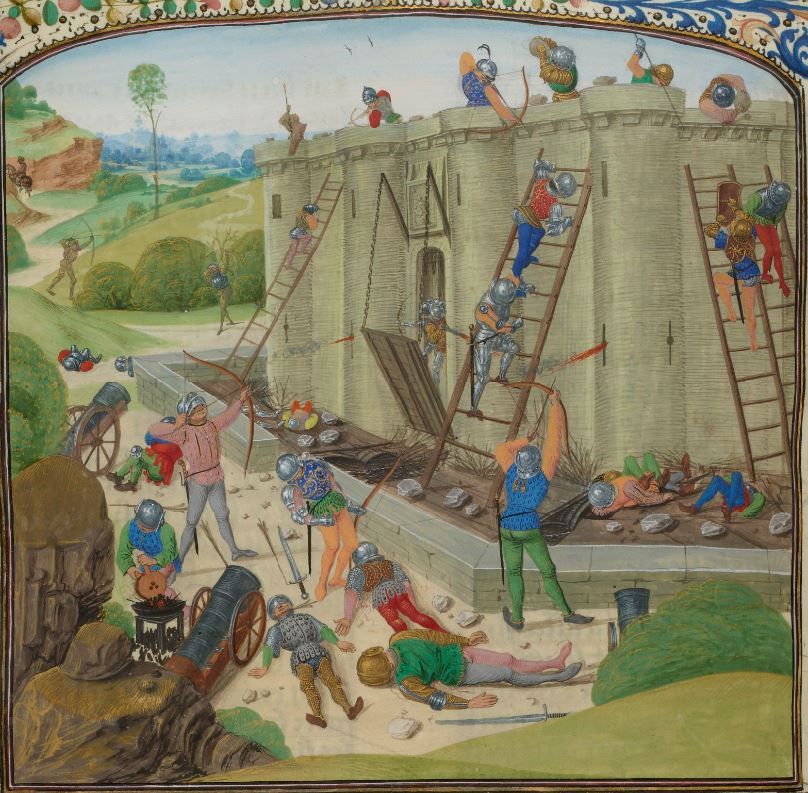
Scene of a siege of Brest from the Chronicles of Jean Froissart. 1386, Paris, BnF, FR 2643, fol. 410. Source: Wikipedia In Scandinavia, the continued Swedish rebellion against the Kalmar-union spread havoc in the Swedish countryside as well as towns throughout the century
- Until 1453, most of Northern and Western France was laid waste by the English until the French finally got the upper hand
- Later, in the second half of the century, the war of Roses culminated in several large, decisive battles ending with Bosworth in 1485
- In Central Europe, the century opened with the Hussite wars, which were more or less a series of civil war played out between two imperial factions – the Luxemburgs and the Hapsburgs.
- In Poland, the Jagiellonian Dynasty establish a mighty power at some point ruling Lithuania, Poland. Bohemia, and Hungary
- In Spain, the final years of the Reconquista were spurred on by the outcome of the Castillian Wars of succession leading to the final capture of Granada and the near annihilation of Portugal.
- In the east, two new imperial powers – Muscovy and the Ottomans build their new powerbases through aggressive behaviour culminating with the Fall of Constantinople in 1453 and the final defeat of the Tatar Golden Horde in 1480
The costs of these wars were immense and led towards more creative forms of suppression of peasants as well as new forms of taxation. Also, the warring was spurred on by technological as well as administrative innovations, the invention of the harquebus as well as the introduction of standing armies (France 1449).
These wars were a reflection of the concentration of powerful nodes inside the network of rival states, as Philippe de Commines so vividly sketched in his memoirs finished in 1498. Finally, the political events in France and Burgundy lead to the consolidation of the four great European powers – France, Spain, England and the Holy Roman Empire of the Hapsburgs.
To some extent, the same concentration of powers took place on a minor scale with numerous minor and major feuds leading to consolidation and petrification of the nobility. At the end of the 15th century, to enter the ranks of the exalted became nearly impossible, as even rich parvenus discovered when trying to hobnob with the mighty of any realm. This concentration of power meant peripheralisation of the less privileged. The formation of the “modern states” of Western Christendom did not just take place in the upper echelons of society. It reverberated in the insignificant corners of small towns, among the gentry and occasionally led to uprisings such as those in Paris in 1413 and Ghent in 1477 culminating at the beginning of the 16th century.
At the centre of these events were the “princes” – kings, dukes, condottieri, princely bishops or knights – whose orbits followed the paths of “fortune”, the beloved metaphor of which was the wheel.
Political Propaganda
The Gutenberg Press, fully developed in 1439 was the most significant invention of the century. Although the consequences in the form of mass production and spread of printed books did not set its mark before the Reformation, the new technology was widely adopted in the second half of the 15th century; and led to the dissemination of manuals and pamphlets of all sorts on how to conduct the good life. Yet, coins, flags, emblems, signs and colours continued to hold sway as means of public messages. Whether reserved for select groups or broader companies, the core ritual was the procession whether along lanes, towards towns, in marketplaces or inside or between churches. Choreographies of such events as well as festivals became continuously more detailed and led to a “liturgisation” of daily life later preserved as popular culture.
No doubt, these forms of cultural communication had a more profound impact than did the steadily growing numbers of political, philosophical, juridical and not least historical tracts, as well as the constant circulation of political propaganda through letters, speeches, and sermons.
Power of consolidation in theology
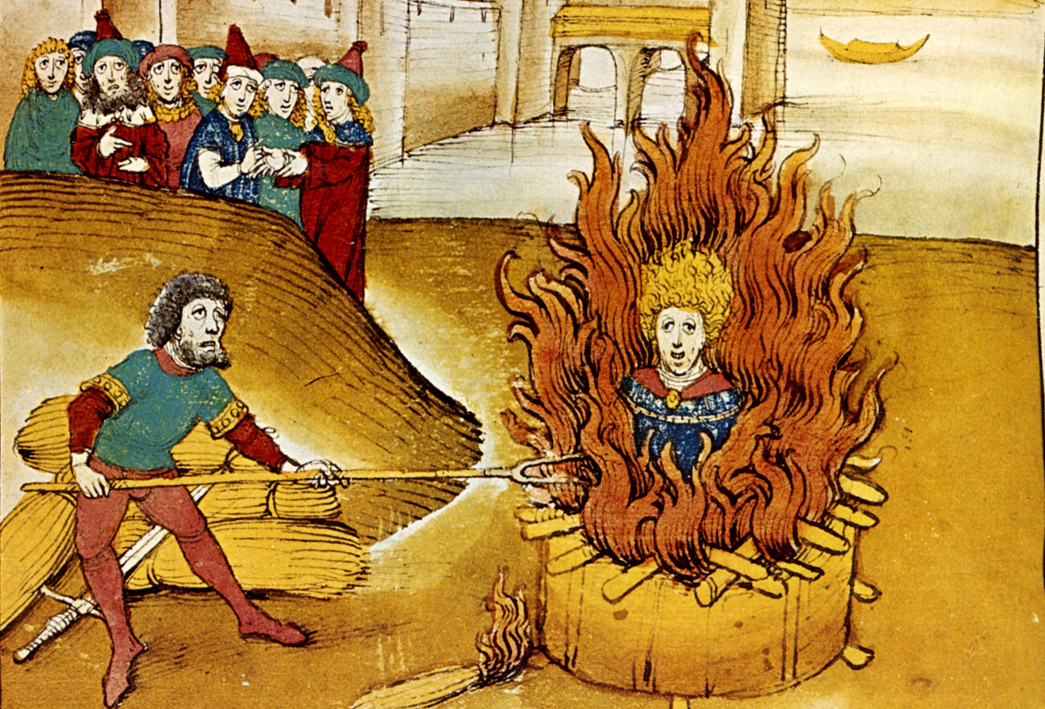
In 1417, the Council of Constance effectively found a solution to the Western Schism and appointed Martin V as Pope. As part of these deliberations, Jan Hus was burned on the stake in 1415, John Oldcastle in 1417, while Wycliffe was exhumed and burned in 1428. To this panoply of pre-reformation “saints” might be added Jeanne D’Arc in Rouen in 1431 as well as Girolamo Savonarola in 1498. As secular powers were consolidated and centralised, so did those of the church. Allowing for pietism in the form of Devotio Moderna, the princes of the church sought to channel any subversive and explosive spiritual fervour into a practical and less controversial way of apostolic renewal. As we know, these forms of late medieval piety did not, however, stop the revolts and reforms of the 16th century. Not only the Reformation followed, but wars came to ravage the continent until the middle of the 17th century.
Keywords:
- Wars
- Consolidation of major powers
- Entrenchment of the higher nobility
- Early Reformational battles for the Soul(s) of Europe
- Renaissance in Italy
FEATURED PHOTO:
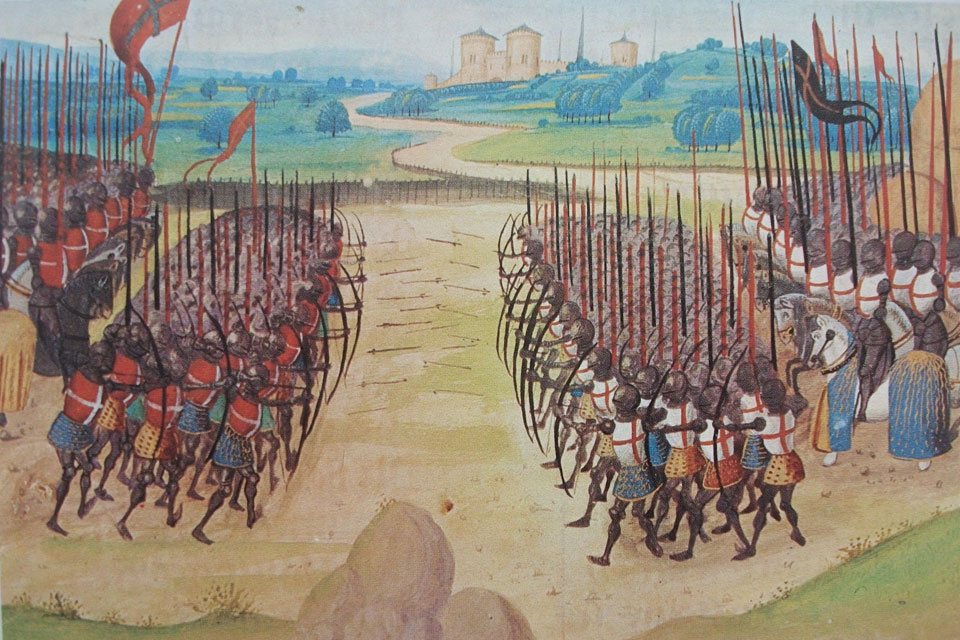
Battle of Agincourt (1415). Miniature from: l’Abrégé de la Chronique d’Enguerrand de Monstrelet, XVe siècle, Paris, BnF, département des Manuscrits, manuscrit Français 2680, folio 208.
READ MORE:


