


Historians sometimes imagine life in the medieval countryside as purely evolving around the ploughing, tilling and harvesting of the fields. Joan Thirsk pioneered the view of medieval and early modern agriculture as a many-sided business. This book is a late result of her research into this complex world.
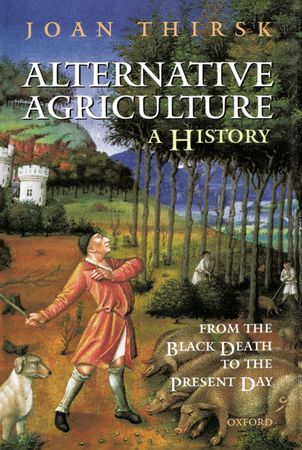
Alternative Agriculture: A History. From the Black Death to the Present Day
By Joan Thirsk
Oxford University press 1997
ISBN: 978-0-19-820662-0
ABSTRACT:
In addition to these fascinating images of past lives, Joan Thirsk reveals how the forces which drive our current interest in alternative forms of agriculture – a glut of mainstream meat and cereal crops; changing patterns of diet; the needs of medicine – have striking parallels with earlier periods of our history. She warns us that today’s decisions should not be made in a historical vacuum. We can still find solutions to today’s problems in the hard-won experience of people in the past.
ABOUT THE AUTHOR:
Joan Thirsk 1922 -2013 was a renowned Agricultural Historian. She was one of the leading economic and social historians of the 20th century, greatly influencing the methodology and direction of research. Her most prominent contribution was to pioneer the use of local manuscripts as a source. During the Second World War she worked as an intelligence analyst at Bletchley Park, providing information that assisted Hut 6 in the breaking of the Enigma ciphers. Her academic career began with assistant lectureship in sociology at the London School of Economics. She was later senior research fellow at the University of Leicester from 1951 to 65, and reader in economic history at Oxford University between 1975 and 1983. She was the editor of The Agrarian History of England and Wales (for volumes 4–6) from 1964 to 1972 and in 1974 was appointed general editor of the series. She acted as President of the British Agricultural History Society. A fine obituary of Joan Thirsk was published in the Guardian.
FEATURED PHOTO:
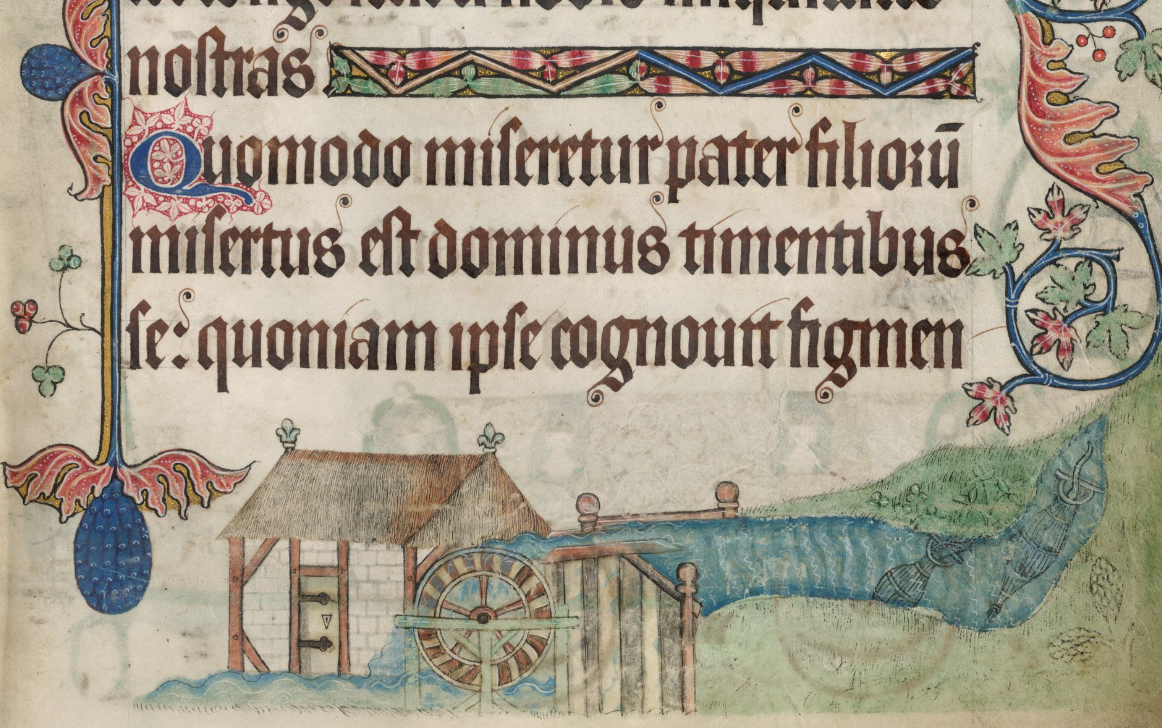
Luttrell Psalter: Watermill with fishing. Add MS 42130, fol 181r. © British Library


