


Medieval ‘Sacred Sites’ were primarily located in the natural wilderness. With the Reformation this changed. Perhaps time has come to return to practices of Medieval Nature Conservation?
Central Italy consists of six regions, Tuscany, Marche, Umbria, Abruzzi and Molise. Covering more than 70.000 km2 the land is characterised by hills and mountains. Almost one quarter of the area is covered by national parks, regional nature parks and locations, which are protected by Natura 2000 status or the Ramsar Convention. As such it is one of the most important biodiversity hotspots in Europe.
But it is also home to an outstanding religious heritage furthered by the large number of religious communities and institutions, which made their mark on the landscape since the time of Benedict of Nurcia (c. 480 – 547). In his dissertation Fabrizio Frascaroli has published a study of the location and character of 539 Sacred Sites in this part of Italy. These were inventoried according to their religious affiliation (religious orders, non-specified affiliation), chronology of religious presence (pre-Christian, Christian etc), and the environmental setting (built, semi-natural, and natural). The sites were identified through guidebooks. More than a hundred were subsequently visited in order to be able to do a proper inventory.

The main results of his work are as follows:
- 57% were located in natural or semi-natural landscapes, while the rest were located in urban or – semi-urban settings.
- The less specifically affiliated a site was, the more often it was located in a natural or semi-natural setting. 30% of the identified sites were non-affiliated.
- Different orders were prone to locate themselves in different habitats
- Apart form the sites affiliated to the order of the Camaldolese hermits, of which 60% were located in a natural setting, no more than 30 to 40% of the sites of the remaining orders were located in natural settings. For instance only a third of the sites affiliated with the Cistercians (34%) or the Franciscans (33%) were located in natural settings; For the Domenicans or the Salesians the percentage was only 20%.
- However, this was very much a reflection of the time-period, when specific orders had found their locations on which to settle. While Early Christian sites were predominantly urban, sites inhabited in the Early or High Middle Ages were definitely located in a natural or semi-natural setting. Post-1400 new sites became increasingly located in urban settings. Less than 10% of new sacred sites founded post-1800 were located in a natural setting.
- Sites, which had been abandoned, were primarily located in semi-natural or natural locations.
- Natural features like grottos, caves rock-formations, springs or specific trees were explicit objects for veneration in nearly 30% of the visited sacred natural sites.
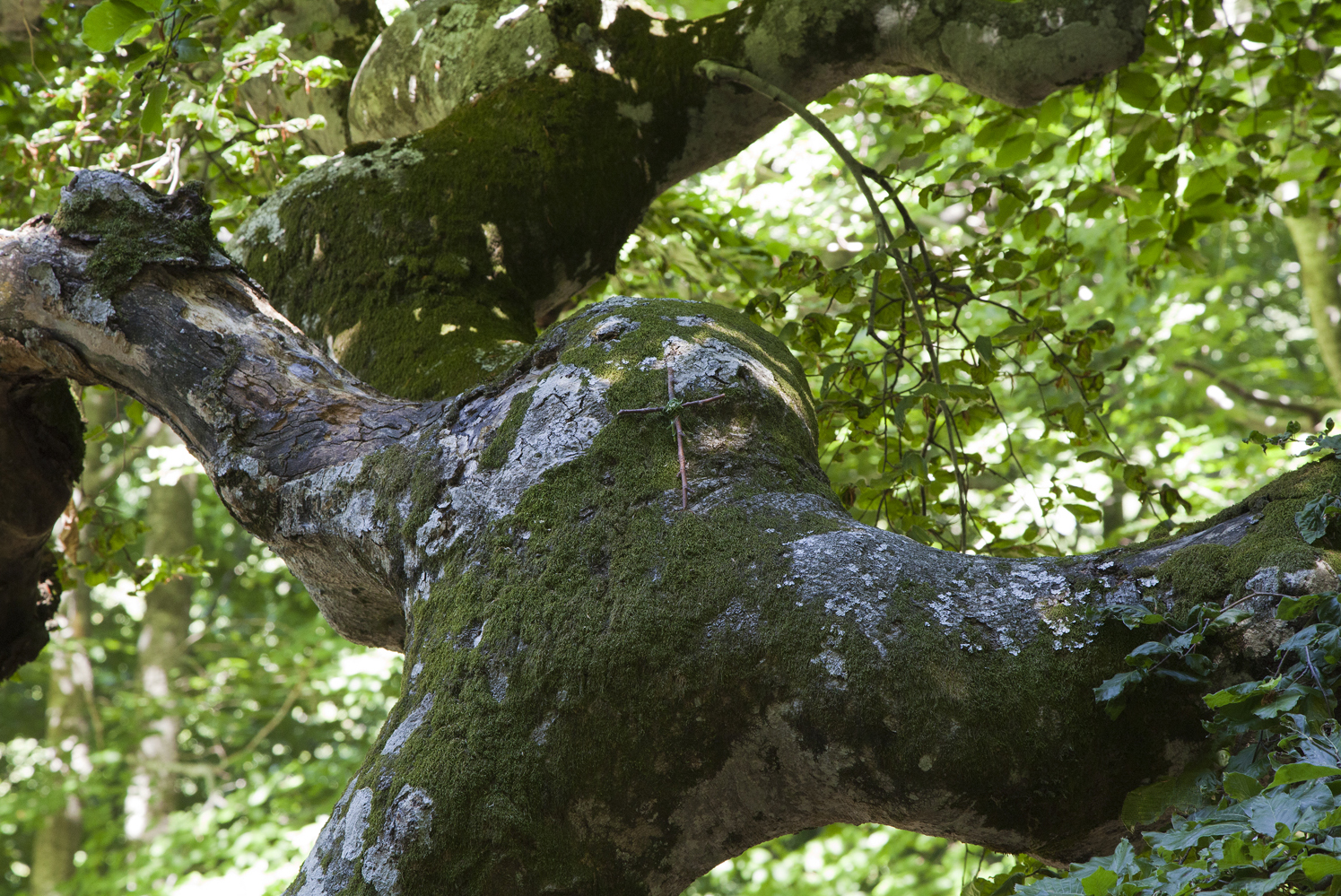
- Forests were the most common type of environment found in connection with SNS, as were specific sorts of trees. For instance the Quercus ilex or evergreen oak seems to have been highly regarded at Franciscan sites, while very old trees might be found at non-affiliated sanctuaries scattered in the landscape.
- In a further context the biotopes at some non-affiliated Sacred Natural Sites have been shown to be important venues or “locations” on the itinerary of traditional herders exploring a pastoral economy (as witnessed by the predominance of useful veterinary plants at some sacred Natural Sites)
All in all, Fabrizio Frascaroli, concludes that there seemed to be a structural relationship between Catholicism and the widespread tradition for selecting natural settings for monasteries, chapels and way-side crosses; and also caring for them. The older these institutions are, the more often they seem to be found in natural or semi-natural landscapes. However, there seems to be virtually no evidence that these early medieval sites where chosen because they carried pre-Christian associations. Quite the opposite seems to have been the case. But it is also apparent that as religious orders post-1400 increasingly abandoned their ascetic roots, they began to move closer to urban centres.
Finally – although not specifically documented in this study – it seems as if there is a direct link with app. half of the inventoried sacred natural sites and their status as important biotopes, since a large part of the new sites added to the Natura 2000 in the last decades are in fact identical with Medieval Sacred Natural Sites.
This leads to a final discussion of the challenges, posed by the rampant religious tourism, which in the last decades have sent trampling hordes of ‘pilgrims’ to places like for instance the Vallombrosa, Chiaravalle di Fiastra, Camaldoli and La Verna; all actively cared for by the religious orders in charge of these places. However, noted is also the predominant lack of interest in and knowledge about the natural value of the sites, when regarded as important biotopes. Finally the deteriorating local interest of keeping minor – non-affiliated sites “alive” has been detected.
In short: a huge number of religious sites in the central part of Italy were traditionally located in natural or – semi-natural surroundings. As time passed, religious orders lost interest in these ascetic settings and moved to town. At the same time, knowledge of the inherent natural value of many places seems to have deteriorated. Best preserved are non-affiliated sacred groves, tiny chapels, road-side sanctuaries and the like which up until now have been venerated by locals.
However, caring for these sacred sites is an important part of future nature conservation, and partners and stakeholders at these locations should be made aware of the many and diverse values, which are linked to the future collaboration between religious stakeholders and nature-conservationists.
In his Encyclical, Laudato Si, the Pope recommends the 1.2 billion Catholics to repair their attitude towards Earth and its creation. Perhaps this will also help to heighten the interest in preserving the unique natural character of these sacred sites; many of which are part of an important medieval heritage.
Catholicism and Conservation: The Potential of Sacred Natural Sites for Biodiversity Management in Central Italy
By: Fabrizio Frascaroli
In: Human Ecoloy 2013, vol. 41 pp. 587 – 601
Healing Animals, Feeding Souls: Ethnobotanical Values at Sacred Sites in Central Italy
By Fabrizio Frascaroli, Shonil Bhagwat, Matthias Diemer
In: Economic Botany 2014, Volume 68, Issue 4, pp. 438-451
ABOUT THE AUTHOR:
Fabrizio Frascaroli earned a BA and MA in Cultural Anthropology from the University of Iceland and an MSc in Environmental Sciences from the University of Zurich. In 2013 he completed his PhD in Ecology at the University of Zurich: Sacred sites for the conservation of biodiversity. 2013, University of Zurich, Faculty of Science. Over the last years, Fabrizio’s research interests have focused on the attitudes towards nature within different Christian traditions, and the conservation potential of sacred sites in European contexts. He has worked extensively on sacred natural sites in Central Italy, and collaborated with NGOs and photographers equally interested in the interface between religion and nature. Fabrizio is co-founder and co-editor of the Sacred Sites Research Newsletter (SSIREN).
ABOUT THE ‘SACRED NATURAL SITES INITIATIVE’
The overall aim of the Sacred Natural Sites Initiative is to assist the protection and revitalisation of sacred natural sites through the support to their guardians and communities. The initiative publishes a newsletter, SSIREN, four times a year.
FEATURED PHOTO:
The beech of St. Francis. Legend has it that St. Francis was caught in a storm in the mountains of Rivodutri. Francis tried to seek shelter. God bent the branches like an umbrella to keep the saint dry! By Francesco Pettinà/Ayappa/alberiedintorni.blogspot.dk


