


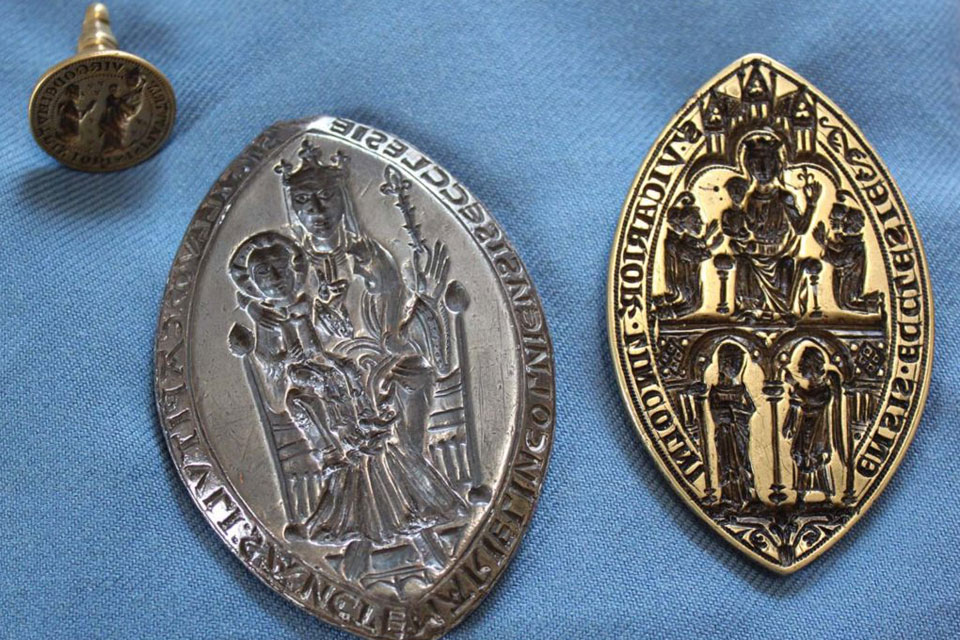
Seals represent some of the most exciting objects preserved from the Middle Ages. Offering distinctive legitimacy to individuals and cooperations, they are one of the most important sources for studying self-representation.
A Companion to Seals in the Middle Ages
Ed. by Laura Whatley
Brill 2019
ABSTRACT:


As the chronological, temporal and geographic scope of the essays in the volume suggests, the study of the medieval seal—its manufacture, materiality, usage, iconography, inscription, and preservation—is a rich endeavour that demands collaboration across disciplines as well as between scholars working on material from different regions and periods. It is hoped that this collection will make the study of medieval seals more accessible and will stimulate students and scholars to employ and further develop these material and methodological approaches to seals.
TABLE OF CONTENTS:
Introduction: Approaches to Medieval Seals and Sealing Practices. By: Laura J. Whatley
- Analysis of the Materiality of Royal and Governmental Seals of England with a Focus on the Great Seals (1100–1300): Methodology and Findings. By: Elke Cwiertnia, Adrian Ailes and Paul Dryburgh
- Material Analysis of Seals Attached to the Barons’ Letter to the Pope By: Paul Dryburgh, Elke Cwiertnia and Adrian Ailes
- Does Size Matter? Seals in England and Wales, ca.1200–1500 By: John A. McEwan
Pages: 103–126 - Fragments of the Past: the Early Antiquarian Perception and Study of Seals in England. By: Oliver D. Harris
- Medieval Armorial Seals in The National Archives (UK). By: Adrian Ailes
- The Seals of the Judges of the Hippodrome: Drawing Data from Seals without Context. By: Jonathan Shea
- Administration and Identity: Episcopal Seals in England from the Eleventh to the Thirteenth Century. By: Philippa Hoski
- Power, Family, and Identity: Social and Personal Elements in Byzantine Sigillography. By: Angelina Anne Volkoff
- Two Seals of Muskinus the Jew (Moshe b. Yeḥiel, d. 1336), the Archbishop of Trier’s Negociator. By: Andreas Lehnertz
- ‘Creatio Regni’ in the Great Seal of Bosnian King Tvrtko Kotromanić. By: Emir O. Filipović
- Reconsidering the Silent Majority: Non-Heraldic Personal Seals in Medieval Britain. By: Elizabeth A. New
- Seals of the Wives of Silesian Knights in the Pre-Hussite Age (1259–1414). By: Marek L. Wójcik
- Coins as Seals in Lombard Italy. By: Ashley Jones
- The (Re-)Use of Ancient Gems and Coins: the Presence of Antiquity in Medieval Sigillography. By: Caroline Simonet
ABOUT THE EDITOR:
Laura J. Whatley, Ph.D. (2010), University of Illinois, is Assistant Professor of Art History at Auburn University Montgomery. She has published articles on crusader and military seals and crusading visual culture in medieval England. She also co-edited the volume The Crusades and Visual Culture (Routledge, 2015).
ABOUT CONTRIBUTORS:
Contributors are Adrian Ailes, Elka Cwiertnia, Paul Dryburgh, Emir O. Filipovi, Oliver Harris, Philippa Hoskin, Ashley Jones, Andreas Lehnertz, John McEwan, Elizabeth A. New, Jonathan Shea, Caroline Simonet, Angelina A. Volkoff, and Marek L. Wójcik. Show Less.
READ ALSO:


READ MORE:
Digital Sigillography Resource

John McEwan BA (University of Western Ontario), MA PhD (Royal Holloway, University of London) specializes in the political, social and cultural history of medieval Britain. His research focuses on social organization, local government, and visual culture in London, c.1100-1350.He is involved in a number of projects that investigate the application of electronic data management tools, including geographic information systems, to the analysis of medieval sources.


