


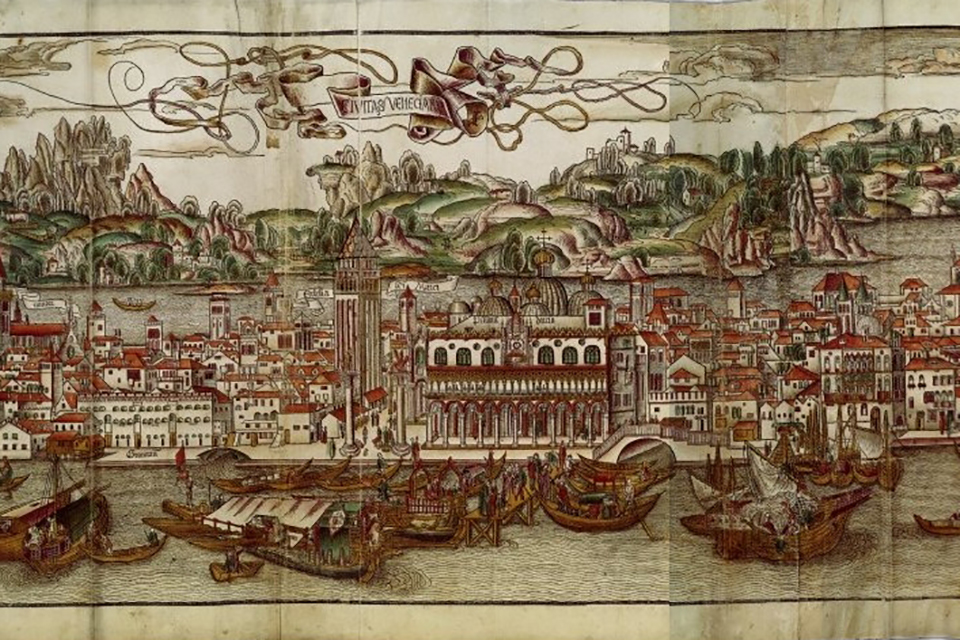
How did Venice emerge as an independent political community between two competing empires, the Frankish realm and Byzantium? And how did its inhabitants construct a collective memory of their past? In a study of early medieval Venice, Luigi Andrea Berto explores how warfare, political rivalries, rumours and historical narratives contributed to the creation of a distinctive Venetian identity.
Early Medieval Venice: Cultural Memory and History
By Luigi Andrea Berto
Studies in Medieval History and Culture
Routledge 2020
ABSTRACT
Yet the emergence of an independent Venice was neither inevitable nor straightforward. During the early Middle Ages, its inhabitants faced repeated military threats, internal conflicts and shifting political allegiances. Their rulers had to negotiate between powerful neighbours, while competing families struggled to establish control over the developing duchy.

In Early Medieval Venice: Cultural Memory and History, Luigi Andrea Berto examines this turbulent period, focusing not simply on what happened but also on how the Venetians understood and remembered these events. His study covers the period from the late sixth to the early eleventh century, when Venice developed from a peripheral territory of the Byzantine Empire into an increasingly autonomous maritime power. Rather than offering a conventional chronological history, Berto investigates a series of episodes and themes that illuminate the political mentality of the early Venetians and the narratives through which they constructed their historical identity.
Central to his investigation is the Istoria Veneticorum, composed around the beginning of the eleventh century by John the Deacon (Giovanni Diacono), who was closely associated with the Venetian ducal court. His chronicle provides an essential account of Venice’s earlier history, but it is also a work shaped by the political circumstances, assumptions and interests of the period in which it was written.
Consequently, Berto approaches the chronicle not merely as a repository of historical information but as evidence of how early medieval Venetians perceived their own society and its place in the wider world.
One particularly revealing subject is the representation of warfare and violence. During the early medieval centuries, Venice experienced conflict both within the lagoon and with neighbouring powers. Yet the chroniclers did not describe all acts of violence in the same way. Their judgements depended upon the identities of the participants, the legitimacy of their political claims and the moral qualities attributed to particular rulers.
The career of Doge Pietro IV Candiano, who ruled from 959 to 976, provides a striking example. His increasingly authoritarian government provoked serious opposition, culminating in a rebellion during which he was killed and the ducal palace destroyed by fire. But how should his overthrow be understood? Was Candiano a ruler whose ambitions threatened the political community, or could his downfall be interpreted differently by writers seeking to explain the legitimacy of his opponents?
Berto uses the episode to examine how the character of a ruler could be reconstructed through historical narrative, and how apparently straightforward descriptions of political events might conceal competing interpretations of authority and legitimate government.
Another central theme is Venice’s relationship with the two great imperial powers of the period.
During the eighth and ninth centuries, the lagoon communities occupied an increasingly contested frontier between Byzantine Italy and the expanding Frankish Empire. The conquest of the Lombard kingdom by Charlemagne in 774 transformed the political balance of northern Italy, while subsequent Carolingian interventions threatened to bring the Venetian settlements under Frankish control. This struggle over Venice culminated in the early ninth century, when the competing ambitions of Byzantium and the Carolingians forced the lagoon communities to negotiate their position between the two empires. Yet political allegiance was not simply a matter of military power. Venetian rulers continued to draw upon Roman and Byzantine traditions of legitimacy, even as they acquired greater independence. Their political identity was consequently shaped by a complex mixture of inherited institutions, diplomatic relationships and local ambitions.
Berto also investigates the circulation of news and information about events beyond the lagoon. Early medieval Venice was not an isolated community surrounded by marshes. Its maritime connections ensured that information about distant rulers, military campaigns and imperial politics could reach its inhabitants through merchants, envoys and other travellers.Such information was not necessarily accurate, nor was it transmitted without alteration. Rumours and stories concerning foreign rulers could be incorporated into local understandings of political events, helping to shape perceptions of Venice’s neighbours and its position in the wider world.
Particularly interesting in this context is the relationship between Venice and the Ottonian Empire. In AD 1001, Emperor Otto III made a remarkable secret visit to Venice, where he met Doge Pietro II Orseolo. The encounter brought together two rulers whose political ambitions were connected to competing understandings of Roman imperial inheritance. For Otto III, the revival of Roman imperial authority formed part of a broader political and ideological programme. For the Venetians, maintaining favourable relations with the emperor was important, but so was preserving their growing political autonomy.Berto devotes a separate chapter to this encounter, examining its representation in the surviving sources and its significance for the historical memory of early Venice.
The question of identity also emerges in his examination of the frontier between the lagoon and the Italian mainland. What did it mean to remain Roman in a region where Lombard, Frankish and Byzantine political traditions overlapped? One chapter approaches this question through personal names recorded in eighth-century Treviso, exploring how Latin and Greek naming practices might illuminate relationships between different communities. Such evidence offers a perspective on cultural affiliations that cannot always be recovered from accounts of warfare or political negotiations.
Finally, Berto investigates the supernatural dimensions of Venetian historical memory. Miracles, visions, predictions and divine interventions were not merely decorative additions to medieval chronicles. They offered ways of explaining political events, legitimising particular actions and identifying divine favour or punishment. By examining these narratives, Berto shows how the writing of history was closely connected to the construction of political and moral meaning.
The broader significance of Early Medieval Venice: Cultural Memory and History lies in its approach to the relationship between historical events and their subsequent representation. The Venetians did not simply inherit a shared political identity from their Roman or Byzantine predecessors. They developed it through centuries of conflict, negotiation and reflection upon their collective past. Their chroniclers played an important part in that process, transforming episodes of warfare, diplomacy and internal rivalry into narratives through which the community could understand its origins and political position.
In this respect, Berto’s study provides an illuminating contribution to the wider history of early medieval Europe. It explores how communities situated between competing political powers negotiated their independence, distinguished themselves from their neighbours and created historical traditions that helped define who they believed themselves to be. The history of Venice thus becomes more than the story of a city emerging from the lagoons. It also becomes an investigation into how a medieval political community fashioned its own memory – and how that memory contributed to the making of its identity.
ABOUT THE AUTHOR
Luigi Andrea Berto is Professor of Medieval History at Western Michigan University. His research focuses on medieval Italy and the Mediterranean, particularly relations between Christian and Muslim communities and the ways in which medieval authors represented the past. His other publications include The ‘Other’, Identity, and Memory in Early Medieval Italy, which likewise examines the construction of political and cultural identities through historical writing.
READ ALSO:


