


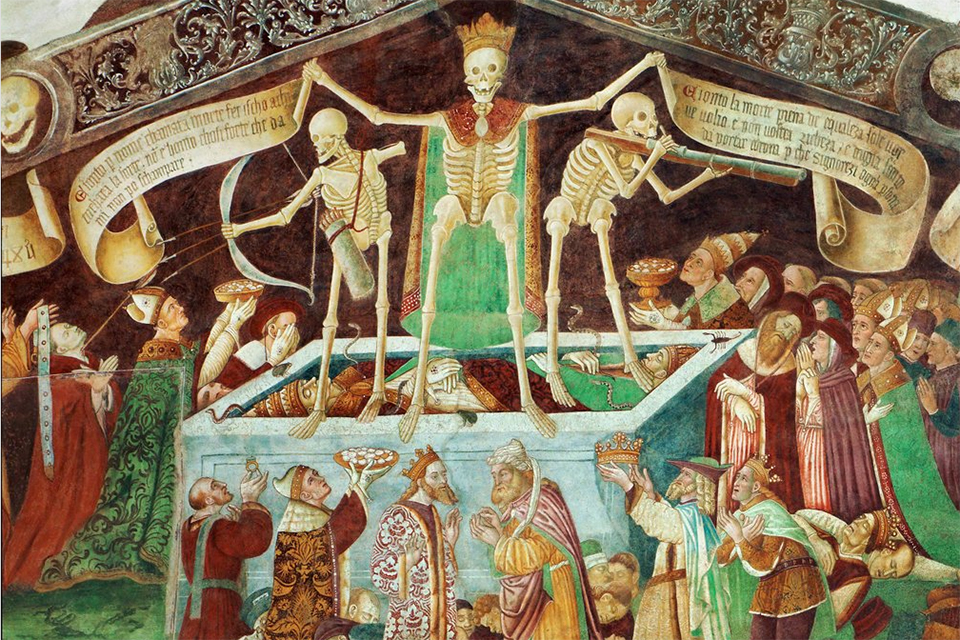
From ancient Greek offerings to medieval Christian commemorations, the ritual foods of southern Italy reveal a remarkable relationship between the remembrance of the dead, the agricultural calendar and the renewal of life.
Every year, on 2 November, Catholic communities commemorate their dead on All Souls’ Day. In southern Italy, the occasion has traditionally been marked by particular foods, often prepared from remarkably simple ingredients: wheat, chickpeas, broad beans, nuts and fruits. Among these are dishes whose names, preparation and ritual associations suggest an ancestry reaching far beyond the medieval Christian calendar.
For example, in northern Puglia, a sweet dish of cooked wheat grains, fruits and nuts is known as grano dei morti – “grain of the dead”. Elsewhere, similar preparations are known as cuccìa, colva or coliba, while in parts of Calabria, broad strips of pasta cooked with chickpeas, lagane e ceci, form part of the commemorative meal. Why these particular foods? And why have similar preparations survived across regions historically connected by Greek, Roman and Byzantine culture?
Recent studies by Anthony F. Buccini suggest that the answer may lie in the extraordinary longevity of ritual food traditions. His research can be read alongside the work of Italian anthropologists such as Ignazio E. Buttitta, Mario Bolognari, Sebastiano Mannia and Ottavio Cavalcanti, who have investigated the relationship between food, death and collective memory. Together, their studies reveal a Mediterranean world in which the deceased were not simply remembered. They were also symbolically invited to share in the nourishment of the living, and food became one of the means by which communities maintained their relationships with the departed.
All Souls’ Day – a medieval Christian commemoration
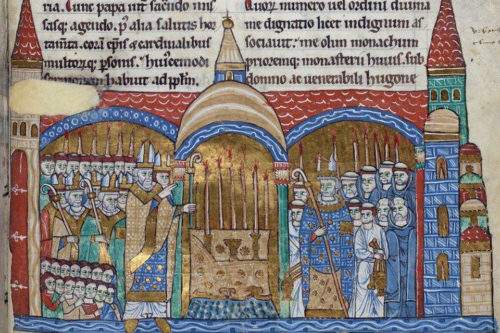

Around 1030, Odilo, abbot of Cluny in Burgundy, established a solemn commemoration of all the faithful departed on the day following All Saints’ Day. From the influential Cluniac monastic network, the observance gradually spread throughout Western Christendom. This invention of a tradition belonged to a broader transformation of medieval religious life, in which prayers, masses and charitable gifts were offered on behalf of deceased relatives and benefactors, whose souls were believed to benefit from the intercession of the living.
In a study of the medieval establishment of All Souls’ Day, the Italian historian Umberto Longo has demonstrated how the Cluniac observance strengthened the relationship between living communities and their departed members. The monastery became a guardian of collective memory, maintaining spiritual relationships with generations of people who had passed away. Yet Cluny did not invent the Christian commemoration of the dead. Collective memorial services already existed in different Christian traditions, and the commemoration promoted by Odilo eventually superseded or absorbed some earlier observances. Nor did the religious practices of the monasteries necessarily replace established local customs. Rather, official liturgies and popular traditions developed alongside one another, sometimes becoming closely intertwined.[1] The question, therefore, is not whether All Souls’ Day represents the direct continuation of a particular pagan festival, but how older practices associated with death, food and remembrance might have acquired new functions within medieval Christianity. It is here that the study of traditional food customs becomes particularly interesting.
The dead and the grain

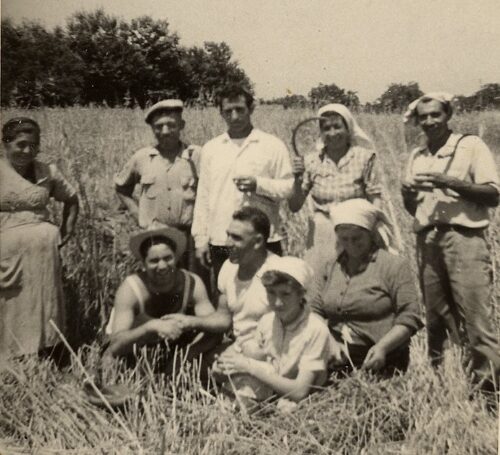
One of the most suggestive contributions to this discussion is Ignazio E. Buttitta’s I morti e il grano – The Dead and the Grain – published in 2006. In this work, Buttitta investigated the relationship between agricultural labour, seasonal festivals and the commemoration of the deceased in Sicily and the wider Mediterranean world. His central concern was the symbolic connection between the cultivation of grain and the human experience of death. This association is readily understood. A grain of wheat is harvested, stored and eventually buried in the earth. Once planted, it appears to disappear, yet under favourable conditions, the seemingly dead seed produces new life. For agricultural communities, this recurring process provided a powerful image through which to contemplate human mortality and the succession of generations. Moreover, the agricultural calendar supplied an annual rhythm for the commemoration of the dead.
In southern Italy, the beginning of November traditionally coincides with the autumn sowing of winter wheat. Thus, as the living bury their grain in the earth, they commemorate those who have themselves been laid to rest. The correspondence is evocative, although the precise dates of sowing naturally vary between regions and years. Also Buccini identifies other significant moments in the southern Italian ritual calendar, particularly St Joseph’s Day in March, St John’s Day in June and Christmas. He suggests that these Christian observances intersected with older seasonal transitions associated with the cultivation of grain. Seen together, he argues, the ceremonies formed a recurring sequence of mourning, expectation, fertility and renewal. Finally, Buttitta has developed a related argument from the perspective of historical anthropology, while emphasising how ritual forms associated with the agricultural cycle could retain their importance even as the religious explanations attached to them changed. Indeed, in a study published in 2026, he again considers the possible traces of ancient agricultural cults in Sicilian religious practices, while recognising the difficulty of demonstrating uninterrupted continuity over such long periods. Nevertheless, the possibility that some of these traditions reach back to ancient Greece remains an intriguing one.[2]
The offerings of ancient Greece
The relationship between grain and the commemoration of the deceased was particularly significant in ancient Greek religion. The goddess Demeter presided over agriculture and the fertility of the earth, while her daughter Persephone, abducted by Hades and taken to the underworld, became central to a myth explaining the seasonal disappearance and renewal of vegetation. According to the Homeric Hymn to Demeter, Persephone was eventually allowed to return to her mother, although her consumption of pomegranate seeds in the underworld bound her to spend part of each year among the dead. Within this mythical setting, grain and seeds acquired an importance extending beyond their nutritional value, representing both the sustenance of the living and the anticipated renewal of life.
One ancient ritual preparation was known as panspermia, literally “all-seeds”. Combining grains, legumes and other seeds, it appeared in several Greek religious contexts, including ceremonies associated with Demeter and Persephone. It also featured in the Anthesteria, an Athenian festival celebrated in late winter. On the final day, known as Chytroi, offerings were made to the dead, including preparations of mixed seeds. Natale Spineto has examined the Anthesteria as a festival of the dead in ancient Athens, while Buccini has particularly emphasised the significance of the seed preparations associated with these observances. The combination of ingredients and ritual functions is striking, not least because of the corresponding use of grains and legumes in later Mediterranean commemorative meals. Nevertheless, there is an important chronological distinction: the Athenian Anthesteria was a late-winter festival, not an autumnal commemoration corresponding directly to 2 November. Consequently, it would be misleading to identify the ancient festival as the straightforward predecessor of All Souls’ Day. What the comparison reveals instead is a much older Mediterranean tradition in which offerings of grain and seeds formed part of the relationship between the living and their deceased ancestors.[3]
From panspermia to cuccìa
The survival of ancient terminology provides yet another clue. In Sicily, and in parts of Calabria, Basilicata and Campania, preparations of cooked whole wheat grains are known as cuccìa. Some versions are sweet, incorporating nuts, dried fruits or pomegranate seeds, while others are savoury, combining wheat with chickpeas, dried broad beans or other legumes. Whether sweet or savoury, the name derives from Greek words associated with kernels, beans and seeds. Buccini argues that this linguistic relationship, together with the ritual function of the dishes, provides substantial evidence of continuity between ancient Greek and southern Italian culinary traditions. Another name, however, offers an even more intriguing connection.
In central and southern Puglia, comparable preparations are called colva or coliba, derived from Greek kollyba. In the Greek Orthodox Church, kollyba remains the name of a preparation of boiled wheat offered at funerals and memorial services. Usually dressed with other ingredients, it is blessed and distributed among those attending commemorations of the departed. Here, therefore, we encounter a much closer relationship between ancient and Christian ritual practice. Moreover, the symbolism of the grain could readily be incorporated into Christianity through the biblical saying that a seed must fall into the earth and die before producing new life (John 12:24). Interpreted through the promise of resurrection, this image provided a connection between the older Mediterranean agricultural imagination and the Christian religious framework.
In this manner, Buccini proposes a broad development from ancient Greek seed offerings towards the dishes known as cuccìa and kollyba, with the southern Italian preparations preserving elements of that older tradition. Nevertheless, linguistic relationships and similarities in ritual function do not necessarily establish the continuous transmission of particular recipes. Rather, they suggest that familiar ingredients and preparations could be repeatedly invested with meanings appropriate to the commemoration of the dead.[4]
When grain became pasta
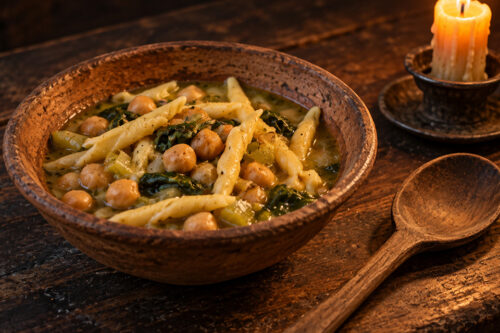
Buccini extends his argument through another southern Italian preparation, lagane e ceci. This simple dish combines broad strips of wheat pasta with chickpeas and is particularly associated with St Joseph’s Day on 19 March. However, it is also eaten on All Souls’ Day in parts of northern Calabria, while in northern Basilicata, a sweet preparation using noodles instead of whole wheat grains is associated with the November commemoration.
The combination of grain and legumes closely resembles the composition of cuccìa and related commemorative foods. Consequently, the question arises whether pasta might have replaced whole wheat grains in some local traditions without fundamentally altering their ritual significance.
Buccini considers this likely, pointing to a much older reference to a preparation combining chickpeas and lagana in classical Roman literature. In one of his satires, Horace, born in Venosa in southern Italy, expresses his preference for the pleasures of a simple life, including a humble dish of leeks, chickpeas and lagana. The exact nature of this ancient lagana remains disputed. Some scholars regard it as a preparation resembling flatbread, while Buccini argues that it was a form of pasta cooked together with the other ingredients. Perhaps, however, this distinction is less meaningful than modern culinary terminology suggests. Ancient sources indicate that preparations made from similar doughs could be boiled, fried or baked. Indeed, the distinction between pasta and flatbread may have depended as much on the method of cooking as on the dough itself. A modern illustration is provided by stregacce – “witches’ biscuits” – which can be prepared simply by taking thin sheets of fresh lasagne cut into the size of cookies and baked until crisp.
Moreover, the choice of cooking method must also be considered in relation to the availability and cost of fuel. Heating a masonry oven required a substantial initial expenditure of energy, whereas cooking in a pot over a smaller hearth involved a different pattern of fuel consumption. Conversely, once an oven had been heated for breadmaking, its residual heat could be used for preparing additional foods at relatively little extra cost. Such considerations must have influenced culinary practices, particularly where firewood was scarce, access to woodland was restricted or fuel had to be purchased. From this perspective, it is worth considering whether the different ways of preparing lagana reflected not only culinary preferences but also the ecological and economic circumstances in which people lived. Boiling, frying and baking were not necessarily competing culinary traditions. They might equally represent practical adaptations of a familiar preparation to different kitchens, resources and occasions.
Horace’s passage does not allow us to determine precisely how his lagana was cooked, nor does it establish that the dish was already associated with funerary commemorations. Nevertheless, it demonstrates the antiquity of a culinary combination involving wheat dough, chickpeas and leeks, while the survival of related preparations suggests how simple dishes could persist despite changes in their form and method of preparation.
Buccini also proposes that broad pasta strips might once have evoked funeral shrouds, just as certain other pasta shapes may preserve symbolic associations with serpents and the renewal of life. These interpretations are intriguing, but they remain speculative. The evidence is considerably stronger for the continuing use of wheat and legumes in commemorative meals than for any particular symbolism attached to the shape of the pasta.[5]
Food for the dead – archaeological evidence from Roman and medieval graves
This brings us to another body of evidence, one that has become increasingly accessible through developments in archaeological science.This is new. When Bonnie Effros in 2002 published her seminal book Creating Community with Food and Drink in Merovingian Gaul, she examined how ritual meals, offerings and commemorative feasts helped maintain relationships between the living and the dead during the early Middle Ages. At that time, archaeological interpretations depended heavily upon the presence of pottery, animal bones and other recognisable remains. Since then, however, increasingly sophisticated archaeobotanical and chemical analyses have made it possible to investigate food residues that would previously have escaped attention.[6]
Recent archaeological research, however, offers a more material perspective on the relationship between food and funerary rituals. Through increasingly sophisticated analyses of plant remains and organic residues, it has become possible to identify some of the foods placed in graves, consumed during funerary ceremonies or deposited during subsequent commemorations. Especially, Italian research has contributed substantially to this development. In a survey published in 2011, Mauro Rottoli and Elisabetta Castiglioni investigated plant offerings recovered from Roman cremation graves in northern Italy. Their evidence, particularly from the first to third centuries AD, revealed considerable quantities of fruits, cereals and legumes, alongside prepared foods such as bread and cakes. These discoveries demonstrate that food formed part of funerary rituals, although it is not always possible to distinguish offerings intended for the deceased from the remains of meals consumed by mourners. Nevertheless, they provide direct archaeological evidence for the inclusion of cultivated plants and prepared foods in the rituals surrounding death.[7]
More recently, Federica Riso has investigated the funerary landscapes of Roman Modena and Piacenza. At Via Ferrari in Modena, two first-century AD cremation burials yielded 836 seeds and fruit remains, representing 19 botanical taxa, including cereals, legumes and edible fruits. The material was recovered through systematic sieving and microscopic identification, permitting a much more detailed reconstruction of the food associated with funerary ceremonies. At Piacenza, meanwhile, investigations of a cemetery dating to the first and second centuries AD identified further evidence of cereals and legumes, particularly broad beans (Vicia faba), whose association with the dead was already well established in Roman religious traditions.[8]
The significance of these discoveries becomes clearer when they are considered together. A broader survey by Barbara Proserpio, Mauro Rottoli and Elisabetta Castiglioni, published in 2023, confirms that plant offerings were widespread in Roman northern Italy. Their research also emphasises the importance of distinguishing between food burned upon funeral pyres, offerings deposited within graves and material left behind by commemorative activities at the graveside.[9]
For the early Middle Ages, an especially instructive comparison comes from the Merovingian cemetery at Elversele in Belgium, dating to the sixth and seventh centuries. In 2019, Thomas Van de Velde and colleagues published the results of chemical analyses performed on eight ceramic vessels deposited in graves. Using gas chromatography–mass spectrometry, they identified degraded animal fats and possible traces of vegetable matter. Combined with the archaeological context, these findings support the interpretation that the vessels had contained actual food offerings, rather than serving exclusively as symbolic grave goods. Thus, the research provides an important material counterpart to the funerary practices discussed by Effros.[10]. Similar analytical methods have also been employed on medieval Italian pottery. At the thirteenth-century church of Sant’Antimo in Piombino, chemical investigations of cooking vessels identified residues consistent with animal products and vegetable preparations, possibly including soups and broths. These vessels were recovered from an architectural context rather than graves, however, and therefore do not provide direct evidence of medieval funerary meals.[11]
Taken together, the archaeological discoveries establish that food deposits formed an important element of Roman funerary practice, while comparable customs continued in at least some early medieval European communities. Particularly significant for the history of All Souls’ Day is the repeated appearance of cereals, legumes, fruits and prepared foods – ingredients that also feature prominently in later Mediterranean commemorative meals.
Yet caution remains necessary. These discoveries do not in themselves demonstrate an uninterrupted tradition linking Roman funerary offerings to the Christian observance of All Souls’ Day. What they offer is something more concrete: material evidence of the longstanding practice of incorporating food into the relationship between the living and the deceased. Precisely how these practices were transformed during the Christianisation of Italy and the early medieval centuries remains an important subject for further investigation. While the historical relationship is suggestive, it should not be understood as proof that every modern recipe descends unchanged from a particular ancient preparation. Moreover, traditions are constantly negotiated and reinterpreted. As the anthropologist Fatima Giallombardo has explored in her studies of Sicilian food culture, food belongs to a symbolic language through which communities express relationships between domestic life, public ceremony and the sacred. From this perspective, the remarkable survival of cuccìa concerns not merely a recipe but a continuing ritual vocabulary of remembrance.[4]
A place at the table for the dead

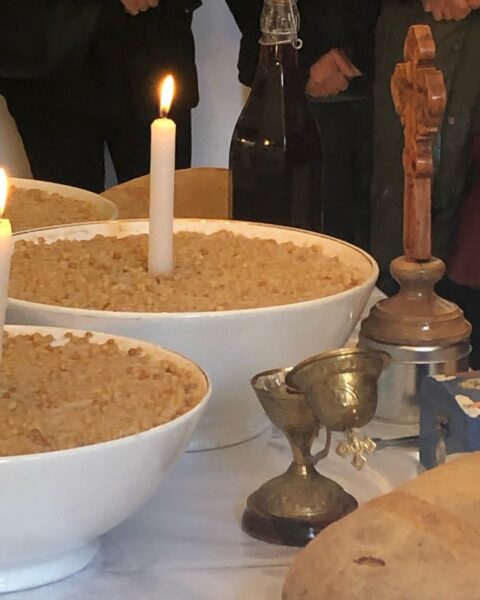
The Italian ethnographic evidence brings these questions into a much more tangible setting, allowing us to observe how food continues to mediate relationships between the living and the departed. In Il banchetto degli invisibili – The Banquet of the Invisible – Mario Bolognari examines the commemoration of the dead among the Arbëreshë communities of Calabria. These communities, descended from Albanian-speaking settlers, preserve traditions associated with Byzantine Christianity.
Bolognari’s particular investigation concerns San Demetrio Corone, where the commemoration known as Psycosabbaton, or Saturday of Souls, takes place before Carnival. Unlike the Catholic All Souls’ Day in November, this observance belongs to the late-winter cycle preceding Lent. It is important not to merge the two commemorations, since the Western observance has its own historically identifiable development. Nevertheless, the religious and culinary associations are remarkably similar. In his fieldwork he has thus described a procession from the church to the cemetery, where families gathered around the graves of their relatives. The tombs were furnished with bread, wine, cured meats and other foods. Afterwards, the participants return to the church, where the priest distributd collivi, involving boiled wheat and bread, according to the Greek rite.
Within the family home, meanwhile, an empty place was left at the table for the soul of a deceased relative. In households that had experienced a bereavement during the previous year, a priest also performed a special blessing known as the panaghia. The ceremony involved a candle placed in a dish of boiled wheat, after which commemorative food was distributed.
Here, the symbolic relationship is particularly clear. The dead remain members of the family and community, even though their physical presence has disappeared. In this respect, the customs resemble broader European traditions associated with the commemoration of the departed, including those surrounding All Souls’ Day. Yet they also demonstrate that similar relationships between food and remembrance could be maintained through different Christian calendars and ritual traditions.[12]
Gifts from the dead
The November commemoration in Sicily presents another dimension of this relationship between the living and the deceased. During the nineteenth century, Giuseppe Pitrè documented the customs associated with I morti, the Feast of the Dead, including the tradition of giving children presents said to have been brought by deceased relatives. These gifts frequently included sweets and elaborately fashioned sugar figures, the pupi di zucchero, alongside other edible treats. Antonino Uccello later documented related traditions in Pani e dolci di Sicilia, published in 1976.
Such foods represent a different form of symbolic exchange from the offerings of grain described by Buccini. In this Sicilian context, the departed themselves become the imagined givers of food. Consequently, the dead are rendered familiar and benevolent, their invisible presence materialised through gifts that can be touched, admired and eaten. This is a particularly striking form of remembrance because it transforms the potentially frightening idea of returning spirits into an expression of continuing familial affection. Moreover, it suggests that food can mediate the relationship between the living and the dead in both directions: the living may offer food to the deceased, but the departed may also be imagined as providing nourishment and gifts to those who remain.
Anthropologists, including Antonino Buttitta and Ottavio Cavalcanti, have explored precisely such relationships, emphasising that religious foods cannot be understood merely as combinations of ingredients. They are also vehicles of social memory and symbolic exchange.[13]
A related tradition survives in Sardinia, where Sebastiano Mannia has investigated the customary visits of children to local households on occasions including All Saints’ Day and All Souls’ Day. In these ceremonies, which also invite comparison with certain Halloween customs, children request and receive gifts, traditionally bread, sweets, fruit and nuts, although money and other presents have increasingly supplemented the older offerings. Mannia emphasises a particularly revealing aspect of the custom: the children may be understood as symbolic representatives of the deceased. Food given to them therefore acquires a meaning extending beyond hospitality or charity. In effect, the act of feeding the children also acknowledges the continuing presence of the dead within the community.[14]
Did pagan beliefs survive Christianity?
Taken together, these traditions invite a tempting interpretation: that not only food customs survived across many centuries, perhaps even millennia, but also that older understandings of ritual and its significance gradually found their way into Christian religious thinking.
Thus, it has been argued that the ritual foods of All Souls’ Day preserve descendants of meals once offered to Demeter, Persephone or the spirits of deceased ancestors, while the ancient Greek panspermia survived as Christian kollyba, southern Italian cuccìa and, eventually, as the pasta and chickpea dishes served on commemorative occasions today. Similar arguments have been advanced concerning the relationship between the Roman Saturnalia and the later celebrations of Christmas and New Year.
Yet such interpretations remain contested. Similarities in ritual practices do not necessarily demonstrate direct historical descent, and the transformation of religious traditions rarely follows a simple course in which one festival is replaced by another. Indeed, Ignazio E. Buttitta has cautioned against precisely this kind of reasoning in his discussion of the supposed survival of Demeter’s cult in Sicilian Marian traditions. Ritual forms may endure, but their meanings can change profoundly. Consequently, the resemblance between an ancient practice and a modern custom must be investigated rather than accepted as evidence of an unbroken tradition.[15]
Nonetheless, the history of commemorative food does introduce another dimension into this discussion. Whereas beliefs, religious explanations and institutional frameworks may change, the repeated preparation of particular dishes can preserve practices across generations without requiring their original meanings to remain intact.
Arguably, this is the most interesting aspect of the studies discussed here. Food occupies a special place within collective memory. Ordinary meals change according to fashion, agricultural production, trade and economic circumstances. Yet foods associated with religious commemorations can remain remarkably conservative, not necessarily because the people preparing them understand their distant origins, but because the occasions themselves demand that particular traditions be maintained. In his work, Buccini argues that such foods belong at the very centre of a community’s culinary identity. They are repeated at regular intervals, taught across generations and preserved because they form part of what a community considers necessary when gathering to remember its dead.
As such, these foods may act as a kind of stepping stone through time. They do not provide a straightforward path from ancient paganism to modern Christianity, but they do offer points of connection between otherwise distant cultural worlds.
Whether in the grain buried in the earth, the bread shared at the graveside or the food distributed among the living, a related idea repeatedly emerges: the deceased remain part of the community, while life continues through successive generations.
The prayers have changed, the festivals have shifted, and the religious explanations have changed. Yet the grain remains.
FEATURED PHOTO:
Fresco on the outside of the oratorium Dei Disciplini in Clusone near Bergamo © wikipedia
Notes and literature
1. The medieval establishment of All Souls’ Day
Umberto Longo, “Riti e agiografia. L’istituzione della festa dei defunti nelle Vitae di Odilone di Cluny”, Bullettino dell’Istituto Storico Italiano per il Medio Evo 103 (2000–2001), pp. 163–200.
See also Georges Declercq, “L’abbaye de Ripoll et la fête des morts au XIe siècle. À propos d’un témoin inédit du Statutum de defunctis d’Odilon de Cluny”, Cahiers de civilisation médiévale 263–264 (2023), pp. 235–248. This study identifies an eleventh-century manuscript witness of Odilo’s decree at Ripoll in Catalonia.
2. Agricultural cycles and the commemoration of the dead
Ignazio E. Buttitta, I morti e il grano. Tempi del lavoro e ritmi della festa. Rome: Meltemi, 2006.
Ignazio E. Buttitta, “La spiga, l’alloro, il pane. Tracce di culti agrari in Sicilia”, in A. Barbera, I. Buttitta and R. Panvini (eds), Tra cielo, terra e mare. Miti, divinità, santi in Sicilia. Fonti, documentazione materiale, architettonica ed iconografica. Catania: Edizioni Sudpress, 2026, pp. 135–148.
3. Ancient commemorative foods and Greek religious traditions
Anthony F. Buccini, “Unspeakable Sacred Things Made of Dough: Vermicelli and Pre-Christian Serpentine Symbolism in Southern Italian Ritual Foods”, Dublin Gastronomy Symposium 2026: Food and Crisis/Hope, particularly pp. 4–9.
Natale Spineto, “La festa dei morti di Atene”, in I. Buttitta and S. Mannia (eds), La morte e i morti nelle società euromediterranee. Palermo: Fondazione Ignazio Buttitta, 2015, pp. 73–81.
4. Cuccìa, kollyba and ceremonial foods
Anthony F. Buccini, “Collective Memory, Culinary Continuity, and Solemn Repasts: Lagana, Itria and the History of Pasta in Southern Italy”, Dublin Gastronomy Symposium 2024: Food and Memory – Traces, Trauma and Tradition, particularly pp. 6–9.
Ignazio E. Buttitta, I cibi della festa in Sicilia. Padua: CLEUP, 2019.
Fatima Giallombardo, La tavola, l’altare, la strada. Scenari del cibo in Sicilia. Palermo: Sellerio, 2003.
5. The antiquity and symbolism of pasta
Buccini, “Collective Memory” (2024), pp. 7–9, and “Unspeakable Sacred Things Made of Dough” (2026), pp. 4–9.
“Ancient Roman Flatbread and Chickpea Soup – Horace’s Lagana and Chickpeas”, Historical Italian Cooking. A practical reconstruction drawing upon Horace, Apicius and Hesychius, illustrating the difficulty of distinguishing ancient pasta from flatbread.
Robyn Veal, “Fuel in Ancient Food Production”, Tijdschrift voor Mediterrane Archeologie 28 (2015). On the availability and economics of fuel in ancient food preparation.
6. Funerary feasting in Merovingian Gaul
Bonnie Effros, Creating Community with Food and Drink in Merovingian Gaul. New York: Palgrave Macmillan, 2002, particularly “Funerary Feasting in Early Medieval Gaul and Neighboring Regions”, pp. 69–91.
7. Plant offerings in Roman cremation graves
Mauro Rottoli and Elisabetta Castiglioni, “Plant Offerings from Roman Cremations in Northern Italy: A Review”, Vegetation History and Archaeobotany 20 (2011), pp. 495–506.
8. Archaeobotanical investigations in Modena and Piacenza
Federica Maria Riso, Roman Funerary Rituals in Mutina (Modena, Italy): A Multidisciplinary Approach. Oxford: Archaeopress, 2023.
Federica Riso, “Archaeobotanical Analysis of a Roman Funerary Context in Mutina: Via Ferrari”, Journal of Bioarchaeological Research 1, no. 2 (2023), e2023014.
Federica Riso, “Analysis of the Funerary Ritual of the Necropolis Ex Manifattura Tabacchi of Piacenza”, Journal of Bioarchaeological Research 1, no. 3 (2023), e2023018; published online in January 2024.
9. Plant offerings in Roman northern Italy
Barbara Proserpio, Mauro Rottoli and Elisabetta Castiglioni, “Le offerte vegetali nelle sepolture di età romana dell’Italia settentrionale: un aggiornamento delle ricerche”, in Valore dei gesti e degli oggetti: monete e altri elementi in contesti funerari. Florence: All’Insegna del Giglio, 2023, pp. 165–175.
10. Food residues in Merovingian graves
Thomas Van de Velde et al., “Lipids, Funerals, Gifts and Feasts: Organic Residue Analysis on Merovingian Ceramics from the Elversele Burial Field (Belgium)”, Journal of Archaeological Science: Reports 24 (2019), pp. 30–38.
11. Organic residues in medieval Italian pottery
Laura Salvini, Alessandra Pecci and Gianluca Giorgi, “Cooking Activities during the Middle Ages: Organic Residues in Ceramic Vessels from the Sant’Antimo Church (Piombino–Central Italy)”, Journal of Mass Spectrometry 43, no. 1 (2008), pp. 108–115.
12. The Arbëreshë commemoration of the dead
Mario Bolognari, Il banchetto degli invisibili. La festa dei morti nei rituali di una comunità del Sud. Catanzaro: Abramo, 2001; second edition, 2010.
Mario Bolognari, “La festa dei morti nei rituali di una comunità del Sud. Immagini e rappresentazioni”, in I. Buttitta and S. Mannia (eds), La morte e i morti nelle società euromediterranee. Palermo: Fondazione Ignazio Buttitta, 2015, pp. 183–198.
13. Sicilian customs and the symbolic exchange of food
Giuseppe Pitrè, “I morti”, in Spettacoli e feste popolari siciliane, vol. XII of Biblioteca delle tradizioni popolari siciliane. Palermo: Luigi Pedone Lauriel, 1881.
Antonino Uccello, “La festa dei Morti”, in Pani e dolci di Sicilia. Palermo: Sellerio, 1976, pp. 51–63.
Antonino Buttitta, “La festa dei morti in Sicilia”, reprinted in Ideologie e folklore. Palermo: Flaccovio, 1971, pp. 49–62.
Ottavio Cavalcanti, Cibo dei vivi, cibo dei morti, cibo di Dio. Soveria Mannelli: Rubbettino, 1995.
14. Children as representatives of the dead
Sebastiano Mannia, “Il cibo dei morti. Questue e figure dell’alterità in Sardegna”, in I. Buttitta and S. Mannia (eds), La morte e i morti nelle società euromediterranee. Palermo: Fondazione Ignazio Buttitta, 2015, pp. 199–220.
15. The problem of religious continuity
Ignazio E. Buttitta, “Frutto di un «comune sentire»? Presunte «sopravvivenze» di culti demetriaci nel folklore mariano”, in R. Deidier (ed.), Kore, la ragazza ineffabile. Un mito tra passato e presente. Rome: Donzelli, 2018, pp. 173–185.
See also Buttitta, “La spiga, l’alloro, il pane” (2026), cited in note 2.
For a broader selection of Italian research, see Ignazio E. Buttitta and Sebastiano Mannia (eds), La morte e i morti nelle società euromediterranee. Palermo: Fondazione Ignazio Buttitta, 2015.
GET THE RECIPE


