


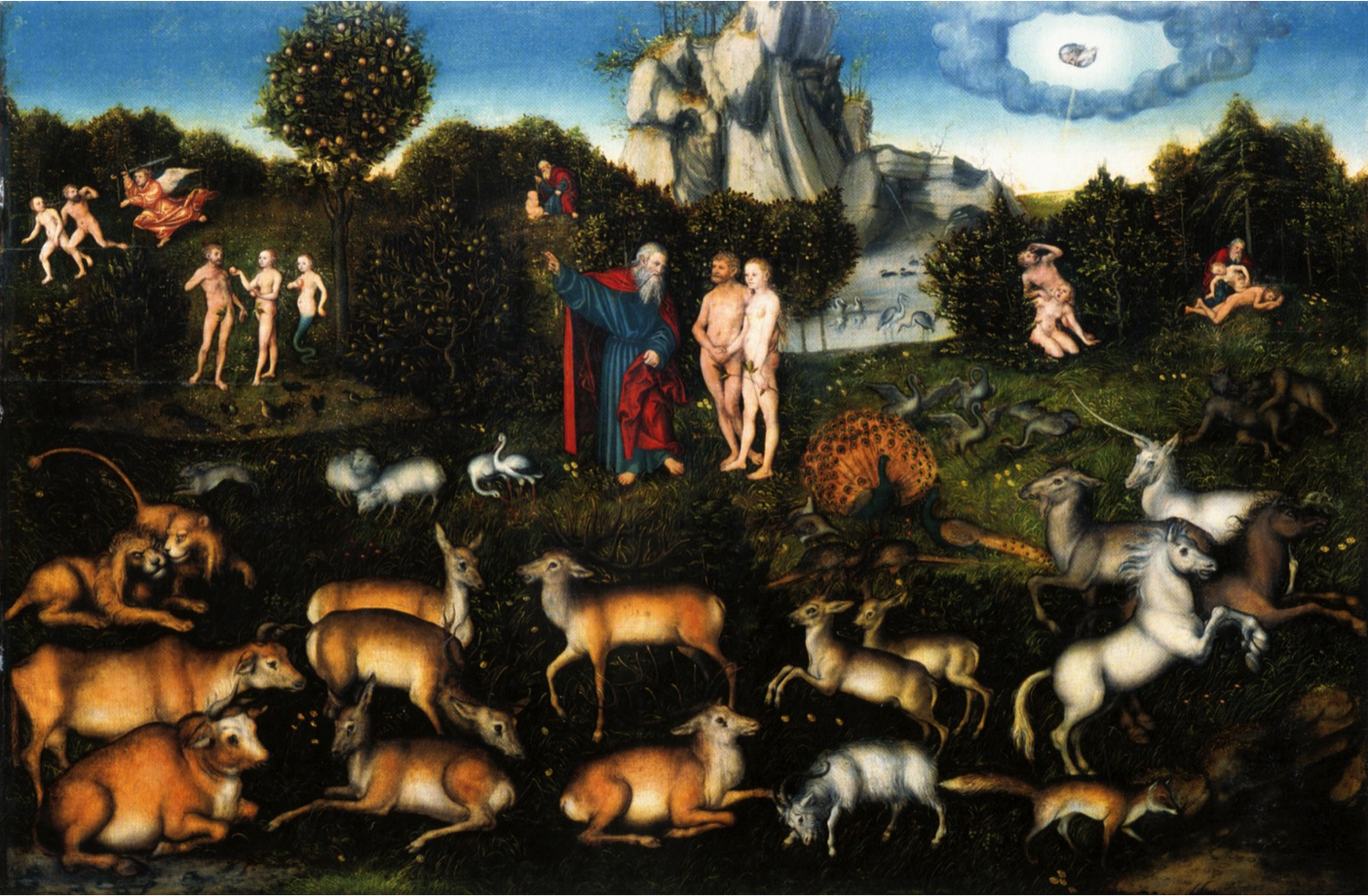
How come nudity played such an important role in the visualization of Renaissance man and woman? One reason was, it could be used to counterbalance the dressing up of people in the 16th century
In the 16th century people were deeply engaged in trying to locate the earthly Paradise in the newly found world across the oceans. At the same time they were busy trying to fathom what happened if they viewed their world through the lens of the Old Testament.
The possibility to read the New Testament in the vernacular has often been seen as one of the important results of the early reformation. This was the text, which John Wiclyffe (1328 – 1384) had translated, Tyndale (1494 – 1536) burned at the stake for, and Luther translated while imprisoned at Wartburg. However, soon after, Martin Luther (1483 – 1546) began – together with his friends – to translate the Old Testament into German he began to fulfil a task, which probably had even more farreaching consequences and which subsequently inspired Tyndale and other protestant reformers all over Europe.

To a certain extent people knew the stories in the New Testament through preaching, popular art, woodcuts (Paupers Bible) etc. However, knowledge of the Old Testament must have been – to say the least – extremely patchy. In 1534, though, it was made available in a German translation to those, who could afford to buy a copy of the whole Bible. At the same time a long list of prominent artists began to ponder the story of Genesis and its broader meaning in a world, which located the earthly Paradise in a tangible geographical setting.
One result was the widespread preoccupation with the naked Adam and Eve in the works of Massacio, Dürer, Cranach, Holbein, Michelangelo, Henri Met de Bles, Jan Brueghel the Elder, Hieronymus Bosch and countless others; another, the numerous theological commentaries on the Pentateuch and the geographical treatises on the exotic whereabouts of this earthly Paradise.
One of the intriguing facts of this art is its preoccupation with the naked body before Adam and Eve fell and entered the earthyly world. As is well known, God – according to Gen. 3:21 – “Unto Adam also and to his wife did the Lord God make coats of skins, and clothed them” (KJV). Nevertheless, this part of the story remained virtually unpainted. Apparently it was more important for the artists to paint Adam and Eve before the fall and in the act of expulsion (when they were still naked). Sometimes their private parts were covered with fig-leaves; sometimes not; (and sometimes fig-leaves or pants were added at a later and more prudish stage.) Whatever was the case, artists obviously went to great lengths to explore the nude state of innocence as opposed to its later fallen – and clothed – version, which was rendered in countless portraits depicting the exact apparel of men and women.
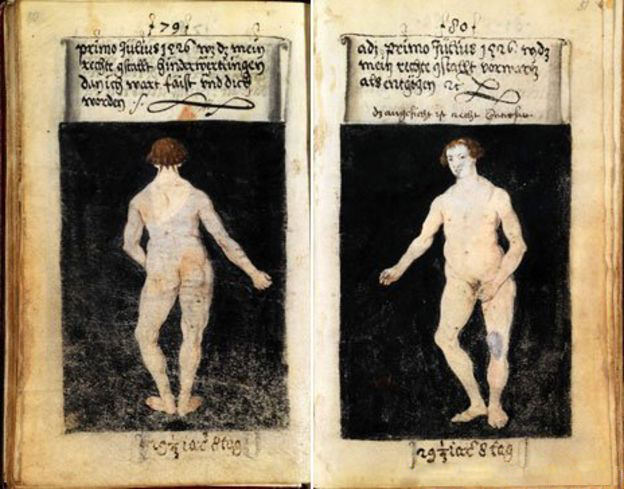
This motive was curiously imported into a number of the “books of costumes” which were either published during this period or produced for the private contemplation of the role of clothes and how they were designed to “make the man”. Nakedness became the symbol par excellence of the pre-fallen innocence, while dressing-up the necessary posturing of a man on his way to power and glory.
Source:
By Ann Rosalind Jones and Peter Stallybrass.
Cambridge University press 2000
ISBN-13: 9780521786638
ISBN-10: 0521786630

By Jena Delumeau.
University of Illinois Press 2000
ISBN-13: 978-0252068805
ISBN-10: 0252068807


