


Italy is blessed with philosophers that abstain from barren “philosophizing” in order to engage vigorously in the life and times of their neighbours. One such is Massimo Cacciari, professor turned politician. Born in Venice he received his doctorate on a thesis on Kant and held a number of professorships in Venezia as well as Milano. At the same time, however, he joined politics, first as a communist, but later as a left-vinged liberal. In 1993 he was elected mayor of Venezia, but was defeated in 2000. Again in 2005 he ran for office and currently he is once again serving as mayor.
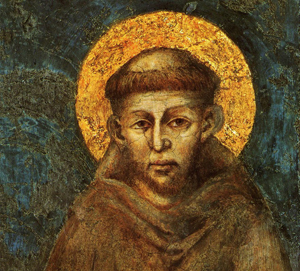
Although declared atheist he has recently published a small book about the patron saint of Italy, San Francesco, and the two different understandings of the legacy of the saint as presented by the double portraits of Giotto and Dante.

On one hand Giotto presented an idealised picture befitting the official embrace of the saint in his powerful circles of paintings in both Assisi and Santa Croce in Firenze; witnessed for instance by the depiction of the deathbed, where San Francesco is depicted clothed in a brown tunica, although the different vitae paint him naked, lying on the bare floor. Thus Giotto presented a picture of a holy man less radical and more in tune with the official policy trying to reign in his radical followers.
On the other hand Dante presents a picture of the Saint as in essence otherworldly – as imitator Christi witnessed in his mystical marriage to the bitter old lady of poverty and his later stigmatisation, reaching an apex in the famous scene of the saint dying in the arms of his beloved – Domina Paupertate.
The small pamphlet – no more than 80 pages – stresses this opposition in order to show how San Francesco, understood as a Christus Redivivus shocked the traditional way of thinking, spurring a new way forward for radical social change, political as well as civil.
While Giotto presents a sanitized San Francesco, who is one with the church – the establishment – Dante presents another “sanitized” picture, where poverty signals fullness, freedom, openness to others, ability to empty one self and become the other – in short become “Christ-like”
There is no doubt that the reflections of Chiaria are meant to open up for a debate about the dilemmas of the present economic world crisis. Should we opt for askesis and austerity and the man rising as the sun from the East? Or should we bargain for the accommodation to earthly wealth and worldly practices, to growth and for another rescue package from the coffers of EU?
An Italian dilemma – and a European!
Doppio ritratto. San Francesco in Dante e Giotto
Massimo Cacciari
Editore Adelphi. Collana Biblioteca minima. 2012


