


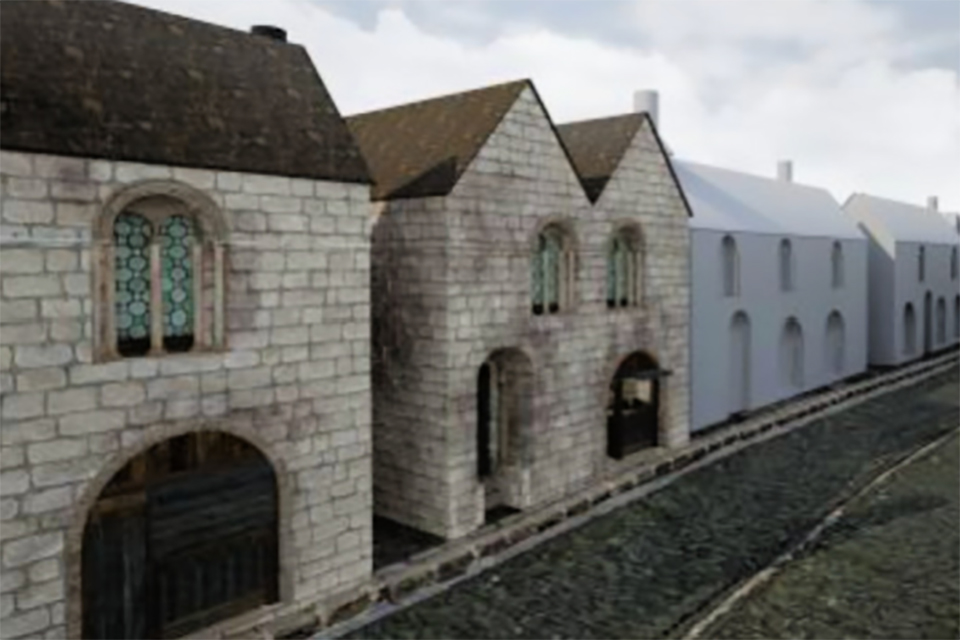
Unearthing new documents and evidence, historians and archaeologists at York University are shedding light on the Medieval Jewish population of York. The research indicates a thriving community where the leading Jewish citizens of the city were also among the most significant figures in England.

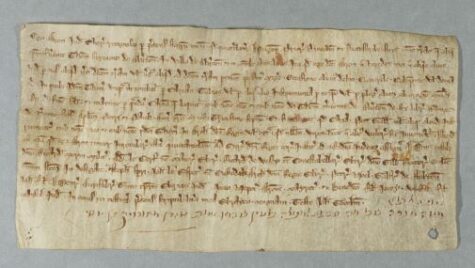
Researchers at York University have uncovered new archaeological evidence suggesting that the Jewish community in the city of York continued to thrive during part of the 13th century, despite enduring one of the most infamous attacks on Jews.
The history of Jews in York is primarily known for the mass suicide of its 150-strong community in 1190. Following the outbreak of anti-Jewish hostility that accompanied the coronation of King Richard I, the Jews of York sought refuge in a local castle, Clifford’s Tower, where they were besieged by an angry mob. Instead of complying with the mob’s demand for conversion to Christianity — and even some of those who agreed were nonetheless slaughtered — the Jews chose to end their own lives collectively.
However, new research conducted at the University of York shows that a Jewish community did survive and, to some extent, thrive in the city after the tragedy. As part of the university’s StreetLife project, online visitors can explore digital reconstructions of the homes and synagogues of the city’s Jews, including Aaron of York, reputed to be the wealthiest man in England at the time. The synagogue behind Aaron’s home has also been identified, along with the homes of other affluent local Jews, including Leo Episcopus, a moneylender who resided in a house on Coney Street with his wife, Henna.
Nonetheless, as the 13th century progressed, life for Jews in England became more difficult. In 1253, King Henry III introduced the Statute of Jewry, which mandated Jews to wear an identifying yellow badge on their outer clothing and subjected them to numerous restrictions. These restrictions reflected growing hostility towards the role played by some Jews as moneylenders — a role imposed on them since they were barred from joining trading guilds but permitted to lend money at interest, an activity forbidden to non-Jews.
Subsequently, in 1290, Jews were outright expelled from England by Henry’s son and successor, King Edward I, resulting in significant revenue for the crown as all debts owed to Jews were annulled.
Major Finds
Key findings from the project include:
- The three leading citizens of the post-1190 Jewish community lived on the west side of Coney Street, backing on to the river. The houses modelled by the project are those of Leo Episcopus (where Boots is now), his son-in-law Aaron of York (where Next is now), and Aaron’s nephew Josce le Jovene (Waterstones and Fabrication).
- Leo and Aaron both served as chief representative of the whole Jewish community of England, and in the 1230s and 1240s Aaron was considered to be the richest man in the country.
- The reconstructions of the houses are based on surviving medieval houses elsewhere in York, as well as comparable houses in Lincoln. They were originally built by Christian landlords and leased to the Jews, and would have been indistinguishable from the other houses on the street where the chief Christian citizens of York lived. Aaron’s house had a synagogue in its back plot, but this would not have been visible from the street.
- The reconstructions show how the stone houses (called ‘solars’) had domestic quarters on the first floor but let out the ground floor as shops. Coney Street was an important commercial high street, and the range of shops depicted (including a clothier, leather worker, vintner, goldsmith, baker, and apothecary) is based on contemporary evidence for these trades operating in this area.
- Charters from Durham Cathedral Archives show how Aaron of York cooperated with the senior clergy of York Minster in purchasing the large stone building which became the city’s Guildhall (the medieval civic centre), ensuring that the city had a central meeting-place and contributing greatly to York’s civic history. It is also likely that Aaron co-operated with the Minster on other major civic projects, including the construction of the ‘Five Sisters’ window in the Minster itself (previously known as the ‘Jewish Window’), in return for land extending York’s Jewish cemetery.
The charter also provides a date, previously unknown, for when York acquired the Guildhall of 8th September 1231. - Other charters from Durham have preserved Aaron’s own handwriting and signature, a rare survival at a time when charters were usually sealed, not signed.
- New research has also pinpointed for the first time the exact locations of the houses of the two leading members of the pre-1190 Jewish community, Josce and Benedict, on Fossgate and Colliergate respectively. This also changes our understanding of where the city’s first synagogue would have been, and where the noted Rabbi Yom Tov would have taught, which was most likely on the south side of Fossgate.
Visual interpretation
Dr Louise Hampson, project lead at the University of York, said “The digital reconstructions offer an accessible visual interpretation of how the Jewish community lived side-by-side with their Christian neighbours, including on York’s most high-status medieval street.”
Dr John Jenkins, researcher on the project, added: “The research brought to light the ways in which Jews and Christians worked together for the common good of the city, playing a key role in the acquisition of the civic Guildhall as well as in the rebuilding of York Minster, both of which remain important civic assets to this day.”
Howard Duckworth, Warden of the York Synagogue, said: “The amount of new information that has been uncovered by the team is truly inspiring and has now been recognised by Jews, not only in the UK, but across the world. He continues: “We have discovered a totally new history of Jews in York, which for many years has been overshadowed by the massacre at Clifford’s Tower. This research is so much more, a real history anyone can relate to. When you walk through York now, you see York with totally different eyes, thanks to the team for all their work.”
VIEW MORE:
READ ALSO:


