


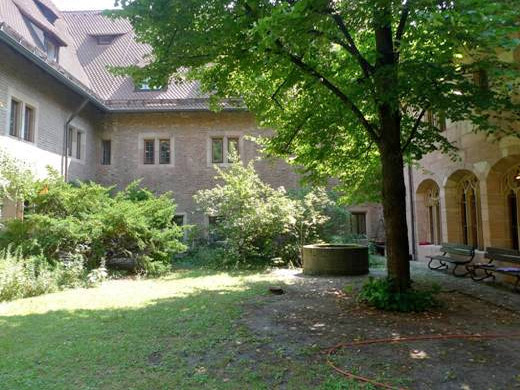
St. Katharina was a large and important convent in Nuremberg. Its library, which held 730 volumes, has recently been digitally reconstructed.
In 1295 Konrad von Neumarkt and his wife Adelheid founded St. Katharina, a Dominican convent in Nuremberg. Soon after construction of a large Gothic church commenced. However, it was especially in the 15th century the convent experienced a period of growth following a reformation of the lax lifestyle of the incumbents. It was during this period a very rich and pious atmosphere helped to lay the foundation for the collection of the library, which in its hey day held 730 volumes. Two thirds of this collection is still in existence.
For some time a group of dedicated medievalists led by prof. Dr. Hartmut Kugler and Dr. Antje Willing, has worked to create a digital reconstruction of the collection based on the identification of extant as well as extinct manuscripts building upon some precious medieval catalogues: a catalogue of the library, an inventory of the private books of the nuns, and two catalogues of the texts that were to be read during meals [1].
This reconstruction has taken the form of a database, where each manuscript details the entry in the medieval catalogues, information about provenance, copyist and date. To this is added information about extant editions and scholarly literature (up until 2010).
The database is accompanied by a printed synopsis of the medieval catalogues of the books [2] which presents these in their entirety, and gives a complete picture of the German parts of the library of the convent and of the use that was made of them during meals for the lectio.
The Church
The church was dedicated to St. Catherine, who was martyred in the early 4th century at the hands of the pagan emperor, Maxentius. Her relics were kept in a shrine housed in the eastern choir.
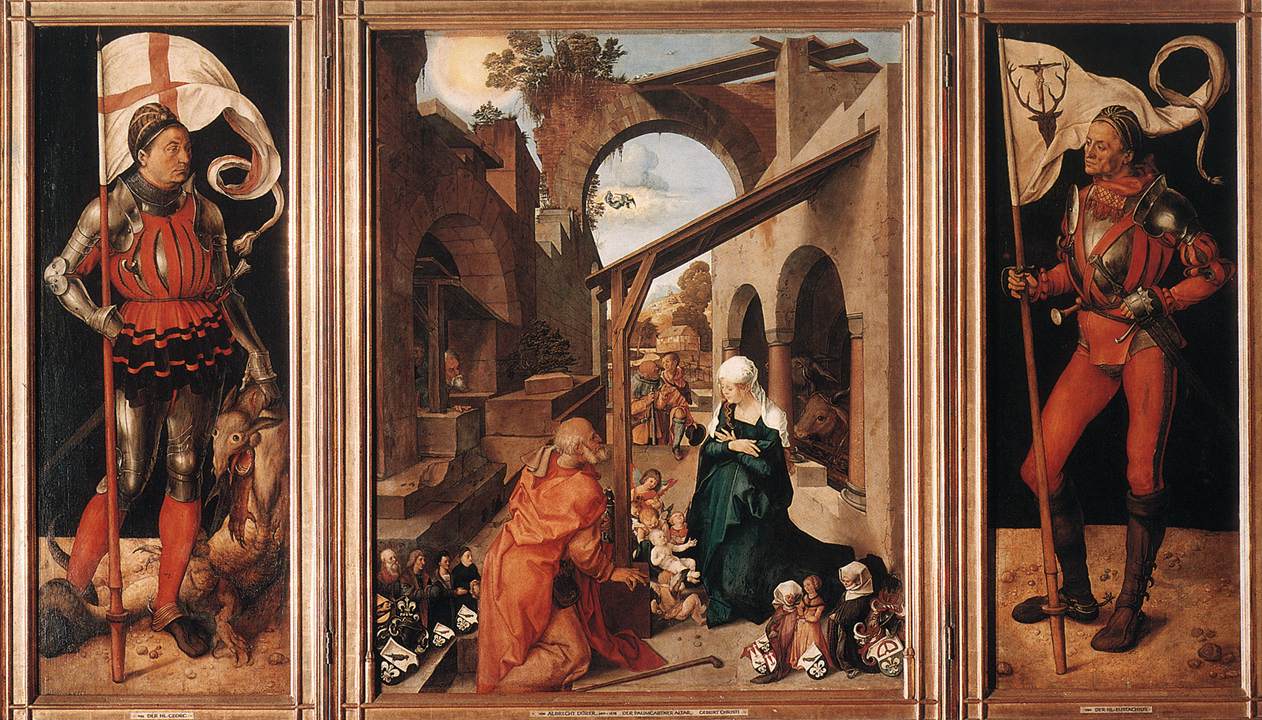
Albrect Dürer painted the famous Paumgartner altar (now in the Alte Pinakothek in Munich) for the church. It was commissioned by two brothers, Stephan and Lukas Paumgartner. St. George and St. Eustace flanking the nativity scene are believed to be portraits of the brothers.
After the reformation the convent was put to profane use and until 1778 it was home to the “Mastersingers of Nuremberg. In 1945 it was destroyed in an air raid. The church has never been rebuilt. However, the ruins have been secured and are used for open-air concerts, while the convent has been carefully rebuilt and used for the city’s library
Notes:
[1] All of these have been edited by Paul Ruf in: Mittelalterliche Bibliothekskataloge Deutschlands und der Schweiz, vol. III/3, Munich 1939, Reprint: Munich 1961, p. 570-670
[2] Die Bibliothek des Klosters St. Katharina zu Nürnberg. Synoptische Darstellung der Bücherverzeichnisse.
Antje Willing
Berlin 2012
ISBN: 978-3-05-005546-6
FEATURED PHOTO:
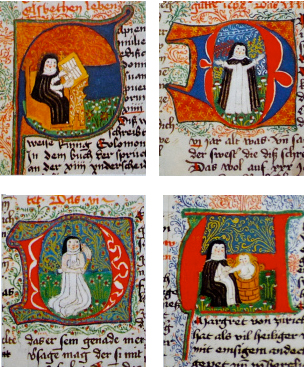
Schwestern zu Toss, Nuremberg Katharinenkloster, mid 15th c. Nuremberg Stadt Library
SOURCE:
The library of the convent St. Katherina in Nuremberg
Monsatic Matrix – S. Katharinenkloster
CONTACT INFORMATION:
Dr. Antje Willing
Friedrich-Schiller-Universität Jena
Institut für Germanistische Literaturwissenschaft
Fürstengraben 18
07737 Jena
Phone.: +49 (0) 3641 / 944205
e-Mail: antje.willing[at]uni-jena.de
READ MORE:
Paradiesgarten und Gefängnis? Das Nürnberger Katharinenkloster zwischen Klosterreform und Reformation
By Barbara Steinke
Mohr Siebeck 2006
ISBN: 3-16-148883-0
ISBN-13-987-3-16-148883-2


