


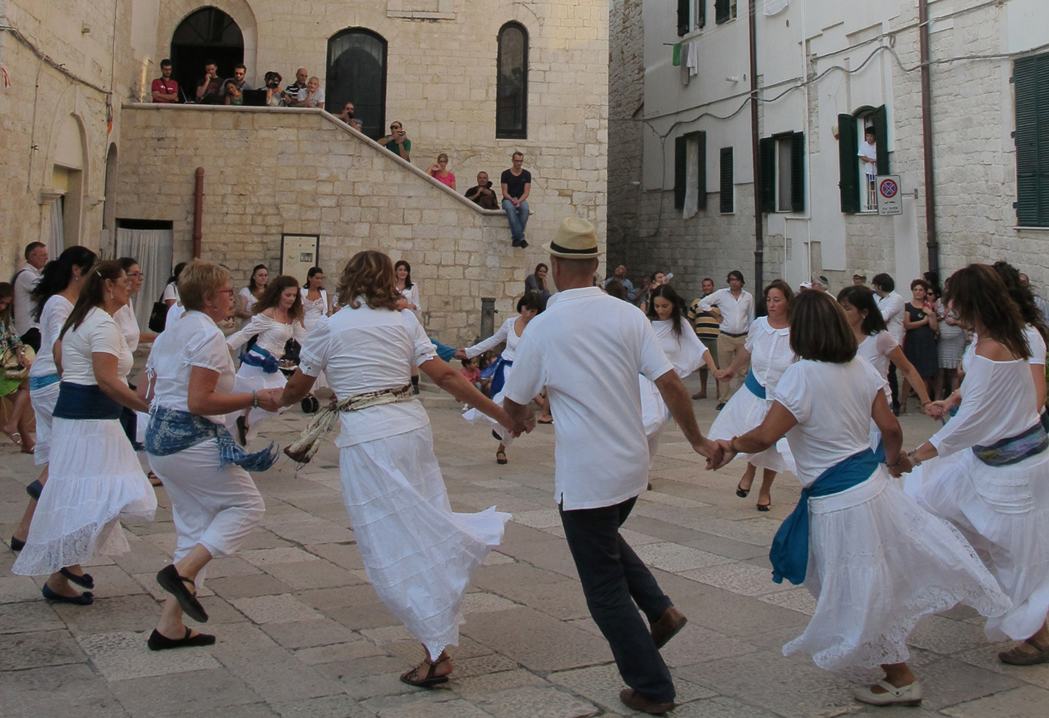
The medieval Scolanova synagogue in Trani was built in the 13th century, but confiscated around 1380 and used as church. In 2006 it was returned to the Jewish community. It recently reopened after a lengthy period of restoration
Trani is a beautiful small city off the East Coast of Southern Italy. Although known from the Peutinger Atlas as a somewhat prominent destination, Turenum, it did not figure as a town until the 9th century, even though impressive Langobardian remnants of a wall remains. However, from the 10th century and onwards it played an important role as a thriving commercial centre, not least due to its large Jewish population, which flourished in the 12th and 13th century. During this period Jewish merchants, weavers, dyers and textile workers as well as money-lenders and local farmers constituted an important part of the local community. Especially the dying of silks was a legally circumscribed monopoly.
There is no doubt that the Jews – before the persecution started in the late 13th century – were regarded as an important and well-integrated part of the city and that their community contributed to the overall wealth of the city. At the same time a flourishing intellectual milieu grew up around a number Jewish talmudists and rabbis, foremost Rabbi Isaiah da Trani (c. 1180 –c. 1260). But it also created a favourable situation for a significant building spree, the remains of which may still be enjoyed in the ancient Jewish Quarter in Trani.
The Giuadecca
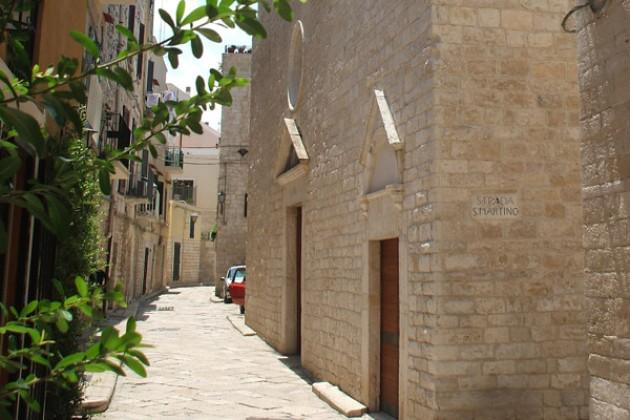
The Jewish quarter, located up to the harbour, was protected by two gates, one of which – the southern gate – is still extant. However, it was never walled, hence it was not a ghetto but a guiadecca. This is one of the reasons why architects and historians, who have studied the quarter in detail, believe that there were no significant hindrances in the daily interaction between Christians, Jews and Muslims in Trani until the late 13th century; such as the laws of Frederick II (1194 – 1250) also set the scene for.
One important feature of the Quarter were a number of extant medieval palaces, which witnessed to the wealth of the Jews at that time. It is believed that there were perhaps between two or three of these grand houses inside the quarter. One such is the Palazzo Lopez, with a spacious courtyard wherefrom a staircase leads to a series of rooms, some of which have a magnificent view over the harbour. On the ground floor were a series of vaulted storerooms.
The same pattern, although on a much lesser scale, can be found in the rows of medieval houses around and behind the Great Synagogue. Here the ground floors opened up to the street and witnessed to a thriving community of artisans and tradesmen of all sorts. With each floor holding two rooms adequate living quarters seem to have consisted of a vaulted cellar, a commercial of industrial ground floor and a spacious two- or four-room apartment above.
Central to the Guidecca were four medieval synagogues, which served the community (or distinct parts of it) up until ca. 1300, when all four were converted into churches, renamed and and rebuilt:
- Santa Maria in Scolanova (Scolanova ia Judeo-Italian for “New Synagogue”)
- San Leonardo Abate (little of the original building remains)
- San Pietro Martire (later demolished)
- Santi Quirico e Gioveta (Since renamed Sant’ Anni in Trani) . This was once the Scolagrande Synagoge. Today it holds the local Jewish Museum, part of the Diocese Museum
Of these four synagogues, two has disappeared, while two are presently functioning. Of these two, the Scolanova, was never basically altered. After WW2 it was empty and disused and in 2006 it was simply desacralized as a church and returned to its original use.
Today this synagogue is used by a community consisting of a mixture of descendants of Anusin (forcibly converted Jews) and Neofiti (Crypto-Jews) from all over Puglia. A tiny local Jewish community exists in Trani itself, which is formally connected with the Jewish Community in Naples. It was from Naples in 2007 Torah Rolls were formally presented to the Scolanova, the synagogue, which recently reopened after the medieval building had undergone a series of repair-work including cleaning and treating of the interior walls and the exterior facade as well as repairing the roof, which had presented signs of possible impending collapse.
According to Jewish Heritage Europe, the slocal Jewish leader Cosimo Yehudah Pagliara has expressed that “further repairs and renovations are planned”. These, he said, will include construction of a bimah and women’s gallery in wood and removal of an altar that was placed during a restoration of the building in 1981.
The Medieval Scolanova
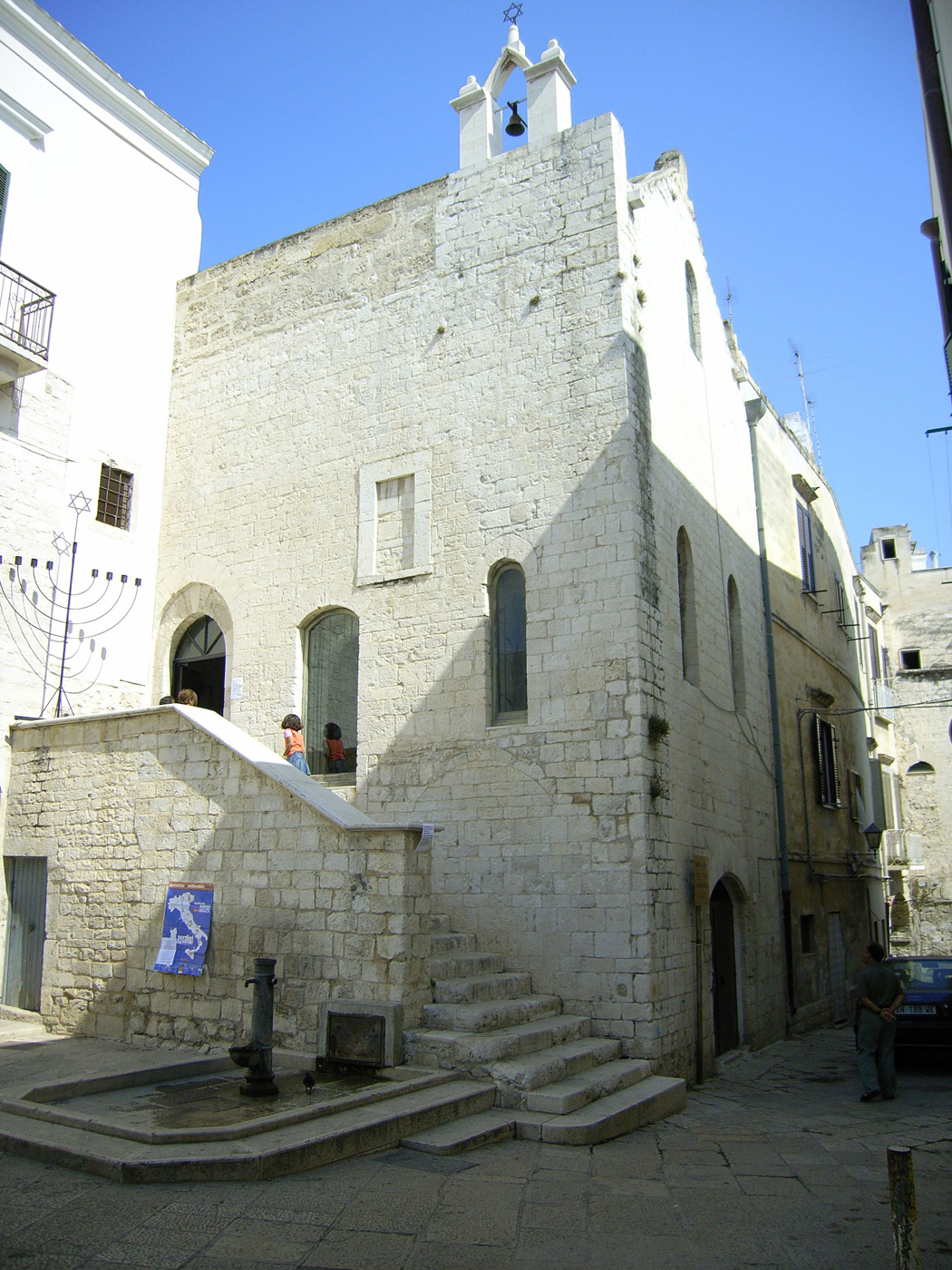
There must have been synagogues in Trani before the 13th century, since the first synagogue mentioned, was the Scolanova.
This synagogue was a simple building with thick limestone walls pierced by narrow slits, through which sparse light flowed into the long nave. Access to the synagogue was originally found via an arched portal in the ground floor. Nowadays a high staircase leads up from the street. The synagogue faced Jerusalem and was probably built ca. 1200.
Inside on the far end was the Aron Kodesh, with the holy arch and the cabinet for the Torah. This niche still retains the jamb for the wooden shutters and hinges, which were carved into the wall. After the conversion into a church, a Byzantine icon of Mary and Child was painted in the background of the niche. For antiquarian reasons this has not been removed; however, at a daily basis it is covered by a curtain with a Menorah.
There are no traces of the original bimah, the pulpit for the rabbi and the cantor
On top of the synagogue it is believed there might have been a women’s gallery, while the ground floor may have contained a separate miqweh.
Behind this synagogue was a house, which might have been used as a Talmudic study centre and perhaps living quarters for the rabbi and his students. This might also have been the place where the matzot was baked.
The Medieval Scolagrande
Around 1246 – 47 the local community decided to invest in a more grandiose meeting place, the so-called Grand Synagogue. While the earlier Scolanova might have been inspired by synagogues in Spain or Northern Italy, this new and more grand edifice was obviously inspired by Byzantine churches or the corresponding Islamic mosques. With its cupola and its main hall, which was almost perfectly square (11.5 x 12.2 meters) the parallel is obvious. On the inside, the dome, which is lit up by windows placed high up, gives a sense of the greatness, the architect and his patrons tried to achieve. However, from the outside it was obviously built in a manner designed not to “outshine” the Christian churches in the city.
Proud, though, they were. On the southern wall of the synagogue the community placed a marble stone with a Hebraic inscription. As translated by Bertagnin, the text sounds:
“In the year 5007 after the Creation, this sanctuary was built by a minyan and friends. With a lofty and splendid dome and a window open to the sky and new portals for enclosing it. And a pavement and benches for seating the leaders of the prayer, so that piety would be watched over by the One who dwells in the glorious Heavens.” [1]
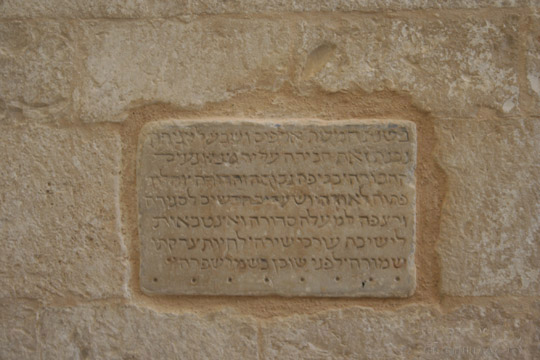
Until 2009 this building was basically left lying around as a ruin. Now, however, it has been carefully restored and turned into a small museum, which tells the story of Jews in Trani.
The Dissolution of the Jewish Community
In the beginning of the 13th century the Jews in Trani experienced a period of remarkable growth, both economically and culturally. There is no doubt that part of this flourishing was due to the favourable laws and regulations, which had been set in motion by Frederick II. Part of this had been the royal decree banishing the Dominicans – the inquisitors – from his realm. However, in the second half of the 13th century the Kingdoms of Sicily and Naples were taken over by France, more specifically by Charles of Anjou (1227 -1285), the brother of Louis the Saint. This opened up for a remarkable series of events, which culminated in the mass conversion of between 6000 and 8000 Jews from all over Southern Italy in 1292.
Behind this mass conversion was obviously a set of economic incentives, which had caught the Jews between a hard rock and a stone; in this case the local Archbishops and the royal religious interests. The point was that Jews by tradition were the “property” and “responsibility “ of the king, his to exploit and tax as he saw fit. The Archbishop on the other hand was dependant on the income from primarily the local fairs often held in conjunction with local feasts. It stands to reason that trade carried out in a Jewish home was to the Bishop not nearly as directly lucrative as that which took place at the open stalls of the traditional feast of St. Nicholas the Pilgrim (to name just one local fair). Thus the King may have had a direct interest in keeping the Jewish population ship-shape in order to be able to continue to milk the cow. This, however, was not carried out directly. Instead the right to tax the Jews had very early on been farmed out to the Archbishop. Already in 1155 the Archdiocese in Trani had acquired the right to protect and tax the Jews. This meant that the Archbishop was directly dependent on the continuous reproduction of the Jewish Community as such, while successive kings, on the other hand, might occasionally be more interested in opening up for the activities of the Dominicans and their Inquisition. The king’s inflow of money was primarily dependent upon the fiscal income collected by the Archbishop. He could afford to show religiously fervor. Paradoxically, the Archbishop did not have this option.
It is not quite easy to determine what exactly lay behind the mass-conversion in 1292. However, it is safe to maintain that what went on was a mixture of local pogroms instigated by the Dominicans and fiscal harassment in general. What is known is that at some point a large segment of Jews apparently decided to convert. Indirectly this had the consequence that the Archbishop critically came to loose a significant part of his income. In order to protect this, the newly converted Jews were simply placed in a separate cultural category and given a special status as “Novus Christiani” or “Nofitis” (Christiani Novelli or Neofiti). As such the former “Jews” continued to be open for exploitation and occasional religiously inspired examinations, whenever those in charge felt the need. It is remarkable, though, that serious persecutions were nearly absent from c.1340 – c.1460 and that participation in the communal affairs was a secure part of the obligation and rights of the “neofiti” post 1465. For a short period in the second half of the 15th century they even seem to have succeeded in defining themselves more as “noble merchants” than Christiani Novelli. Scheller, who has studied the history of this group in detail, have found that they practiced intensive endogamy. Neofiti married other Neofiti and that they continued to live in the old “Jewish Quarter” until at least the beginning of the 15th century. Interestingly enough it is those two cultural factors, which the Inquisition complained about in 1311 and 1343 – cultural in-marriage and spatial segregation. Both were claimed to fester “heretical wickedness” [2]
However, at the end of the 15th century even this precarious situation came to an end, when the Kingdom of Naples was reduced to a province in the Spanish Kingdom, which from 1503 was governed by Ferdinand the Catholic and Isabella. As is well known they sought to cleanse Spain of not only Muslims but also Jews. This project was imported into Southern Italy. In the whirlwind of pogroms, which followed, even the “New Christians” were renamed “marrani” and expelled with reference to their inherent “evil nature”. Obviously it was complicated to refer to them as non-Christians. The reason given, was that they were “unnatural Christians”. Large contingents fled to the North (or wherever some modicum of peace may be found). However, many stayed behind and fought it.
Post Script
At some point in the 1930s a Hungarian scholar (and Jew) by the name of Ernõ Munkáczi ended up in Southern Italy, where he began to explore the Jewish heritage in Naples and elsewhere. The result was a book with the title: Der Jude von Neapel (The Jew from Napoli), which was originally (1939) published in Hungarian. A German translation was published in 1940 in Zürich. This book was presumably originally thought to be a historical and artistic exploration of Jewish heritage. However, it ended up as a decidedly testimony to his own mystical experiences in Trani. In his book he simply wrote how he traveling along the Adriatic Coast ended up having deep mystical experiences of the life and times of his fellow Jews. About his visit to Trani he writes:
“In the evening, after I had lodged in my simple and cheap lodgings, I found my way into the Giudecca. It lies only a few minutes from the centre of the city. Deeply moved I went through the ancient gate, which leads into Via Giudea, the main street in the ancient Jewish Quarter. A wonder of history! Four hundred years has gone by, where no Jews have lived here and more than five hundred years since the famous synagogues where changed into churches; nevertheless, the Jewish Quarter stands nearly intact with its high, snowy white houses, its narrow passages and small piazzas… looking upon the people, who went around their business in the streets and looking at their faces, I could not help myself: do they have any inkling about their heritage at all?…” [3]
It seems not: If a tourist here in 2015 should happen to consult the official tourist guide – Viaggare in Puglia – in order to get a sense of place of Trani and surroundings, he or she is told about the Cathedral, the Castle, the Villa Communale and the church in the centre of the town, Maria Colonna. Further, visitors are guided to take a look at the impressive harbour. However, no mentioning of the Jewish Quarter nor its impressive heritage can be found ( in fact, searching for “Jew” on the website yield no links at all!)
NOTES:
[1] Bertagnin 2003, p. 39. A minyan is the quorum of ten males of thirteen years or older, which is required to fulfil the necessary religious obligation in order for the community to count as fully functioning.
[2] Scheller 2009, p. 417ff.
[3] Scheller 2013, p. 359 – 60
SOURCE
Synagogue in Trani, Italy reopens after refurbishment
READ MORE:
A Mediterranean Jewish Quarter and its Architectural Legacy: The Giudecca of Trani, Italy (1050 -1550)
By Mauro Bertagnin, Ilham Khuri-Makdisi and Susan Gilson Miller
In: TDSR – Traditional Dwellings and Settlements Review 2003, Vol. 16, No. 11 pp. 33 – 46
Die Stadt der Neuchristen: Konvertierte Juden und ihre Nachkommen im Trank des Spätmittelalters zwischen Inklusion and Explosion
By Benjamin Scheller
Walter de Gruyter 2013
The Materiality of Difference: Converted jews and their descendants in the Late medieval Kingdom of Naples
By Benjamin Schiller
In: The Medieval History Journal 2009, Vol. 12, No. 2, pp.405 – 430.
FEATURED PHOTO:
Dancers outside the 13th century Scolanova synagogue in Trani, during the Lech Lecha Jewish culture festival, September 2012. © Ruth Ellen Gruber


