


New book explores the monastic culture in Western European Catholic and Russian Orthodox monasteries and convents from the Medieval and early Modern Period
Monastische Kultur als transkonfessionelles Phänomen. Beiträge einer deutsch-russischen interdisziplinären Tagung in Vladimir und Suzdal
Ed. by Ludwig Steindorff and Oliver Auge
Series: Veröffentlichungen des Deutschen Historischen Instituts Moskau
De Gruyter Oldebourg 2016
Abstract
This collection of articles offers a unique comparison between Western European Catholic and Russian Orthodox monasteries and convents during the late Middle Ages and Early Modern period. It reveals their common roots in the Western and Eastern monastic traditions as well as similarities in the meaning and practical implementation of their shared early Christian heritage. The adopted social-historical perspective illustrates how the world of the monastery is connected to secular spaces. Fokus is on the religious roots of monasticism, liturgical aspects, daily life, the monastery or convent as architecture, their role in the life of families, the state formation, cities and landscapes plus finally as centres for book-production.
Tables of Content:
- Das spätantike Mönchtum als „konfessionelle“ und regionale Grenzen überschreitendes Phänomen by Andreas Müller
- Der soziale und kulturelle Status russischer Klostergründer (14.–17. Jahrhundert) by Elena V. Romanenko
- „Desperatio facit monachum“ – Mönchtum als Weg zur Reformation by Vasilij V. Ivanov
- Ansätze eines Vergleiches: Gemeinsame Wurzeln und verschiedene Wege. Kommentar zu den Vorträgen in der Sektion „Religiöse Anliegen des Mönchtums; Entstehungsbedingungen des Mönchtums“ by Isolde Thyrêt
Teil 2: Die Liturgie im Kloster
- Psalterien des Frühen und Hohen Mittelalters im monastischen Gebrauch by Ulrich Kuder
- Die altrussische Beichte als Bestandteil der Klosterkultur. Traditionen und schriftliche Überlieferungen by Marija V. Korogodin
- Die Liturgie in byzantinischen und slavischen Klöstern (9.–15. Jahrhundert) by Aleksej M. Pentkovskij
- Ansätze eines Vergleiches: Gemeinsame Wurzeln und verschiedene Wege. Kommentar zu den Vorträgen in der Sektion „Die Liturgie im Kloster“ by Ulrich Köpf
Teil 3: Religiöser Alltag: Regeln und Lebensformen – oder das Kloster als Ort der Sozialdisziplinierung
- Verstöße gegen die Regel in spätbyzantinischen Klöstern aus der Sicht kirchlicher Gerichtsbarkeit des Ökumenischen Patriarchats by Günter Prinzing
- Der Welt entfremdet – der Welt zugewandt. Religiosentum und Kommunikation im frühen und hohen Mittelalter, by Markus Schürer
- Der Skit als besondere Organisationsform mönchischen Lebens by Elena V. Beljakova
- Die Praxis der Anleitung von Novizen in altrussischen Klöstern by Svetlana A. Semja Semjačk
- Lebensformen in altrussischen Frauenklöstern by Elena B. Emčenko
- Zwischen Kloster und Welt. Deutungen eines weiblichen franziskanischen Lebens im 14. Jahrhundert am Beispiel Sanchas von Neapel By Cristina Andenna
- Ansätze eines Vergleiches: Gemeinsame Wurzeln und verschiedene Wege. Kommentar zu den Vorträgen in der Sektion „Religiöser Alltag: Regeln und Lebensformen – oder das Kloster als Ort der Sozialdisziplinierung“ by Eva Schlotheuber
Teil 4: Das Kloster als Baukörper
- Regelwahrend und identitätsstiftend: Die Gebäude klösterlichen Lebens im abendländischen Mittelalter by Matthias Untermann
- Das Ensemble des Geburt-der-Gottesmutter-Klosters im architektonischen Kontext der Stadt Vladimir (12.–17. Jahrhundert) Tat’jana P. Timofeeva
- Die Nekropolen der großen koinobitischen Klöster der Moskauer Rus’ des 15.–16. Jahrhunderts als Spiegel des Prozesses der Verkirchlichung der Gesellschaft by Sergej Z. Černov
- Begegnung an der Istra: Die Archäologie des Neu-Jerusalem-Auferstehungsklosters By Leonid A. Beljaev
Teil 5: Mönche, Nonnen und ihre Herkunftsfamilien (Klöster in Familienstrategien)
- Die Klöster im Kreise der Familien. Orte der Erinnerung, des religiösen Kultes und der Feste by Eva Schlotheuber
- Das Kloster in der Sozialstruktur der Gesellschaft im 16. und 17. Jahrhundert: Brüder, Stifter und Weltliche im Klosterdienst (auf der Grundlage von Sinodiki, Stiftungs- und Speisungsbüchern des Troica-Sergij-Klosters) by Svetlana V. Nikolaeva
- Sinodiki mittelgroßer Klöster und die Möglichkeiten ihrer Erforschung (am Beispiel des Dionisij-Glušickij-Klosters in Vologda und des Nikolaus-Klosters in Staraja Ladoga vom 16. bis ins 19. Jahrhundert) by Nikita V. Bašnin
- Die Vorsteher von Männerklöstern im Russland der Synodalzeit (18.–19. Jahrhundert) und ihre soziale Herkunft by Gleb M. Zapal’skij
- Ansätze eines Vergleiches: Gemeinsame Wurzeln und verschiedene Wege. Kommentar zu den Vorträgen in der Sektion „Mönche, Nonnen und ihre Herkunftsfamilien (Klöster in Familienstrategien)“ by Ludwig Steindorf
Teil 6: Klöster als Integrationsfaktoren in Reichsbildungsprozessen
- Der Beitrag der Klöster zur territorialen Integration: Der Raum des heutigen Schleswig-Holsteins als Beispiel by Oliver Auge
- Klöster als politische Integrationsfaktoren – am Beispiel des Wirkens des Iosif Volockij by Aleksej Aleekseev
- Klöster und die dynastische Fehde der Moskauer Rjurikiden by Vladislav D. Nazarov
Teil 7: Klöster als Integrationsfaktoren im städtischen Leben
- Kloster als Option. Zur sozialen Dynamik religiöser Orte in der spätmittelalterlichen Stadt by Stefanie Rüther
- Stadtklöster im soziokulturellen Raum von Vologda (16. – Anfang des 17. Jahrhunderts) by Marina S. Čerkasova
- Ansätze eines Vergleiches: Gemeinsame Wurzeln und verschiedene Wege. Kommentar zu den Vorträgen in der Sektion „Klöster als Integrationsfaktoren im städtischen Leben“ by Aleksandr Lavrov
Teil 8: Das Kloster im Raum, als Gestalter von Landschaft, als Wirtschaftsfaktor
- Zisterzienserklöster in der Germania Slavica und ihr Beitrag zur Gestaltung der Kulturlandschaft und zur Entwicklung der Wirtschaft im 12. und 13. Jahrhundert by Winfrid Schich
- Die Wirtschaftskultur russischer Klöster im 16. und 17. Jahrhundert by Vladimir I. Ivanov
- Ansätze eines Vergleiches: Gemeinsame Wurzeln und verschiedene Wege. Kommentar zu den Vorträgen in der Sektion „Das Kloster im Raum, als Gestalter von Landschaft, als Wirtschaftsfaktor“ by Johannes Rosenplänter
Teil 9: Mönchtum und kulturelles Schaffen / Klöster als Zentren der Buchproduktion
- Handschriftliche Buchproduktion, Buchdruck und Reformen im Gefüge von Klosterbibliotheken am Ende des Mittelalters by Kerstin Schnabel
- Johann Aventin (1477–1534) und „der Diebstahl der Klosterhandschriften“. Ein Kriminalfall oder das Renaissance-Programm? By Andrej V. Doronin
- Austauschbeziehungen der Klöster im Bereich der Buchproduktion (15.–17. Jahrhundert) by Elena É. Ševčenko
- Die Bibliothek des Evfimij-Erlöser-Klosters in Suzdal’ und ihr Schicksal by Sergej P. Gordeev
- Die Ikone der „Spanischen Gottesmutter“ aus dem Kloster des Schutzmantels der Gottesmutter in Suzdal’ by Marina A. Bykova
FEATURED PHOTO:
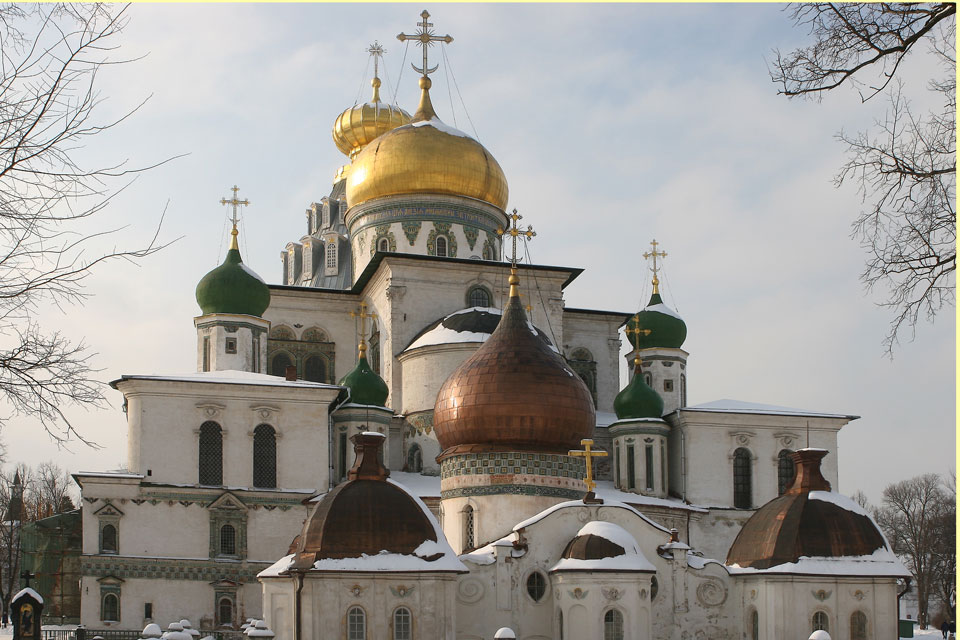
Istra in Russia – New Jerusalem Monastery. Source: Wikipedia


