


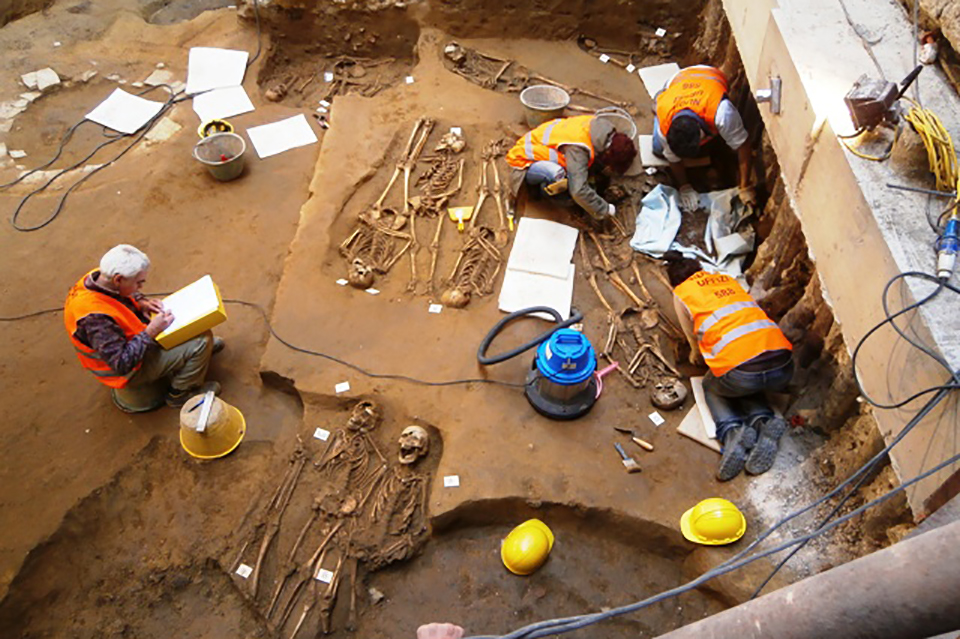
Sixty skeletons buried in a graveyard from the 5th – 6th century have been found during renovation at The Uffizi Galleries in Florence
Sixty skeletons buried in a graveyard from the 5th–6th centuries have been found during renovation at the Uffizi Galleries in Florence.
Recently, workers discovered a graveyard with sixty skeletons beneath the Uffizi. The skeletons were probably victims of an infectious disease. The victims appear to have been placed hastily next to each other in a temporary graveyard. Each burial contained at least four to five bodies, placed very close to one another. In order to save space, some of the bodies were arranged like playing cards; children were squeezed in between the adults wherever there was room. The dead were buried within a very short period.
Experts have ruled out the possibility that a massacre lies behind the multiple burials, as the dead do not show signs of having been subjected to violence. Nor does a preliminary investigation show signs of starvation.
At present, scientists and archaeologists believe the people died of plague, possibly the Justinianic Plague. Samples are currently being analysed at the University of Mainz to corroborate this.
In general, the scientists are very excited. Apart from the possibility of studying the infectious disease the people presumably died of, the cemetery has yielded one of the largest assemblages of early medieval individuals from Italy, all having lived at approximately the same time. Thus, it will be possible not only to study living conditions, health, nutrition, and work-related diseases in a comparative perspective, but also, through isotope analysis, perhaps to discover where the people came from.
The cemetery was found beneath a massive layer of landfill dated from the 7th to the 13th century. After this, the area was urbanised until Giorgio Vasari gutted the medieval quarter to make way for the ducal palace, which now houses the Uffizi Gallery.
SOURCE:
PRESS RELEASE
Sotto gli Uffizi un cimitero del V secolo con sessanta scheletri
READ MORE:
The find has later been published here dating the burials to the end of the 4th and the beginning of the 5th century (radiocarbon and coins). Thus, the epidemic, which the authors infer from the archaeological explorations of the skeletons point to a more complicated story, perhaps involving the Gothic invasion of Italy in the beginning of the 5th century.
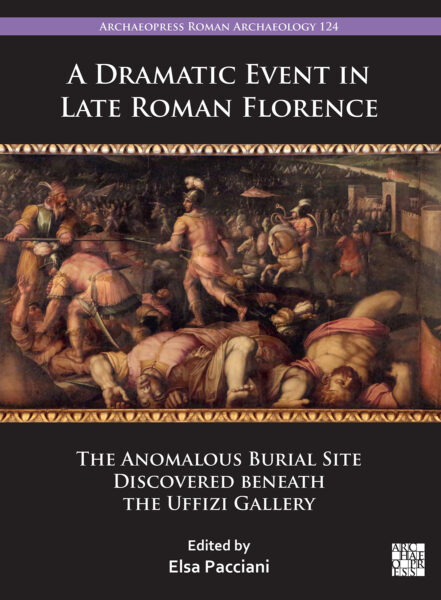
Edited by Elsa Pacciani
Series: Archaeopress Roman Archaeology 124
Archeopress 2025

The Anomalous Burial Site Discovered beneath the Uffizi Gallery presents a multi-disciplinary scientific investigation arising from excavations under the Uffizi Gallery in Florence, Italy. Investigations revealed traces of a striking, hitherto unknown episode and made it possible to write an entirely new chapter of the city’s ancient history. Between the end of the 4th and the beginning of the 5th century AD this space – then a strip of land between the walls of Roman Florentia and the River Arno – was chosen as the burial place for dozens of inhabitants who had died within a short time span. Indeed, what has survived the expansion of the medieval and Renaissance city represents a small part of an originally much larger emergency burial area used in the course of a dramatic event of considerable proportions, most probably an epidemic, of which there is no historical record. The scientific investigations described here aim to understand, through a synergetic and coordinated approach, not only the cause of these deaths but also the historical and socioeconomic context of this event.
The volume therefore collects contributions by several specialists in different disciplines: anthropology, medicine, numismatics, C14 dating, palaeogenetics, palaeobacteriology, and palaeoparasitology. The results are of considerable historical interest: they reveal contemporary living conditions, which contributed to the onset of mortality; the event was likely a contributing factor to subsequent well-known demographic changes; and its chronology suggests a probable relationship with the first barbarian aggression against the city.


