


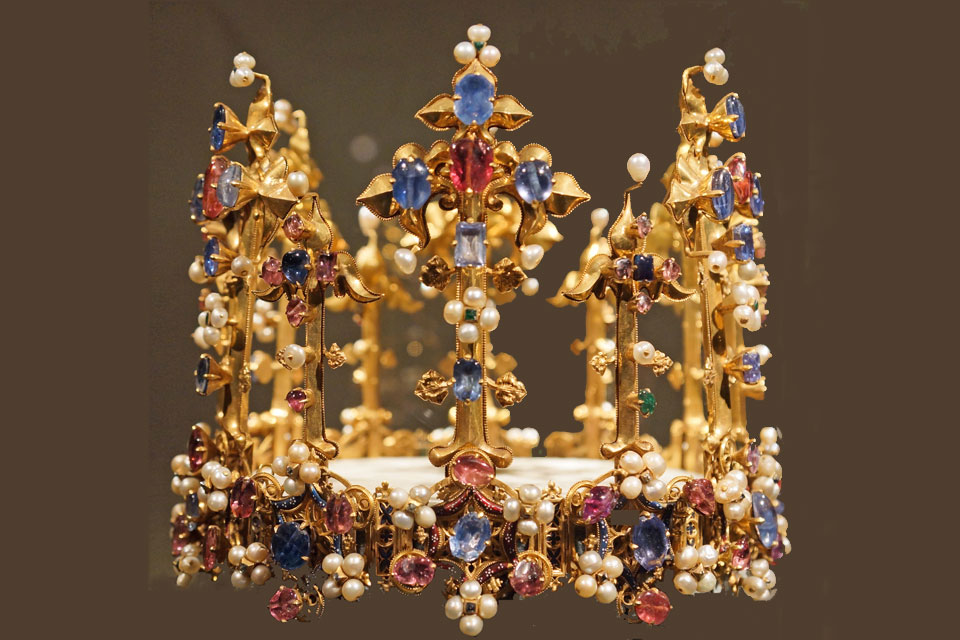
How do you recognise a king or a queen? Through splendid magnificence, a new book reveals.
Magnificence and Princely Splendour in the Middle Ages
By Richard Barber
Boydell Press 2020
REVIEW
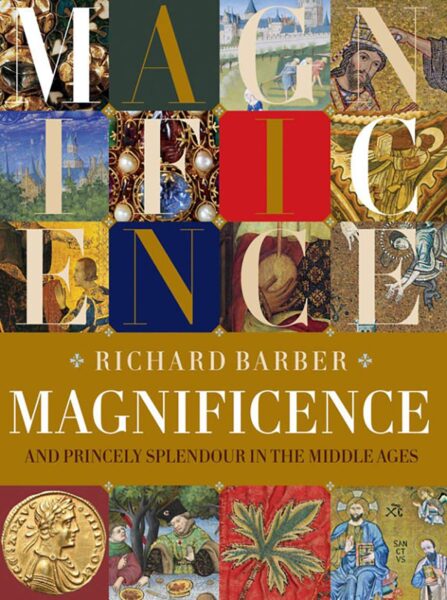

In 2017, Richard Barber published a very charming book on The Splendour of Princes, as expressed in medieval court festivals in all their forms: jousts, knightings, processions and banquets. The present book is a follow-up to this work. In the new book, he does cover some of the same ground. However, he also presents us with a more detailed exposé of how the idea of magnificence came to play such a massive role in the later Middle Ages.
The story is that the idea of magnificence emerged as part of the revival – or rather rediscovery – of the Greek philosophical works of Aristotle in the 12th century. Building on Plato, yet differing from him, Aristotle wrote about magnificence as a profound virtue expressed in a “fitting expenditure involving largeness of scale”: that is, magnanimity concerning votive offerings, sacred buildings and sacrifices. This idea was picked up by Thomas Aquinas, who regarded magnificence as a virtue which – though it belonged to God – might be shared by human beings. Thus, for Aquinas, magnificence was more a question of expressing fortitude and courage while undertaking glorious actions than of expressing magnificence through the sheer demonstration of wealth in attire and material surroundings.
Later, however, kings in the 14th century began to believe that they had to dress and behave magnificently to play the role of God’s representative on earth. In due course, this led to the opulent lifestyles of kings, queens and their retinues, which they excelled in parading before each other and their lesser minions.
What shifted was what it meant to enact royal status. In the 12th century, people did expect kings and queens to be splendid: that is, to appear with a great entourage of numerous people. They were also expected to wear crowns, dress in silks and look kingly. However, in terms of material wealth, other virtues might be just as important; for instance, appearing humble when caught out in a major sin – killing an opponent (Henry II) or seeking reconciliation with the pope (Henry IV) – or being magnanimous towards (royal) saints by building great shrines in the form of cathedrals or chapels.
Gradually, however, this changed during the 13th century, creating a new royal atmosphere permeated by a thirst for material magnificence. Until then, royal splendour might occasionally be regarded as a malicious and selfish display. Now, it became a prerequisite of kingly behaviour. Enacting splendour was no longer an option which might be manipulated according to the situation. It was obligatory.
So what did it take to appear magnificent? Chapter after chapter, Barber guides us through how to dress in embroidered clothes set with jewels, put on crowns and carry magnificent weapons and armour. Another essential element was to be seated next to a queen fitted out in like manner and surrounded by an entourage dressed in livery with badges and collars. Thus fitted out, the court would gather numerous artists, musicians, composers, poets and writers, expected to create the right atmosphere in the new magnificent castles and their royal apartments, to celebrate memorable royal feasts and banquets, or to organise tournaments. The list is endless, and Barber enjoys parading all the trinkets and remnants of this past magnificence before us. But he also tells us about the management of all this “stuff” – the cost of magnificence, royal resources and the role of bankers.
There is, Barber writes, a significant feeling of “unreality” attached to this display or show of material wealth. It appears almost “childish” when we imagine kings using their afternoons to inspect their treasuries, as Charles V was wont to do according to Christine de Pizan’s biography. “Magnificence”, however, was simply “part of the complex way in which a ruler was judged”.
Later, this opulent fashion was overturned when leisure became the great symbol of wealth, expressed in ladies who no longer paraded at grand balls dressed in heavy garments and adorned with jewels, but instead were expected to demonstrate that they had the time to do nothing: neither working nor caring for the home. The “leisure class”, Thorstein Veblen famously called it. Today, of course, we are once again expected to work, as signalled by lean, fit and youthful bodies, walking on ridiculously high heels or fitted out in immaculate white trainers, ready to be on the run. Indeed, times have changed.
Magnificence is a great and fascinating book: fun to read and enjoyable to peruse. Some minor quibbles, though, need to be noted. The book is weak on the theoretical sociology of the field. Barber may be forgiven for not quoting or considering Thorstein Veblen’s The Theory of the Leisure Class (1899). However, the work of Norbert Elias is absent, more precisely his The Civilizing Process (1939), but also The Court Society (1969). Both are difficult to avoid when exploring shifts in comportment from the Middle Ages onwards.
Also, the examples are sampled almost exclusively from French, English or German (Bohemian) contexts. It might have been interesting if Barber had at least acknowledged that Scandinavia was united in a single and indeed mighty kingdom at this time (see the map on p. XXII, where it is absent from a map purporting to show the major kingdoms of Europe in the 14th century). Likewise, the Jagiellonian dynasty, which played such a significant role in Eastern and Central Europe between 1386 and 1596, has escaped the author completely. Recently the object of a major international research project, it would have provided a fine addition. A broader perspective might have yielded insight into the workings of “magnificence” far away from Paris and London, and shown that it was seemingly a pan-European idea, reaching into the corners of the supposed periphery of late medieval Europe.
However, this is a gilded and sumptuous sourcebook: a joy to read and peruse.
Karen Schousboe
ABOUT THE AUTHOR
RICHARD BARBER has had a huge influence on the study of medieval history and literature, as both a writer and a publisher. His first book on the Arthurian legend appeared in 1961, and his major works include The Knight and Chivalry (winner of the Somerset Maugham Award in 1971), Edward Prince of Wales and Aquitaine, The Penguin Guide to Medieval Europe and The Holy Grail: the History of a Legend which was widely praised and was translated into six languages.


