


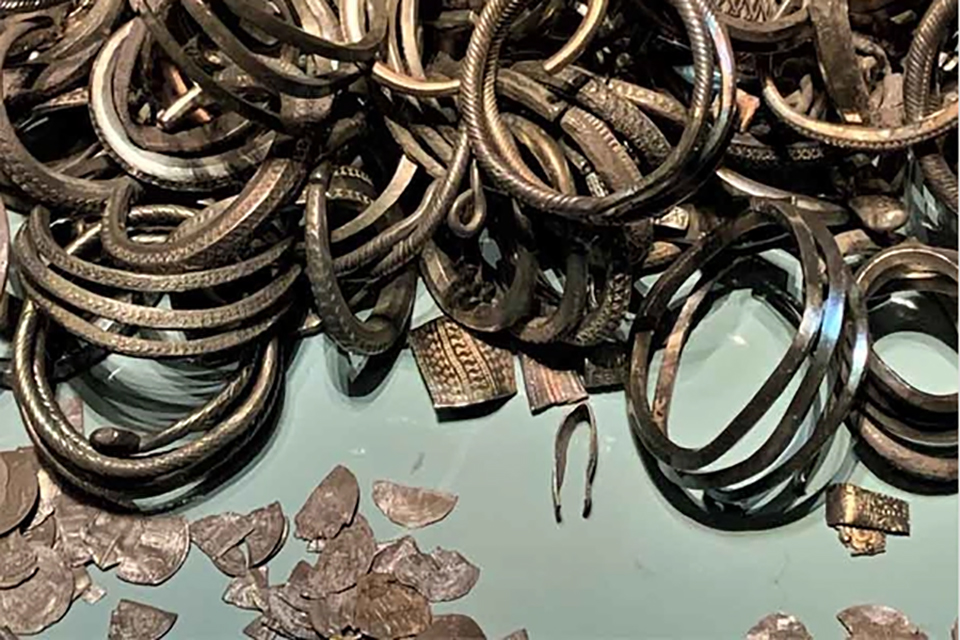
Gotland is famous for its extraordinary wealth of Viking-Age silver. More than 700 silver hoards have been discovered on the island including around 170,000 Viking-Age silver coins — roughly two-thirds of all those found in Sweden. More tightly defined archaeological datasets identify more than 500 deposits that can be classified as hoards.

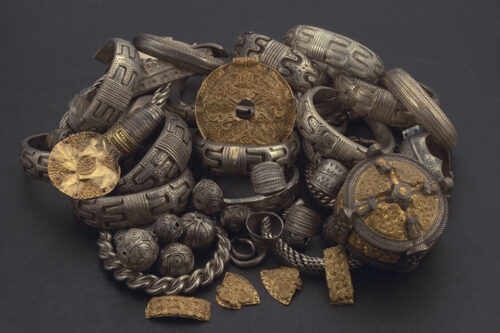
Few places in Viking-Age Europe offer anything comparable for studying the accumulation, circulation and deposition of silver, but Gotland.
One particularly important find was discovered at Stale in Rone parish in April 2012. The hoard was found intact beneath the ploughsoil during a metal-detector survey and was lifted en bloc for excavation in the laboratory.
What initially appeared to be a copper container holding perhaps 6,000 coins proved to be a vessel of copper or copper alloy with a bark lid. It contained 6,543 objects, including 6,372 coins and 171 other silver objects. Around 5,000 of the coins were German, and the youngest coins date the deposition to around or shortly after AD 1050. The Stale Hoard is now regarded as the largest Scandinavian hoard dominated by western coinage.
Remarkably, this was not the first enormous silver hoard found at Stale. Another deposit containing 5,922 coins had been discovered in the same area in 1838 and is dated after about AD 1070. The two finds underline the exceptional concentration of silver accumulated in parts of Viking-Age and early medieval Gotland.
An island of silver
The Gotlandic hoards span several centuries and vary enormously in composition. They contain imported coins, jewellery, arm-rings, ingots, hacksilver and other precious-metal objects.
During much of the Viking Age, a coin did not necessarily function primarily as a coin in the modern sense. Silver could be valued according to weight and purity, and coins might be cut into fragments and circulated alongside pieces of jewellery and ingots as bullion.
The geographical origins of the coins also changed over time. Enormous quantities of Islamic dirhams reached Gotland through eastern European networks during the ninth and tenth centuries, while German and English coins became increasingly important later. These finds demonstrate Gotland’s unusually extensive connections across the Baltic, through Rus and towards the Islamic world, as well as westwards towards Germany and England.
Earlier interpretations often regarded this silver principally as the profits of long-distance trade, especially trade in furs. Trade certainly remains central to the explanation, but recent research presents a more complicated picture. The movement of slaves has increasingly been considered alongside furs and other commodities as one of the forces driving the flow of Islamic silver into northern and eastern Europe. The ways in which silver subsequently circulated within Gotlandic society are themselves the subject of continuing debate.
Why bury it?
An even harder question is why so much of this wealth ended up in the ground. Once, it was tempting simply to imagine Viking farmers burying their fortunes in dangerous times and subsequently dying before they could retrieve them. Some deposits undoubtedly may have resulted from concealment in moments of danger. But more than 700 known hoards make this single explanation difficult to sustain.
Archaeologists have consequently explored a much wider range of possibilities. Silver might function as stored household wealth, as capital associated with trade, as socially significant wealth, or in some circumstances as ritualised deposition. Different hoards may have been deposited for different reasons.
The sheer scale of Gotlandic hoarding is therefore not merely evidence of the island’s wealth. It raises a deeper question about the place occupied by silver in Gotlandic society.
The Spillings Hoard
The most spectacular example is the Spillings Hoard, discovered at Spillings farm in Othem parish in 1999.
The find consisted of two deposits containing altogether about 67 kg of silver, together with a separate deposit of bronze. The silver included more than 14,300 coins, 486 arm-rings and bracelets, 25 finger-rings and around 80 silver ingots, together with other pieces of silver. Most of the coins were Islamic, and many had been fragmented. The youngest coins show that the hoard was deposited sometime after AD 871.
Subsequent excavation considerably improved our understanding of its archaeological setting. The silver deposits had been concealed beneath the floorboards of a substantial building. Since the building had no hearth, it has been interpreted as some form of utility building, warehouse or store rather than an ordinary dwelling. Excavations at Spillings continued until 2007 and demonstrated that the hoard belonged within a wider Viking-Age settlement landscape. The quantity involved is difficult to grasp. The medieval Gutasagan preserves a tradition that the people of Gotland paid 60 marks of silver annually to the Swedish king and jarl in return for protection and trading rights. The Spillings silver alone represented several times that amount. The comparison should not be treated as a precise economic calculation – the saga was written down centuries after Spillings was buried – but it conveys something of the extraordinary concentration of wealth represented by the hoard.
Silver, trade and Gotland
The Gotlandic hoards remain among the most important bodies of evidence for the Viking economy. They reveal an island connected to networks stretching from western Europe through the Baltic and Rus to the Islamic world. Yet they also warn against reducing Viking silver to a simple story of commerce.
The central puzzle remains: why did so much silver reach Gotland, how was it used once it arrived, and why was such an extraordinary amount deliberately placed in the ground? Those questions are still being debated.
VISIT:
For the objects and current museum presentation, see Gotlands Museum’s Viking-Age treasury ( Currently closed until beginning of October 2026)
READ MORE:
Viking Silver, Hoards and Containers: The Archaeological and Historical Context of Viking-Age Silver Coin Deposits in the Baltic, c. 800–1050.
Jacek Gruszczyński.
Routledge, 2019.
Viking-Age Trade: Silver, Slaves and Gotland.
Edited by Jacek Gruszczyński, Marek Jankowiak, and Jonathan Shepard. Routledge, 2021.
The Viking Age Coinage of the Northern Lands. Vol I -II
Edited by Kenneth Jonsson and Torsten Edgren.
BAR International Series 122. British Archaeological Reports, 1981.
Silver Economy in the Viking Age
by James Graham-Campbell and Gareth Williams
UCL Institute of Archaeology Publications
Routledge 2016


