


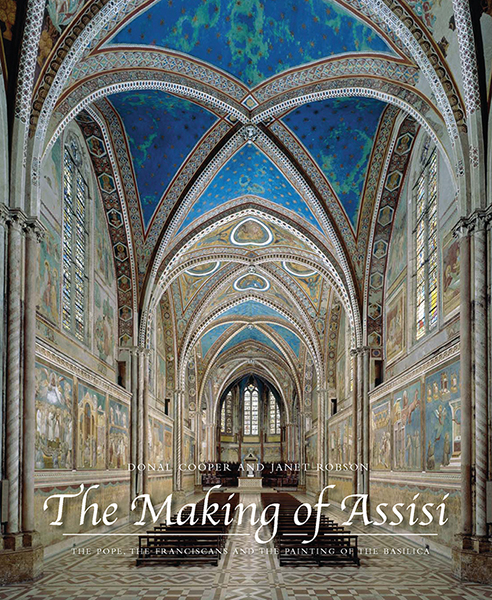
‘The making of Assisi’ explores the history behind and meaning of the famous cycle of frescoes from the upper Church in the Basilica in Assisi
The Making of Assisi
The Pope, the Franciscans, and the Painting of the Basilica
By Donal Cooper and Janet Robson
Yale University Press 2013
ISBN: 9780300195712
REVIEW:
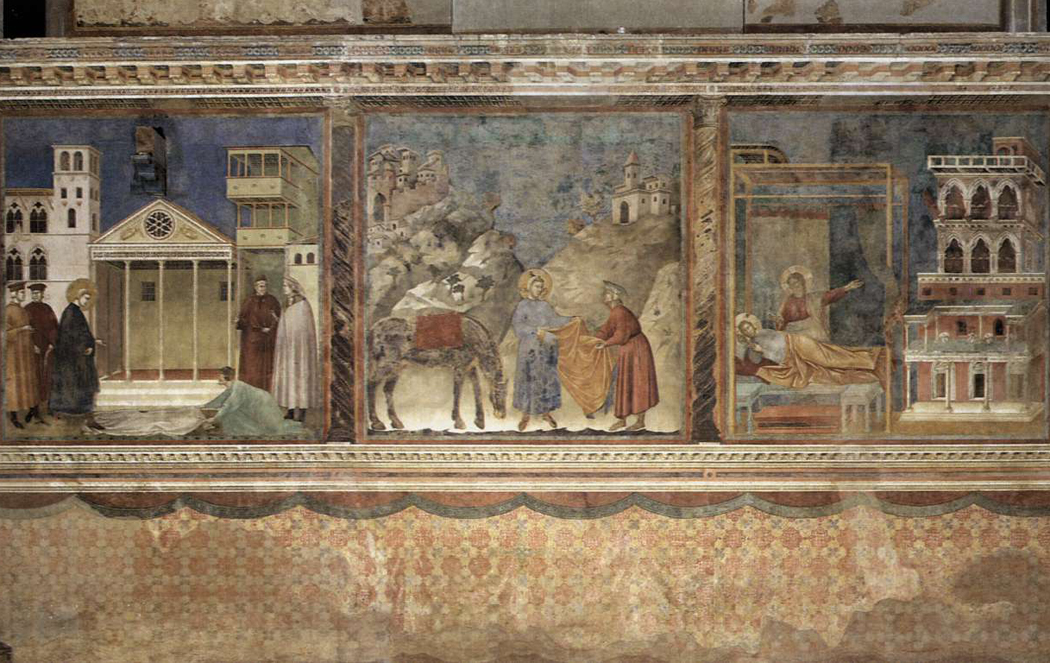
Putting to one side the long debate about whether the Saint Francis cycle was or was not painted by Giotto, a recent art-historical book, The Making of Assisi undertakes to treat this cycle of paintings as part of a larger, integrated, and far-reaching program of renewal at the Basilica. As a visualization of the interlocked lives of Christ and saint Francis, it simply came to serve as a very compelling official statement as to what the life as a proper Franciscan was all about. Having visited the basilica and feasted the eyes on these frescoes it became – then as now – compelling to follow in their footsteps.
Any art historian might feel tempted to ascribe these wondrous feelings as results of the fact that the frescoes are simply some of the most compelling art ever painted. Hence the seemingly never-ending quest to identify the “artist in charge”. This book, however, presents us with a slightly different angle on what is at stake here. By presenting us with detailed explorations of the role of possible patrons, the prior decorative elements like panels, glass- and wall-paintings are documented and the practical challenges the painters were met with, having to integrate the upper circle of biblical scenes with those below telling the story of St. Francis and his companions.
However the book is primarily concerned with the meaning of the frescoes in the upper church – the system of thought, whereby St. Francis was aligned with the prophets of the Old Testament and considered the fundamental renovator of the church. This was especially done through the emphasis upon the stigmatization, seen as mirroring the Pascal redemption of the Lord.
This visual programme thus mirrored a distinct theology displayed and unfolded in a number of diverse texts: biblical glosses, devotional texts, theological tracts, sermons and papal bulls; in short the stuff which more and more came to fill up the breviaries of the ordinary Franciscans working in the hastily growing cities and towns all over 13th and 14th century Europe. How to actively approach this job and at the same time perfect a more contemplative life-style is vividly presented here and must have served to invigorate the friars, who travelled to Assisi in 1295 in order to attend the general chapter. It was first later the call to juggle these two lifestyles broke into the vicious and open fight between the so-called conventuals and spiritualists, which led to the de fact splintering of the Franciscan Movement.
This is a sumptuous book, lovely to look at and inspiring to read. But it is more than that: because of its detailed exposition of the central visual programme in the Basilica in Assisi, the book is able to serve as an artistic sound-board for the historians working on getting a better grip on what for more than a hundred years has been posed as the “Franciscan Question” – who was the man behind the myth? This book does not answer this question in any way. Nor does it claim to do so. What it does, is rather to present us with a fascinating read about how the Franciscans in the late 13th century went about having their official take on the myth painted, thereby creating a very particular and evocative version of what the good Franciscan life ought to be – Christlike, yet practically immersed in the business of renovating the church.
In this deeply researched, illuminating, and beautifully illustrated book, Donal Cooper and Janet Robson investigate the particular historical moment in which the frescoes were made, casting new light on their patronage, iconography and underlying theology.
Karen Schousboe
ABOUT THE AUTHORS:
Donal Cooper is an associate professor (lecturer) in the History of Art Department, University of Warwick. Janet Robson is an independent scholar.
READ MORE ABOUT THE FRANCISCAN QUESTION:
Very Early Life of St. Francis of Assisi Discovered


