


In the 11th century Léon in Northern Spain became the capital in a kingdom united by a marriage between the Castilian Count, Fernando I, and Sancha, heir to the Léonese crown.
From Léon decisive inroads into El-Andalus were carried out establishing a future powerbase for the events in the later Middle Ages. Due to these successful military campaigns a veritable flood of wealth in the form of tribute from the Muslim Taifas, furnished the royal family with means to embellish their churches, monasteries and not least their treasuries.
Internationally this resulted in a yearly donation to the Monastery in Cluny, which was a significant contribution to the erection of the largest basilica at that time, Cluny III. For which sums, incidentally, Fernando succeeded in buying the same extraordinary commemoration within the Cluniac liturgy, which was accorded the Holy Roman emperors and empresses.
At home in Léon (and elsewhere) the royal couple initiated the construction of a new palatine church and the foundation of a royal pantheon in Leon. This was part of the same penitent project securing a distinct royal aura as well as salvation for the royal couple in their afterlife. The complex (part of a royal palace) was one of the first pieces of Romanesque architecture in Northern Spain. Originally dedicated to John the Baptist, it was renamed San Isidoro, when Fernando succeeded in capturing the remains of the Visgothic saint in Seville to have them translated to his new royal church in 1063.
On the day of dedication of this new church, Fernando and Sancha donated a veritable treasure to embellish its furnishings: The list included a gold altar frontal encrusted with emerals and sapphires, three silver altar frontals, three golden votive crowns of the regalia type ( one of which was the personal cerown of Fernando), a chalice and paten of gold and gems, two gold censers and a gold cross studded with jewels and enamels. Other luxury items were also mentioned, e.g. Islamic textiles.
Only one of these fabulous pieces of art – an Ivory Cross – is still in existence, but others might be mentioned in order to give a sense of the overwhelming wealth, the royal couple donated.
Reliquary of Saint Isidore
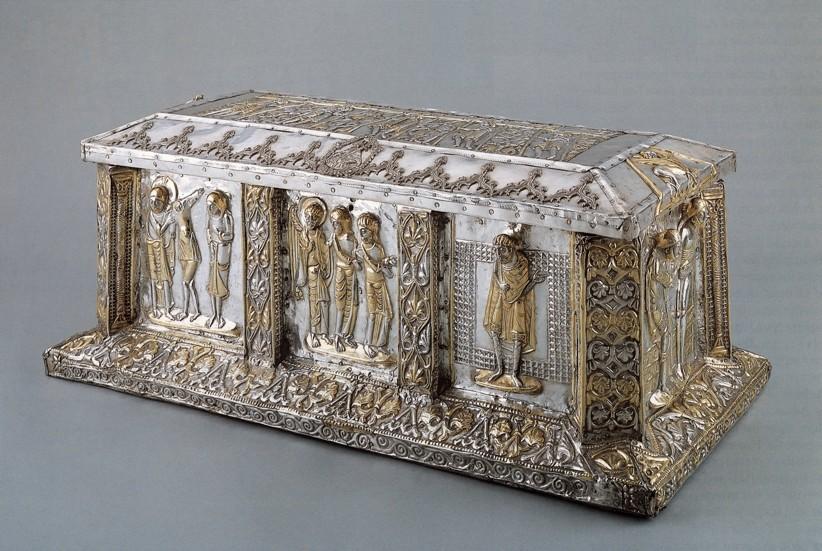
In 1063 the relics of Saint Isidore arrived in Léon. Soon after they were deposited in a small silver casket, measuring 33 x 81 x 44 cm. As it stands today it bears the mark of a heavy restoration undertaken in the middle of the 19th century of what was left after the destruction of the Napoleonic army in 1808.
The casket is made of wood, covered with silver gilt sheets with narrative scenes, of which two has been lacking since the Napoleonic Wars. The exact sequence of the scenes is not quite known. The five scenes in repoussé illustrate episodes from Genesis – the creation of SAdam, the temptation of Adam, the accusation of Adam, the robing of Adam and Eve plus the expulsion from Paradise. Lacking are the naming of the animals and the creation of Eve. On the front is a bareheaded figure, which is believed to represent the donor, Fernando I of Leon in a penitential posture. It is believed this figure was originally placed on the lid of the casket and accompanied with one of his wife, Sancha.
The scenes recall a similar set of narratives on the bronze doors in Hildesheim and the inscriptions are written with a Carolingian and not Visigothic script. The goldsmith presumably belonged to a group of artists recruited via the Cluniac network.
The casket is lined with two different fabrics. One of these of silk with a near- Eastern design is believed to be of Tunisian extraction; the other is embroidered with silk in split and couching stiches, comprising rows of squares filled with birds and animals. The reliquary is exhibited in the treasury of Real Colegiata de San Isidoro, Léon.
Ivory Cross with the Effigy of the Crucified Lord
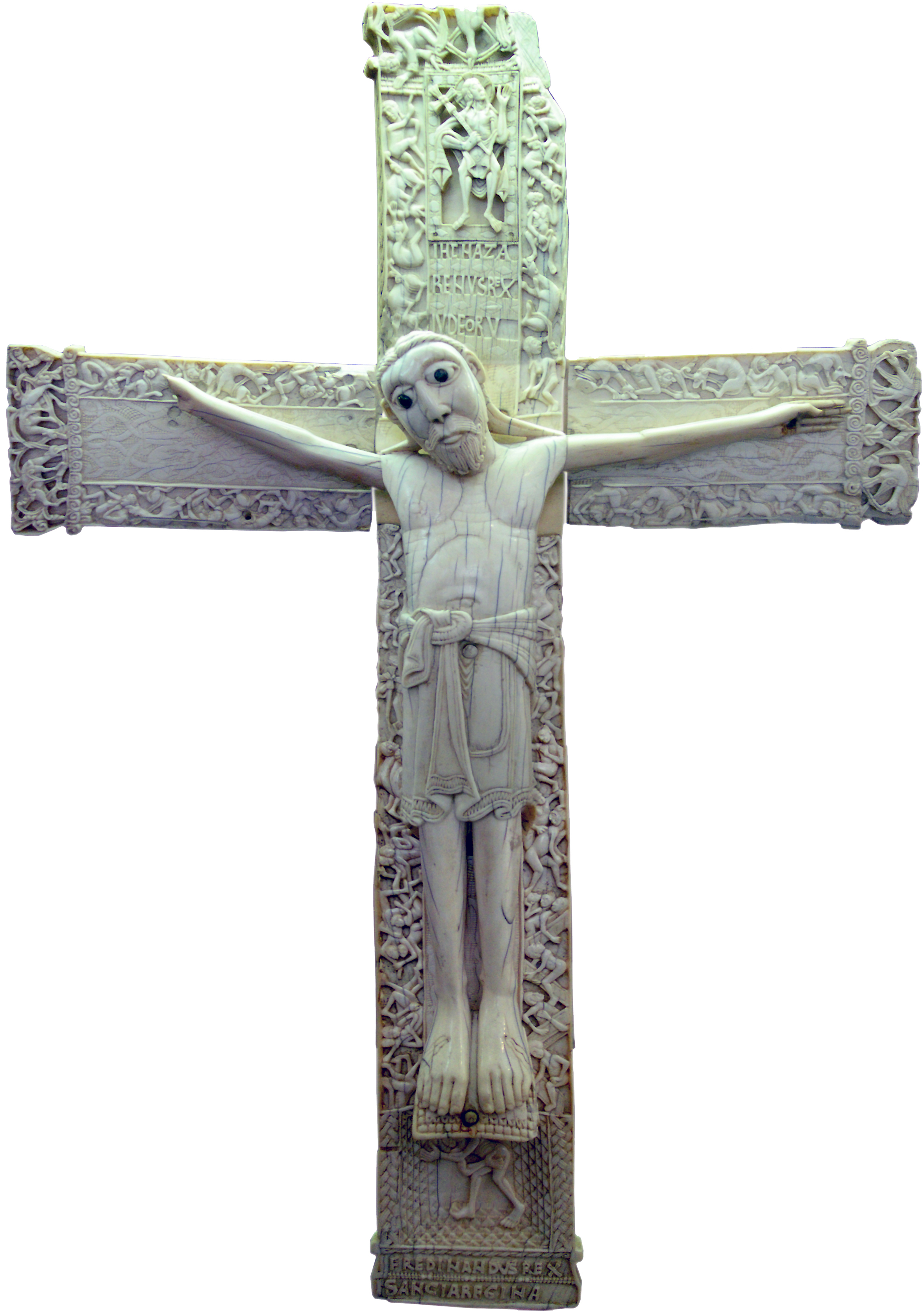
Until 1869 this cross of Ivory, believed to be one mentioned in the list of donations from 1063, was preserved in the treasury of San Isidoro. The royal couple’s names are inscribed at the foot of the cross – FERDINANDVS REX SANCIA REGINA.
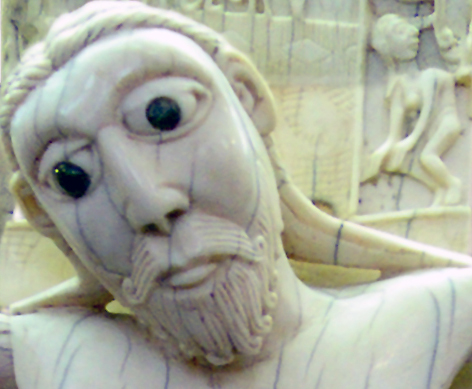
Traces of gold can be seen in the crevices on the front. On the back there is a small cavity, which presumably held a splinter of the real cross. The remarkable feature is the figure of the crucified Christ, which is something quite different from earlier crosses. The theme of death and resurrection in the delicate carving is perhaps a witness to the penitence of the Royal couple approaching their death (as is the inclusion of the Mozarabic Liturgy of death included in his still existing prayer-book). Another curious fact is the inhabited scroll on the backside filled with souls crawling from hell to heaven or fallowing down in the opposite direction. The scroll mirrors a Northern aesthetic found on the small Viking box made of walrus and perhaps a diplomatic gift acquired in Quedlinburg in the mid 10th century (also in the treasury in léon). Notice also the long hair and beard of Christ, identical with the hairstyle sported by Fernando on the reliquary of San Isidoro. Other carvings generally show barefaced priests and monks. This Christi is a reigning king, curiously enough lacking the crown of thorns. Perhaps it was originally outfitted with a golden crown like the one, which may be seen in the dedication page in the personal prayerbook, which belonged to Fernando. The cross is exhibited in the Museo Arquelógico Nacional, Madrid (852.340)
SOURCES:
The Grove Encyclopedia of Medieval Art and Architecture: Vol. 2, p 15.
Oxford University Press, 2012
The Art of Medieval Spain A.D. 500 -1200
The Metropolitan Museum of Art 1993
READ MORE:


