


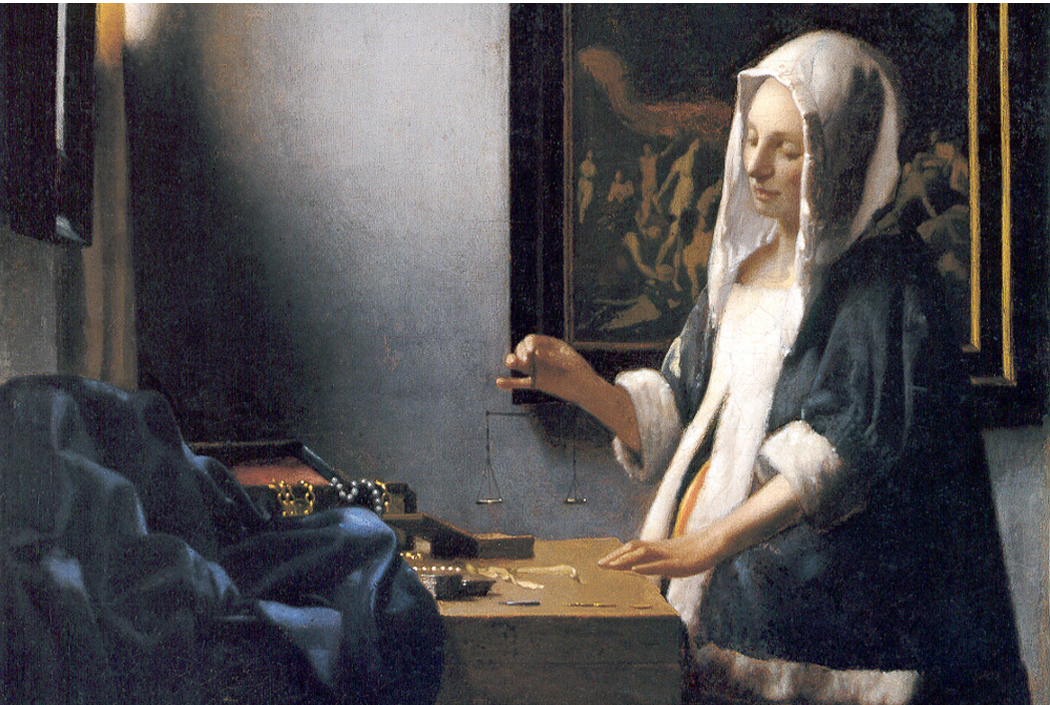
Drawing on the latest scholarship from international researchers, a new dedicated collection investigates how medieval and early modern Europeans understood and articulated emotions
No wonder we have in the last twenty years witnessed a regular renaissance of emotion as a topic of not only psychological research, but also as a subject of interest for archaeologists, historians, linguists, literary scholars, theologians, anthropologists etc.
Inside medieval studies this occasioned ‘pleasure’ to be the thematic strand at the International Medieval Congress in Leeds in 2013, where a number of pioneers inside the field were celebrated, especially Philippa Maddern from Australia, who was the founding director of the Australian Research Council Centre of Excellence for the History of Emotions, Europe 1100-1800. Sadly she passed away in 2014.
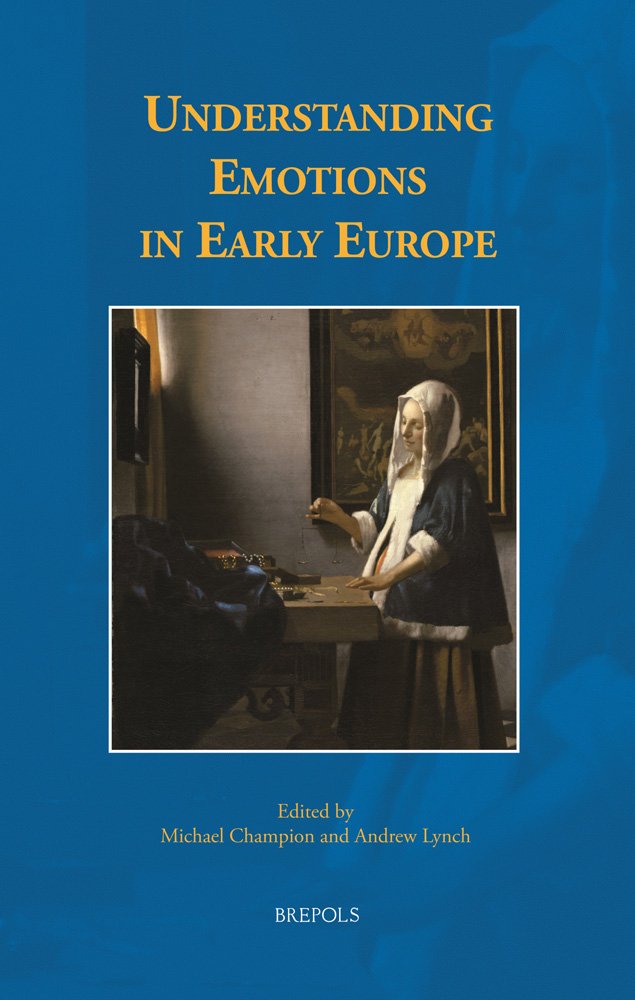
However, scholars in Australia has carried on her work and expanded upon it by deliberately trying to do it from an interdisciplinary perspective. The latest outcome of this work is a collection of studies exploring how medieval and early modern Europeans constructed, understood and articulated emotions ed. by Michael Champion and Andrew Lynch, both teaching at the University of Western Australia.
Understanding Emotions in Early Europe
Ed. by Michael Champion and Andrew Lynch
Series: Early European Research (EER 8)
Brepols 2015
ISBN: 978-2-503-55264-4
ABSTRACT:
This book investigates how medieval and early modern Europeans constructed, understood, and articulated emotions. The essays trace concurrent lines of influence that shaped post-Classical understandings of emotions through overlapping philosophical, rhetorical, and theological discourses. They show the effects of developments in genre and literary, aesthetic, and cognitive theories on depictions of psychological and embodied emotion in literature. They map the deeply embedded emotive content inherent in rituals, formal documents, daily conversation, communal practice, and cultural memory. The contributors focus on the mediation and interpretation of pre-modern emotional experience in cultural structures and institutions — customs, laws, courts, religious foundations — as well as in philosophical, literary, and aesthetic traditions.
This volume thus represents a conspectus of contemporary interpretative strategies, displaying close connections between disciplinary and interdisciplinary critical practices drawn from historical studies, literature, anthropology and archaeology, philosophy and theology, cognitive science, psychology, religious studies, and gender studies. The essays stretch from classical and indigenous cultures to the contemporary West, embracing numerous national and linguistic groups. They illuminate the complex potential of medieval and early modern emotions in situ, analysing their involvement in subjects as diverse as philosophical theories, imaginative and scholarly writing, concepts of individual and communal identity, social and political practices, and the manifold business of everyday life.
Table of Contents
Introduction: Understanding Emotions: ‘the things they left behind’ — MICHAEL CHAMPION and ANDREW LYNCH
Intellectual Traditions
- From Regret to Remorse: The Origins of a Moral Emotion — DAVID KONSTAN
- Representing Emotions in Three Byzantine Orations of Michael Psellos — MICHAEL CHAMPION
- ‘Tears such as angels weep’: The Evolution of Sadness in Demons — JUANITA FEROS RUYS
- Emotional Strategies in the Early English Lyric — DANIEL ANLEZARK
Literature
- ‘What Passion cannot Musick raise and quell!’ The Pindaric Ode and the Musical Sublime in the History of Emotions — MIRANDA STANYON
- Embodied Emotion, Conceptual Metaphor and the Aesthetics of Reading Old English Poetry — ANTONINA HARBUS
- Guinevere as ‘Social Person’: Emotion and Community in Chrétien de Troyes — ANDREW LYNCH
- Positive Emotion in the Thirteenth Century: The Emotional World of Goswin of Bossut — JENNIFER CARPENTER
- Decoding the Emotions in Aphra Behn’s and Anna Maria Falconbridge’s Travel Narratives — MARGARETE RUBIK
Social History and Material Culture
- Fear, Gender and Violence in Early Modern Ireland — DIANNE HALL
- Fear of Crime in Eighteenth-Century London — ROBERT SHOEMAKER
- Reality and Ritual in the Medieval King’s Emotions of Ira and Clementia — PENELOPE NASH
- Affective Bequests: Creating Emotion in York Wills, 1400–1600 — LISA LIDDY
- ‘Memento mori’: Love/Fear of and for the Dead amongst Early Homo sapiens: Archaeological Approaches — SANDRA BOWDLER and JANE BALME
Notes on Contributors
Dr Michael Champion is Lecturer Classics and Ancient History
Professor Andrew Lynch is Professor English and Cultural Studies
Read More:
Australian Research Council Centre of Excellence for the History of Emotions, Europe 1100-1800


