


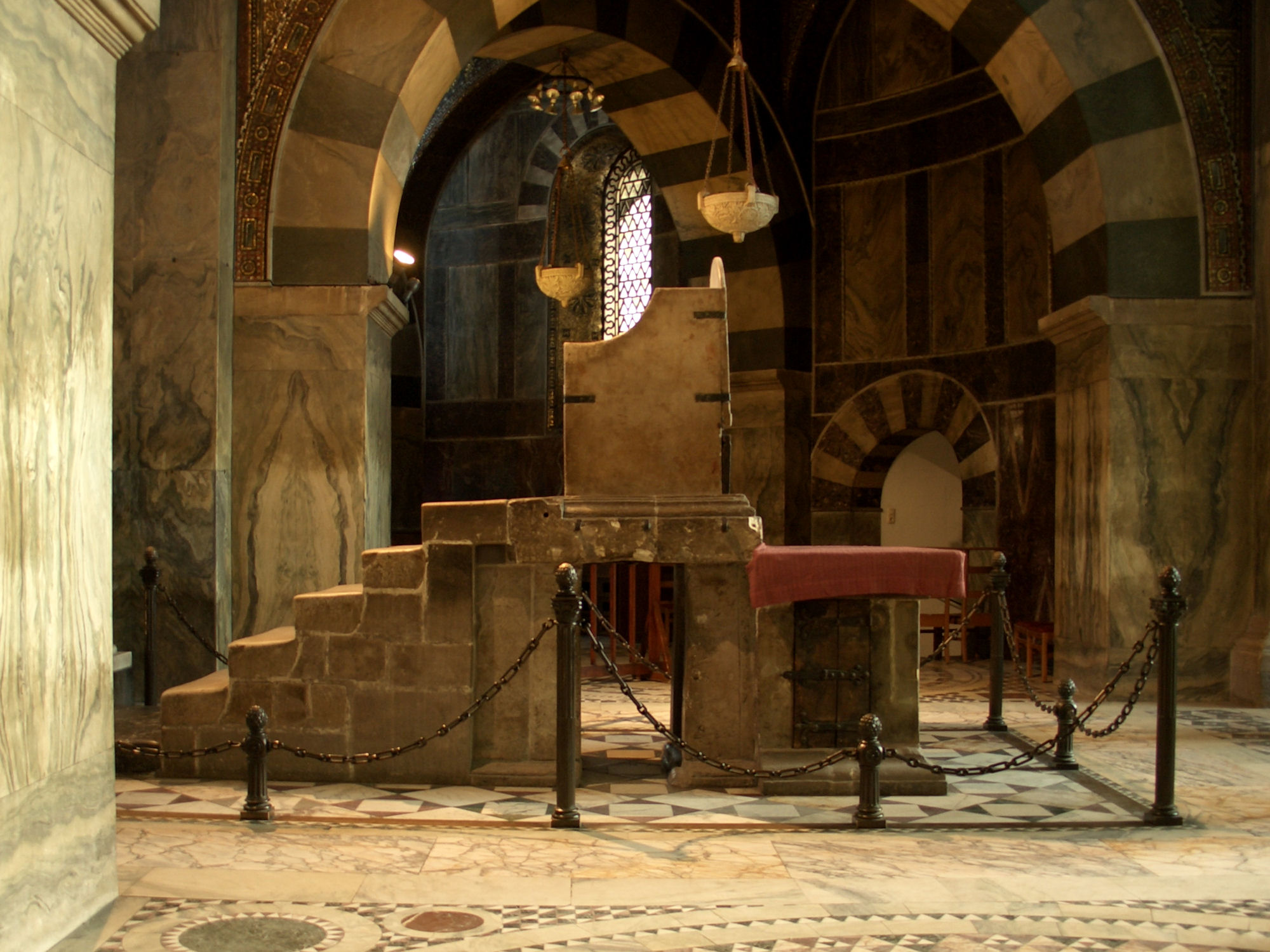
The throne of Charlemagne may still be seen in the Cathedral in present-day Aachen. New research presents an overview of other Carolingian thrones and argues the existence of a parallel in a palace in Mainz
The armrest of a Carolingian throne from Mainz. A revision of the interpretation of the disputed stone slab with tendril ornaments from the Stadionerhofstraße [Eine karolingerzeitliche Thronlehne aus Mainz. Erneut zur Deutung der umstrittenen Steinplatte mit Rankenreliefs aus der Stadionerhofstraße]
By Mechthild Schulze-Dörrlamm
In: Archäologisches Korrespondenzblatt 2014, Vol. 44 No. 1
ABSTRACT
The fragment of a limestone slab with tendril reliefs discovered in 1911 in the Stadionerhofstraße of Mainz has hitherto been considered the armrest of a throne. This conclusion was recently published by Mechthild Schulze-Dörrlamm in connection with an article about Carolingian Mainz in a German publication: Mainz im Mittelalter [1]
However E. Tóth [2] recently interpreted the find as the remains of an oblong »Pannonian« table top from the 2nd – 3rd century characterised by a short end with a segment in the shape of a small half or three quarters circle and a roughly hewn back side. But the Mainz slab does not only differ in the unusual size of the segment and the unique relief decoration on its inner edge, but also in a perfectly smooth edge which served as stand/floor space. Due to its shape and the spiral tendril reliefs on its upper edge (middle to second half of 8th century) it must, however, rather be the armrest of a throne with a quadrant segment dating to the Carolingian period.
As part of a stone – and therefore immobile – royal throne resembling the emperor’s throne in Aachen, it is archaeological evidence for the existence of an imperial palace of Charlemagne in Mainz. This palace seem to have been located directly next to the present Cathedral.
The article presents this interesting find in details and contextualize it by discussing a number of other extant “thrones” like for instance the throne from Conques on which a statue of St. Fides is sitting. The article demonstrates that the throne must be Carolingian insofar as it does not look like the traditional Cathedrae as they are known from early medieval churches in for instance Santi Luca et Martina in Rome (from the time of Honorius 1 (AD 628 -635).
[1] Mainz im Mittelalter. By Mechtil Dreyer and Jörg Rogge (editors). Verlag: Philipp von Zabern. 2010 pp. 17 – 33
[2] Römisch oder karolingisch? Zu einer Steinplatte aus Mainz. In: Archäologisches Korrespondenzblatt 2013, pp. 553 – 567
Due to copyrights it is not possible to show the actual reconstructed throne here. But it may be viewed in the article


