


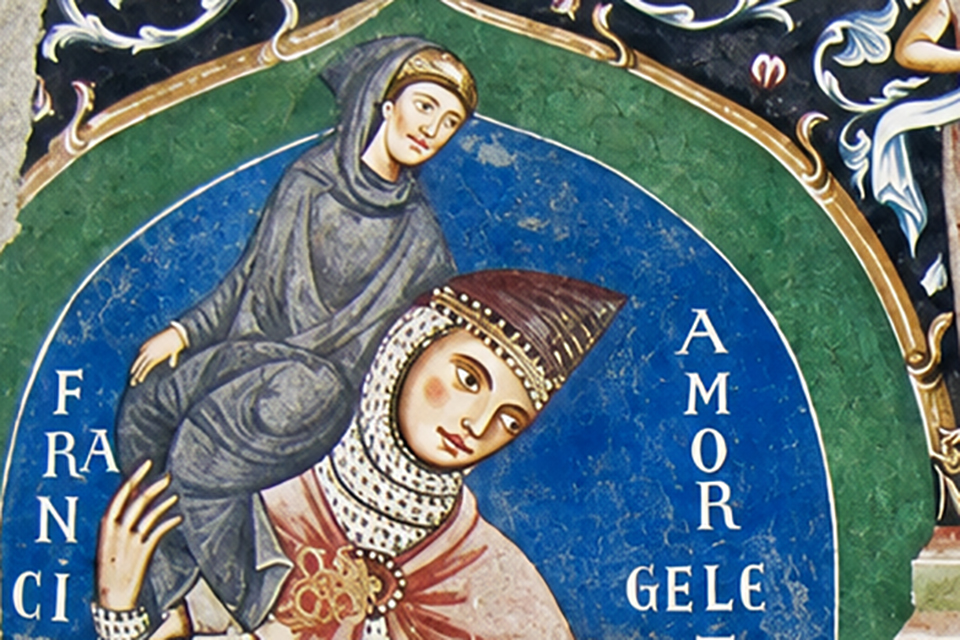
How did the man remembered by Thomas of Celano become the instantly recognisable St Francis of medieval art?
Few medieval people are as immediately recognisable as St Francis of Assisi. The rough habit, cord, tonsure and wounds of the stigmata have become a visual shorthand for the saint. Yet Francis died in 1226, before this familiar image had fully taken shape. The earliest texts and paintings allow us to follow something rather more interesting: how memories of an individual man were gradually transformed into the image of a saint. So the question is: What did St Francis look like?
What did St. Francis really look like?

Thomas of Celano, who wrote the first official Life of Francis in 1228–29, described him as a man of moderate height, tending towards shortness, with a rounded head, somewhat elongated face, small forehead, dark eyes and dark hair. His nose was straight and slender; his ears small but prominent; his beard black and rather sparse. He had short arms, slender hands, long fingers and small feet. But Celano was not writing a modern physical description. Francis’s appearance forms part of a portrait of the whole person: his voice, gestures, intellect, temperament, manner towards others and extraordinary ability to adapt himself to whomever he met. Thomas’s Vita prima is generally dated to 1228–29 and was produced following Francis’s canonisation. The Bibliothèque nationale de France dates the first version work to 1229
The complete Latin passage, together with an English translation, can be read here:
Was Francis really very short?
Celano does not give a measurement. His phrase is statura mediocris parvitati vicinior: of moderate stature, tending rather towards shortness. The conclusion that Francis measured approximately 152–153 cm derives from later examination and reconstruction of the remains preserved at Assisi. They should therefore be distinguished from Celano’s near-contemporary written testimony. That distinction matters. One source tells us how Francis was remembered shortly after his death; another attempts to reconstruct the physical body many centuries later.
Did Francis wear a tonsure?
The answer is probably yes – but not necessarily the large, conspicuous tonsure familiar from later images. Francis was not a monk. He was, however, at some point ordained a deacon, and a later anecdote in Thomas of Celano’s Second Life tells how Francis warned the barber cutting his hair not to make his corona too large. He wanted, he said, his “simple brothers” to have their share in his head (= be part of his leadership). This anecdote is revealing, but it belongs to a later layer of Franciscan memory. Celano’s Second Life was written in the 1240s, roughly twenty years after Francis’s death. It therefore cannot simply be used as proof that every early image showing Francis with dark hair or a relatively full hairline must be incorrect.
Is there a genuine portrait of St Francis?
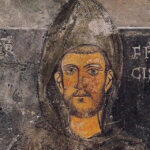
Several early images have been treated as if they might preserve Francis’s actual appearance. None can securely be described as a portrait taken from life. The fresco at the Benedictine monastery of Subiaco is often singled out because of its early date and unusual appearance. Francis is shown without the fully developed iconography familiar from later Franciscan art. But the painting has been restored and its original date and identity have long been debated. The problem illustrates a wider difficulty. An early image is not necessarily a portrait, and an apparently realistic image is not necessarily early. What matters is to establish when an image was painted, what alterations it has undergone, and what visual conventions were available to the artist.
When does the familiar St Francis appear?
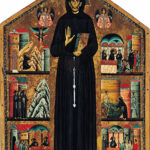
One of the crucial surviving works is the painted panel signed and dated 1235 by Bonaventura Berlinghieri in the church of San Francesco at Pescia. Only nine years after Francis’s death, the saint is here depicted standing frontally in the centre of the panel, surrounded by scenes from his life and miracles. The work already presents Francis not simply as a remembered individual, but as the centre of a carefully constructed visual narrative. Layer, this design was copiously adopted by other artists. This panel is particularly important because it is securely dated. In discussions of early Franciscan imagery, that makes it a firmer chronological anchor than paintings whose dates depend largely upon stylistic judgement.
- The University of Michigan records the Pescia panel and its scenes here
- Read here for a useful introduction to the painting and its visual form:
When did the stigmata become part of Francis’s image?
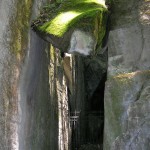
According to the Franciscan tradition, Francis received the wounds of Christ at La Verna in 1224. The stigmata quickly became central to Franciscan understandings of the saint, but their visual representation did not appear in one fixed form overnight. The Pescia panel of 1235 already represents the stigmatisation and shows the wounds on Francis’s body. Later artists developed increasingly explicit ways of connecting the seraph, the wounds and Francis’s transformation into an image of the suffering Christ. The history of these representations therefore concerns more than artistic convention. The body of Francis itself was becoming a theological argument.
Why was Francis called a jongleur?
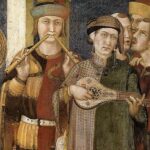
The image of Francis as a performer is another important part of the tradition surrounding him. Francis and the early brothers preached through gesture, song, bodily performance and deliberately unconventional behaviour. Later Franciscan sources remembered him through the language of the ioculator or jongleur – the travelling entertainer who performed through speech, music and gesture. This was not merely picturesque language. Francis communicated through his body. His clothing, poverty, gestures, movements, voice and behaviour were themselves signs. Long before Francis became a painted icon, he had made himself visible through performance. That helps explain why the transformation from remembered man to recognisable image happened so rapidly.
Did the images change the way Francis was remembered?

Almost certainly. A living person is inconsistent. He can change clothes, alter his appearance, behave differently in different circumstances and will be remembered differently by different people. A saint needs to be recognisable. During the decades after Francis’s death, painters and Franciscan writers increasingly selected particular features through which he could be identified: the habit, cord, tonsure, slender face and above all the stigmata. What had once been an unstable collection of memories gradually became a visual code. Yet, the process did not erase Francis the man completely. But it reorganised him. The cheerful face, resonant voice, black hair, small feet and quick intelligence described by Celano receded behind the signs by which Christians throughout Europe could recognise St Francis at a glance. Later, in the 20th century, scholars and historians worked to “reexcavate” the real man.
How quickly did this iconification of St. Francis happen?
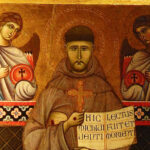
Remarkably quickly. Francis died on 3 October 1226 and was canonised in July 1228. Thomas of Celano’s first official Life followed in 1228–29. Within less than a decade of Francis’s death, Bonaventura Berlinghieri’s dated panel at Pescia already presented the saint through a sophisticated combination of iconic image and narrative scenes. The process continued throughout the thirteenth century as biographies, legends, liturgy and visual art interacted with one another. Francis therefore offers an unusually well-documented opportunity to watch a medieval saint being made. Not invented – but selected, interpreted and transformed.
Explore further
The Essay: From Jongleur to Icon: The Making of St Francis
The Source: Portrait of St Francis of Assisi – Thomas of Celano
Latin text and English translation of Celano’s description of Francis:
Modern Biographies: A guide to some of the most important modern attempts to recover the historical Francis behind the accumulated traditions:
External Resources
- Thomas of Celano, First Life of St Francis, selected passages
- Bibliothèque nationale de France, record for Thomas of Celano’s Vita beati Francisci
- Bonaventura Berlinghieri’s St Francis panel at Pescia, University of Michigan
- Introduction to the Pescia panel, Smarthistory
- Paroma Chatterjee, The Living Icon in Byzantium and Italy, reviewed in The Medieval Review
Three Books to Start with
- Francis of Assisi. The Life and Afterlife of a Medieval Saint. By André Vauchez. English translation. Yale 2012.
- Francis of Assisi. A life. By Chiara frugoni. Continuum 1998
- Francis of Assisi: The Life of a Restless Saint. By Volker Leppin. Yale 2025


