


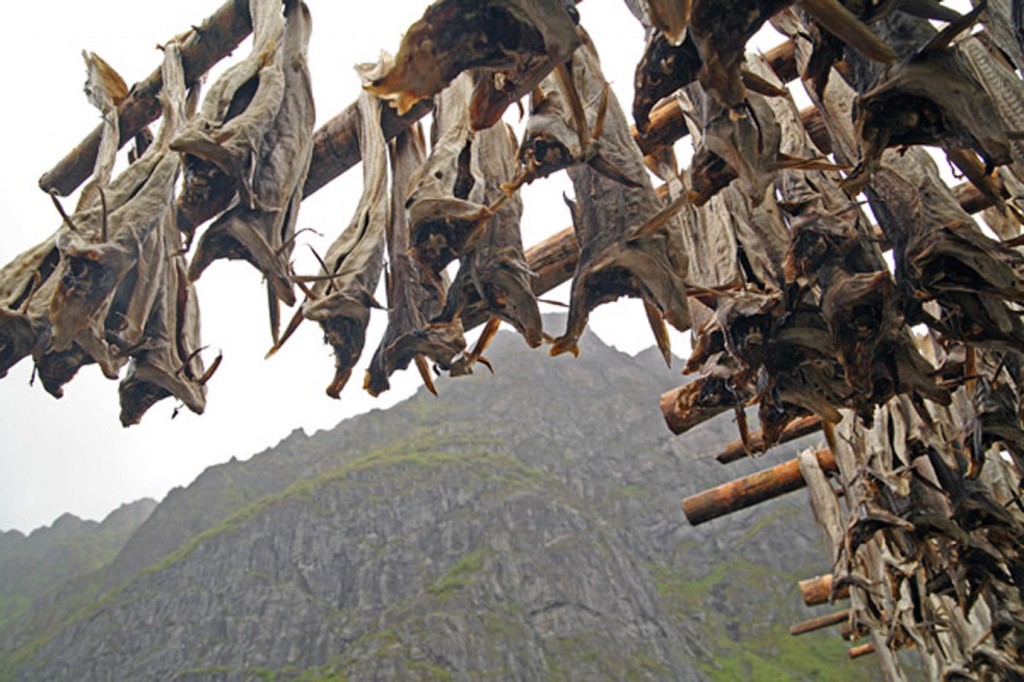
When marine fisheries developed around the year 1000 AD, cod quickly came to play a crucial role
Marine fisheries caught on around the year 1000 AD, when new technologies were introduced. Very soon cod came to play a crucial role in supplying the cities around the Baltic and North Sea with fish to feed their growing populations. However the source was primarily local until 1225 AD, new research tells us:
Fish for the city: meta-analysis of archaeological cod remains and the growth of London’s northern trade
By: David C. Orton, University College London, James Morris, University of Central Lancashire and Museum of London, Alison Locker, Escaldes-Engordany, Andorra and James H. Barrett, University of Cambridge.
In: Antiquity. 2014, Vol. 88, No. 3, pp. 516 -530
ABSTRACT
When marine fisheries caught on around the year 1000 AD, cod very quickly came to play a crucial role in supplying the cities around the Baltic and North Sea with fish to feed their growing populations. To what extent this so-called ‘Fish Event Horizon’ was fuelled by growing urban populations in the burgeoning medieval cities around the millennium is difficult to decide; or whether perhaps changed practices concerning fasting were behind the shift. Another driving factor may simply have been the introduction of more sea-worthy ships with larger hulls.
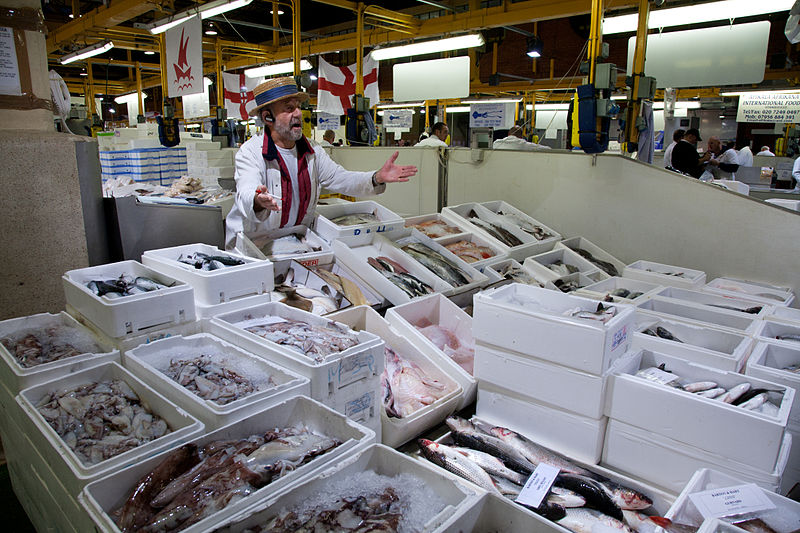
Whatever the causes, recent isotopic studies of cod bones from diverse settlements in England and Flandern have shown that the ‘initial’ cod brought to market came from local waters. It was first later that the more grandiose grand-scale trade began to play a role. The question, however, is what the extent of this far-flung professional fishing industry and trade was? And when it more specifically took off.
One challenge here is that the role of trade in medieval marine resources cannot be followed through tolls, since accounts do not reach so far back making it possible to measure the shifting trends and the general oscillations during longer periods.
To get a more precise picture of these shifts a research group of zoo-archaeologists and scientists have quantitatively studied the remains of fish-bones from cod in London. The point is that cods are typically decapitated before hung out to dry in order to be exported later. The relative abundance of cranial and post-cranial bones in a given context is thus a reliable measure of how far the cods have been sourced. Local fresh cod brought to market has heads on. Fluctuating frequencies of cranial bones and vertebrae might thus give an understanding of the ups and downs of this international trade.
In this ground-breaking study the finds from 91 archaeological sites in London have been counted and the relative abundance of cranial bones, vertebrae and Cleithra have been estimated during the period from 800 to 1800.
Main results are that marine sourcing of fish takes off around 975 – 1000. Until around 1200 this fish is sourced locally. Around 1225 a vigorous international trade in dry cod is obviously evolving. This is both demonstrated through a quantitative measurement of the relative abundance of the different types of fish bones, but also through isotopic analysis of the sourcing.
A certain dip is noticeable from 1350 to 1450, after which it takes off again. A maximum is reached around 1500. Of course these results are tentative. Much depends on the actual method used to procure the different samples and the authors warn that “changes in the overall frequency should…be treated with caution, although the sheer concentration of research in London means that they are likely to be informative in broad terms” (p. 522 – 523).
Unfortunately it is not possible to map differences between cods from the different North Atlantic fisheries – North of Scotland, Iceland or Newfoundland. Thus it is not possible to come to a conclusion as to when fishing in the waters off America was de facto introduced. (Hopefully this will be possible in the future, writes the authors).
It is possible that one reason for the increased sale of cod simply was an “increase in demand for preserved cod – whether for reasons of longevity or quality”. However, the conclusion is that the initial expansion of marine fishing AD 1000 was driven by demand and/or the introduction of new technologies. However, the rather sudden shift away from locally sourced fish around 1225 seems rather to be the result of Scandinavians (or seafaring English and Sscottish fishermen) pushing to market.
One conclusion, which the authors lead up to, but do not draw, is what happened to the local fishermen around 1225, when the demand for locally sourced fish seemed to dwindle? In fact we do know that they later set sail for Norway and Iceland, thus proving as the often enough repeated talk about a millennium long “tradition” for local and traditional fishing communities in the English Channel as somewhat romantic. The local fishermen may operated along the coast since 1000 AD, but not without suffering from competition from marine fishing on a very grand scale post 1225 AD. This is something, which needs to be investigated in view of this groundbreaking study.
The article is Open Source and may be enjoyed freely. Highly recommended!
READ MORE:
Save
Save
Save
Save
Save


