


Medieval urban landscapes are often seen reflecting the top-down intentions of the secular or religious powers in whose shadows the markets and industries grew. New research sheds light on the process from bottom-up.
Research: Ben Jervis, Kate Autumn Evetts, Benjamin Morton and Joe Chick, Industry and Medieval Urban Landscapes: Archaeological and Historical Evidence from English Small Towns c. 1200–1550”, The Antiquaries Journal, first published online 10 November 2026, pp. 1–50. Open access, CC BY 4.0.
We are used to zoom in on cathedrals, castles and walls when trying to understand the urban medieval landscapes. Beneath these formal topographies of power, however, “small” people bustled about getting ready for a day’s work as craftspeople, tradesmen and merchants while setting their mark on the different zones dedicated to different types of workspaces.
New interesting research by Ben Jervis, Kate Autumn Evetts, Benjamin Morton and Joe Chick into the industries of medieval English small towns suggests a much less orderly geography of work than the familiar image of streets occupied by single trades. Workshops, homes, waterways and marginal ground belonged to one interconnected economic landscape which was much more diverse than we normally think.
Where Medieval Towns Worked: Industry in the Streets, Houses and Margins of England
The medieval town was never simply a collection of houses surrounding a marketplace. It was a working landscape in which smoke, heat, animal skins, water, waste, raw materials and finished goods continually crossed the boundaries between domestic and commercial life. Yet that landscape can be surprisingly difficult to reconstruct. Documentary sources may identify the occupation of the head of a household without recording the work of other family members, while archaeological excavations reveal buildings, hearths and industrial residues without always establishing precisely who used them. It is this uneven evidence that Ben Jervis, Kate Autumn Evetts, Benjamin Morton and Joe Chick bring together in a new study of England’s smaller towns between about 1200 and 1550.
Their central question concerns space. Where did production take place? Were industries concentrated in particular neighbourhoods, and what determined those locations? How did local geography and institutions influence the relation between work and urban growth? Instead of beginning with the better-documented guilds of major cities, the authors work through the often-fragmentary archaeology of smaller settlements, supplementing it with previously unpublished evidence from escheators’ inventories. The resulting account suggests that medieval industrial organisation was neither universally specialised nor rigidly zoned in terms of the wider urban space. So-called shophouses and hall-houses intermingled.
Working at home

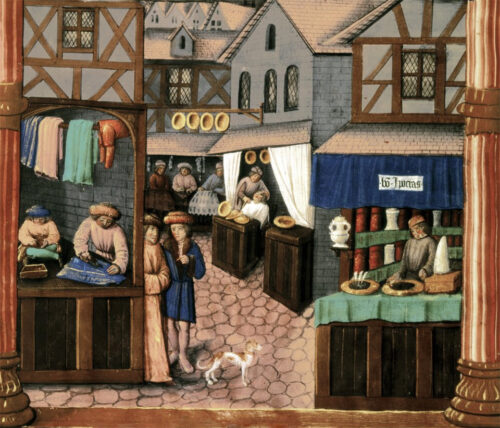
One of the strongest findings concerns the importance of the household as an economic unit. Baking, malting, processing agricultural produce, leather-working and metal-working could all occur within domestic plots. Archaeological ovens inserted into existing buildings suggest that changing domestic arrangements might accommodate production for sale, though an oven alone cannot prove a commercial enterprise. The authors point to households whose inventories contained equipment and materials associated with productive work, reminding us that a residence could also be a storeroom, workshop and place of exchange.
At Wisbech, for instance, the complicated history of a property affected by repeated flooding is especially revealing. Occupation deposits and floors span several centuries, but activity-related artefacts are sparse, possibly because domestic waste was routinely removed. During a later phase, material from copper-alloy and iron working was incorporated into part of a building, with a spatial distinction between industrial and domestic areas. Here the evidence shows both the value and the limitations of archaeology: it is possible to recognise work and its distribution, but harder to reconstruct the identities or organisation of the workers.
The inventories bring a different scale of observation. John Tyrell, a glover in Cirencester, possessed sixty dried skins and 180 fleeces in 1423–24. Such quantities suggest more than casual household production, yet they do not neatly translate into a modern distinction between domestic and industrial establishments. They illuminate a world in which the physical and economic boundaries of the household remained porous.
Water, waste and urban margins
The second major conclusion concerns the topography of industry. Certain trades had obvious environmental requirements. Tanners, dyers and those retting flax needed water, while pottery kilns, smithies and ovens required space and generated heat or potentially troublesome waste. The authors identify repeated associations between industry and damp, flood-prone land, riverbanks, town boundaries and other peripheral sites.
At Reading, tanning and dyeing occupied parts of the Kennet floodplain. At Doncaster, tanning was concentrated beside the River Don, while evidence for industrial activity along streams and drainage channels appears in Birmingham. Such settings were not simply inferior land abandoned by respectable householders. They could offer essential resources and practical opportunities. Moving goods by water, disposing of waste and obtaining supplies for wet processes were all reasons for locating production beside a river. Nor were all activities relegated to the edges: metalworking could also take place on a commercial street or in a domestic courtyard.
The distinction matters because medieval urban maps can suggest a false separation between the town and its surroundings. Marshy ground, banks, ditches, quays and reclaimed land were not empty spaces waiting to become streets. They participated actively in urban economies. An unpromising site for housing might be highly suitable for a tannery or kiln, while an area close to a market could command advantages of another sort.
Industries depended upon one another
A third pattern is the spatial clustering of related occupations. The production of a knife might require a smith and a worker in bone or other handle materials; fishing involved the making and repair of nets as well as the catching and processing of fish. Such associations did not necessarily arise from a formal guild system. They could result from practical interdependence, shared markets or access to the same resources. This is an important corrective to histories that identify a single dominant trade and treat its practitioners as a self-contained occupational group.
Religious houses and castles could also shape the geography of work. Institutions were consumers, landlords and sometimes producers in their own right. Nevertheless, the authors are careful about causality. Towns possessing important institutions have frequently attracted more excavation, so an apparent connection between monasteries and industrial development may partly reflect where evidence survives. In some places, industrial activity preceded the planned development of house plots; in others, land became available for work as settlement contracted. There is no single trajectory from industrial outskirts to organised town centre.
Methodological reflections
For readers interested in medieval landscapes, the study shifts attention from monuments and street plans to the processes that made towns function. The small English town emerges as an interface between countryside and commerce. Agricultural materials were transformed into food, textiles, leather and manufactured objects; urban households combined production and consumption; and watercourses, reclaimed plots and apparent wastelands helped organise the economy. This also complicates any tidy opposition between rural and urban industry. A smith or potter might work on either side of the boundary; what differed was the balance between crafts, agriculture, markets and institutions as well as the law guarding urban monopolies.
The paper does not claim that all small towns followed one pattern. Indeed, its conclusion is almost the opposite. Industrial organisation varied with local ecology, resources, political circumstances and the history of each settlement. The wider lesson is to ask not merely which trades a medieval town supported, but where their materials came from, which spaces they occupied, which other crafts they relied upon and how the physical landscape enabled their work. An urban history attentive to such questions is also an environmental history.
Micro-topography
What the paper touches upon only marginally is the micro-topography of the living and working spaces of the shop- and hallhouses, in which these people lived, and how they negotiated the balance between working spaces and living spaces. Especially, the employment of permanent stalls appears not to be taken into account.
Hopefully, the next step in this research project is to expand upon the seminal work of Goldberg, who has studied this question by exploring what makes a house a home in medieval York. According to his work, the “basic form of the artisanal house comprised a hall, a kitchen, and one or more upper chambers. Numbers of houses possessed in addition a summer hall or a parlour”. Where the “hall” might be considerede the opening space holding the more or less public workshop with the private area behind holding a kitchen and and upper story with bedrooms.
Karen Schousboe
ABOUT THE AUTHORS:
Ben Jervis is a lecturer in later medieval archaeology, contributing to teaching at undergraduate and postgraduate level. Currently undertaking research into medieval material culture and small towns in medieval England.
Kate Autumn Evetts Is currently working on her PhD preliminarily titled Understanding the Plant Economy of Small Towns in Medieval England (c.1200-1600): A synthetic analysis and interpretation of archaeobotanical evidence
Benjamin Morton is a research associate in Archaeology in the School of Heritage and Culture at the University of Leicester, specialising in the landscape archaeology of medieval Britai
Joe Chick is a Research Associate in Medieval History. His research centres on the history of urban societies in small towns during the later medieval period.
FEATURED PHOTO:
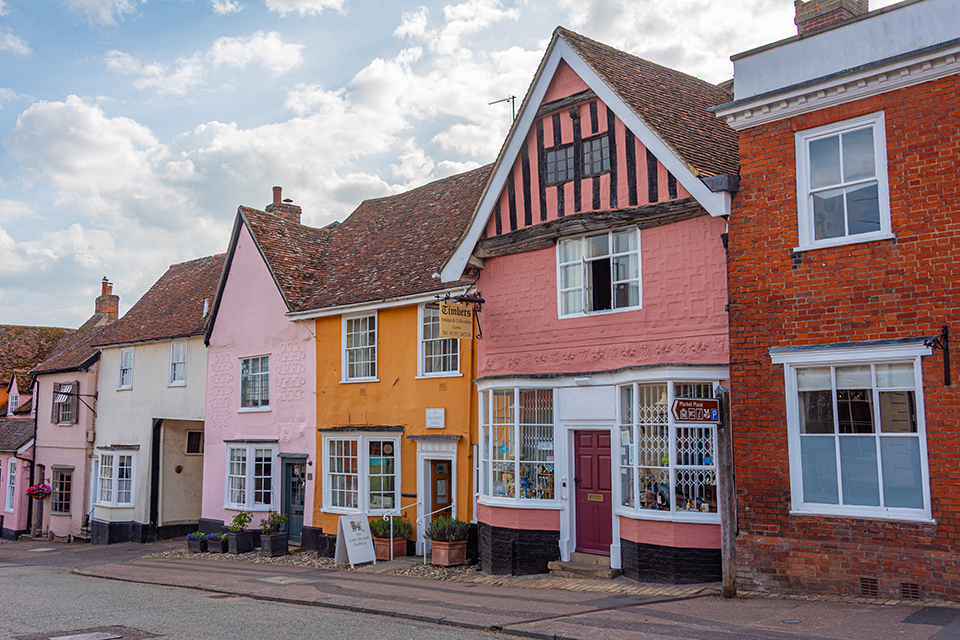
Street in Lavenham © Dudlajezov/Dreamstime ID 446726920
READ ALSO:
Making the house a home in later medieval York
Jeremy Goldberg
Journal of Medieval History (2019), pp 162-180
Pages 162-180 | Received 01 Dec 2018, Accepted 01 Feb 2019, Published online: 26 Mar 2019


