

The week the opening of the exhibition on Nicolas Flamel at Musee de Cluny in Paris is the main event. However, a major exhibition at Tewkesbury, a major Norman building, explores how the social consequences of conquest unfolded following Hastings.
Secondly, two books make the medieval economy and the circulation of information unusually visible: Jordan Claridge relocates the supply of working horses to peasant breeders, while News in the Middle Ages treats news as a social system rather than a product of print. Finally, the Mesmont excavations and the Peak District lead study offer complementary evidence for power, industry and environmental cost in early medieval landscapes.
New Exhibitions and Events
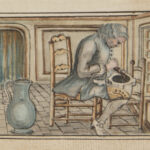

13.10.2026 – 24.10.2027 Exposition Nicolas Flamel at Musee de Cluny in Paris
How did the wealthy Parisian Nicolas Flamel, property investor and benefactor, become one of the most famous alchemists in history? A new exhibition at the Musée de Cluny in Paris explores the extraordinary transformation of Nicolas Flamel from a medieval businessman into an immortal magician
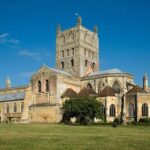
Tewkesbury Abbey opens From Conquest to Kingdom – The Bayeux Tapestry and Norman Heritage Trail on 22 October. The free exhibition combines a full-scale printed reproduction of the Bayeux Tapestry with the abbey’s own architecture and history, tracing more than eighty years from 1066 to 1154. At the centre is the Abbey founded within decades of the Conquest and dominated by Europe’s largest Romanesque tower, is not merely the venue but part of the evidence. The interpretation moves beyond Hastings to rulers, faith, architecture, craftsmanship, fashion, music and everyday life.
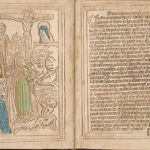
The Morgan Library & Museum’s exhibition and catalogue examine blockbooks as a distinct experimental medium at the manuscript–print transition, supported by a new census of examples in American collections.

Following extensive restoration, the Galleria dell’Accademia at the Bargello in Florence is showing two restored panels by the anonymous Master of 1416. This is a useful object-led lead rather than a large exhibition.
New books.
Horse Power in Medieval England. By Jordan Claridge. Cambridge University Press 2026
Claridge argues that horses powered England’s agricultural and economic expansion, yet lords largely failed to breed the workhorses their estates required. Peasant breeders instead supplied the animals on which manorial agriculture depended. The book is an immediate fit for the developing horse lifeworld and may alter the balance between elite horse culture and the ordinary working animal.
Necessary Inventions: Roger Bacon, the Middle Ages, and the Making of Modern Science. By E. R. Truitt. University of Pennsylvania Press 2026
Truitt uses Roger Bacon and his later reputation to challenge the medieval/modern divide in histories of science. The book follows how Arabic learning was borrowed, synthesised and Christianised, and how later narratives turned Bacon into a prophetic modern while erasing non-Christian texts, actors and cultures.
News in the Middle Ages. By Helen Birkett, Adam Franklin-Lyons, Chris Given-Wilson, Wendy Scase, David Gary Shaw, Vasilina Sidorova, Thomas W. Smith and Igor S. Filippov. Palgrave Macmillan 2026
A collaborative account of medieval news as a social practice carried by communities, networks, letters, postal systems, rumour and purposeful misinformation. Its significance for Medieval.eu is both historical and reflexive: it asks what ‘news’ means in a society without newspapers and what remains continuous across the print divide.
The Immersive Global Middle Ages. By Lynn T. Ramey and Roger L. Martínez-Dávila
Cambridge University Press 2026.
This Element examines virtual reality, 3D modelling and game-based learning as research and teaching methods for an interconnected Global Middle Ages. It should not be confused with the separate Springer edited collection of a similar title published in January 2027
The Salvation of the Involuntarily Ignorant in Medieval Theology. By Liam McDonnell Oxford University Press 2026
This book examines medieval debates over whether those ignorant of Christianity through no fault of their own could be saved.
Monasticism and Politics in Norman Italy. By Graham A. Loud. Manchester University Press 2026
The Chronicle of Montecassino gives a detailed and compelling account of the monastery during its ‘golden age’ under Abbots Desiderius and Oderisius I, and the challenges that it then faced from the early years of the twelfth century onwards. As law and order in the Principality of Capua broke down, the monks faced increasing threats.
New Research
Social dynamics of toxic metal industry in medieval Europe: Peak District lead production, AD 600–1500. In: Antiquity 2026
Christopher P. Loveluck and colleagues use lead concentrations preserved in tooth enamel, combined with radiocarbon dating, to reconstruct the development and human impact of medieval lead production in the Peak District. Post-Roman production was established by the mid-seventh century, and by the mid-eighth century children at Castleton were growing up in a heavily contaminated landscape. The study is important because centuries of re-smelting erased much of the industrial archaeology. Human teeth therefore become an archive of production, residence, childhood exposure and social difference. All but one of the sampled medieval individuals had substantial anthropogenic lead exposure; the paper also explores status, gender and possible mobility.


