


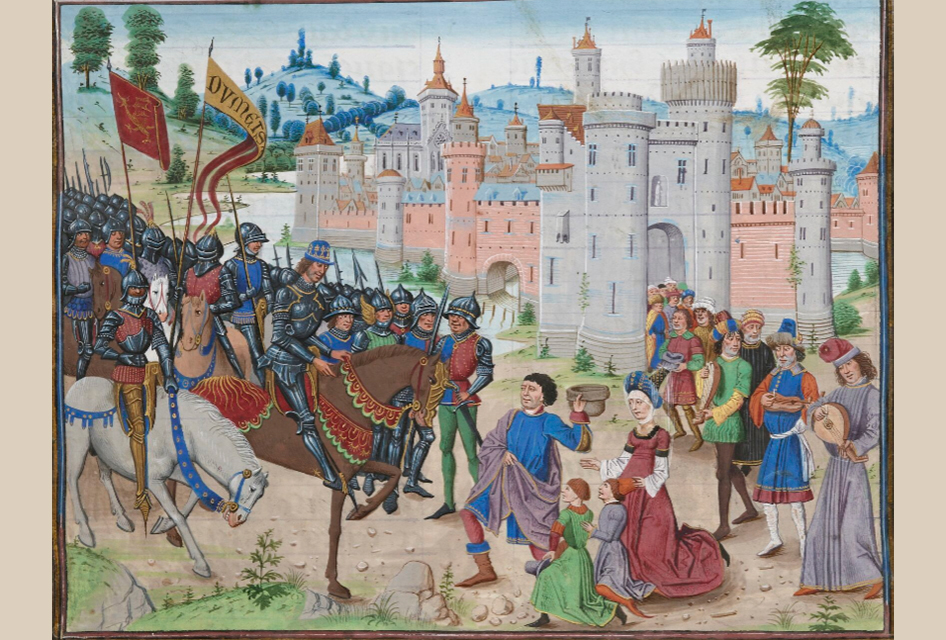
What did Paris sound like in the lifetime of Nicolas Flamel (c. 1330–1418)? As part of its exhibition Nicolas Flamel, alchimiste de papier, the Musée de Cluny invites visitors to explore the musical world of the wealthy Parisian bourgeois, scribe and legendary alchemist.

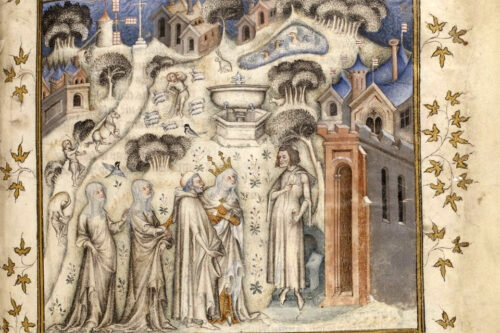
Performed by the internationally acclaimed medieval music ensemble Alla francesca, a concert in Pari in December evokes the extraordinary flourishing of music and literature during a period otherwise marked by plague, warfare and political turmoil. The programme draws on the satirical Roman de Fauvel, the innovative Ars Nova compositions of Philippe de Vitry and Guillaume de Machaut, and the literary world of Christine de Pizan.
Philippe de Vitry (1291–1361) was one of the leading intellectual and musical figures of fourteenth-century France. A composer, poet, royal administrator and eventually Bishop of Meaux, he is closely associated with the development of the Ars Nova, the new musical style that transformed rhythmic notation and opened the way for increasingly sophisticated polyphonic compositions. Traditionally credited with the influential treatise Ars nova, Vitry helped shape a musical culture in which intricate rhythmic structures and overlapping melodic lines became vehicles for artistic experimentation. His surviving motets offer a glimpse into the intellectual and political world of the French royal court during the decades preceding Flamel’s adulthood.
Guillaume de Machaut (c. 1300–1377) brought the musical innovations of the Ars Nova to extraordinary artistic maturity. A poet, composer and cleric, he served John of Luxembourg, King of Bohemia, before establishing himself at Reims. His compositions range from elaborate polyphonic motets and the celebrated Messe de Nostre Dame to courtly love songs, ballades, rondeaux and virelais. Moreover, Machaut was among the first medieval composers to oversee the compilation of substantial manuscripts preserving his own literary and musical works. His carefully crafted interplay of poetry and music profoundly influenced the cultural world of late fourteenth-century France, providing a musical backdrop to the Paris in which Nicolas Flamel made his fortune.
Founded in the early 1990s and currently under the artistic direction of Brigitte Lesne, Alla francesca specialises in music from the late eleventh to the sixteenth century. Its repertoire ranges from troubadour songs and medieval polyphony to instrumental dances and early Renaissance music. Drawing directly on medieval manuscripts, the ensemble combines rigorous musicological research with expressive performance, improvisation and a lively engagement with its audiences. Its interpretations seek to recover not merely the surviving melodies but also something of the performance traditions of medieval jongleurs and minstrels.
Finally, the concert transports its audience to Paris in August 1389, when some 1,200 prominent citizens gathered to celebrate the ceremonial entry and coronation festivities of Queen Isabeau of Bavaria, wife of Charles VI. Through voices and medieval instruments, Alla francesca brings the cultural world of Flamel’s Paris to life.
FETURED PHOTO:
Musicians c 1435-1512. From Faits Grand Alexandre. BnF MSF22547
ENJOY:
Music in the Time of Nicolas Flamel – A Concert at the Musée de Cluny. Musée de Cluny, Paris, 3 December 19.00, 2026. Read more and booking


