


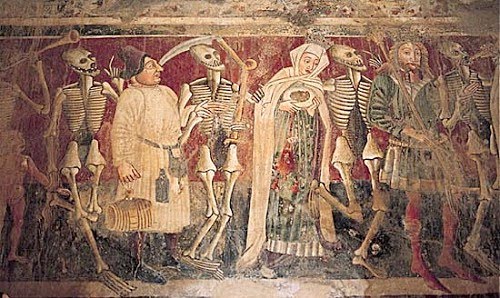
Was Yersinia Pestis responsible for the Black Death? Some believe the jury is still out…
While the detection of Y. pestis in today’s plague victims can be achieved without major difficulties, the detection in ancient samples such as skeletons is much more complicated.
However, in 1998 Y. pestis DNA might have been recovered for the first time from 400 year-old skeletons. Since this first (later contested) description further detection of Y. pestis DNA in human remains has been published and just recently the whole genome sequence of Y. pestis from a Black Death victim was determined and afterwards published in Nature.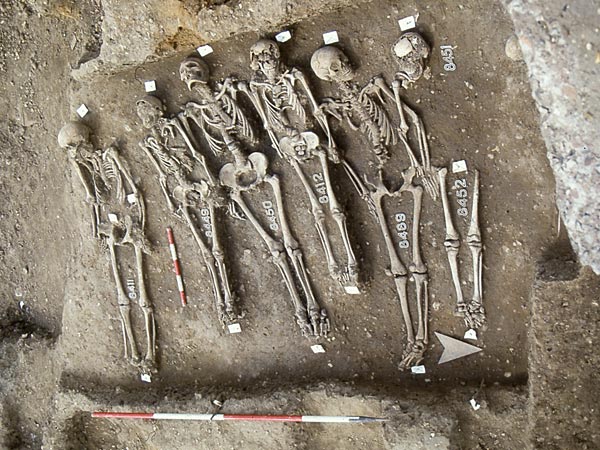
Thus Yersinia pestis might according to scientist be identified as the causative agent of the Black Death pandemic in the 14th century. However, retrospective diagnostics in human skeletons after more than 600 years are critical.
In a brand-new article (2013) a group of scientist – apart from presenting an overview over recent DNA-studies – describes a strategy following a modern diagnostic algorithm and working under strict ancient DNA regime for the identification of medieval human plague victims. Their study confirms the existence of Y. pestis in more than a third of a group of skeletons assumed to be the remains of victims of the plague in the 14th century.
Not Yersinia
One might think that the steady stream of reported scientific DNA-probes recently conducted by scientists in labs all over the world and published in peer-reviewed journals of high acclaim might end the fight among the scientist on one hand and the historians on the other. But no: In a recent overview of the position of historians by Phyllis Pobst (ecclesiastical historian and founding president of The 14th century Society) the author makes the claim once more that the cause of the Black Death is still unknown. It might have been pest; but it might also have been any other plague…
According to her the absence of the rodents – the rats serving as vehicles of the microbe – from medieval sources is just one of the significant matters which is left out of the equation. Another issue is the speed with which the infection spread pointing to the fact that human-to-human must have played a role. (However very recent research show that according to epidemiologists it was in fact moving very slowly)
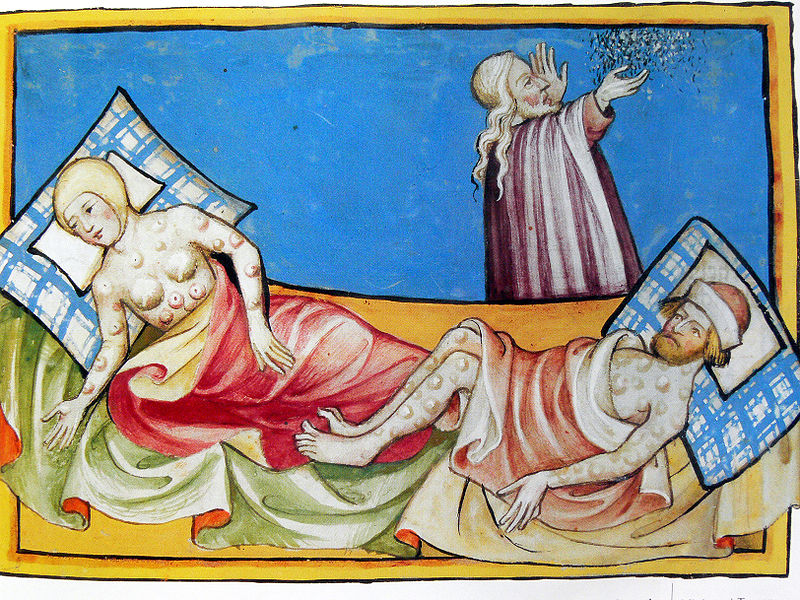
These findings support the notion that factors other than microbial genetics, such as environment, vector dynamics and host susceptibility, should be at the forefront of epidemiological discussions regarding emerging Y. pestis infections, they claim.
Pest or plague? The jury still seems to be out…
SOURCES:
Strategy for Sensitive and Specific Detection of Yersinia pestis in Skeletons of the Black Death Pandemic.
By Lisa Seifert, Michaela Harbeck, Astrid Thomas, Nadja Hoke, Lothar Zöller, Ingrid Wiechmann, Gisela Grupe, Holger C. Scholz, Julia M. Riehm
In: PLoS ONE 2013 8(9): e75742. doi:10.1371/journal.pone.0075742
A draft genome of Yersinia pestis from victims of the Black Death
By Bos KI, Schuenemann VJ, Golding GB, Burbano HA, Waglechner N et al. (2011).
In: Nature 478(7370): 506–510.
doi:10.1038/nature10549.
Should we Teach That the Cause of the Black Death Was Bubonic Plague?
In: History Compass 11:10 2013 p. 808 – 820
By Phyllis Pobst


