


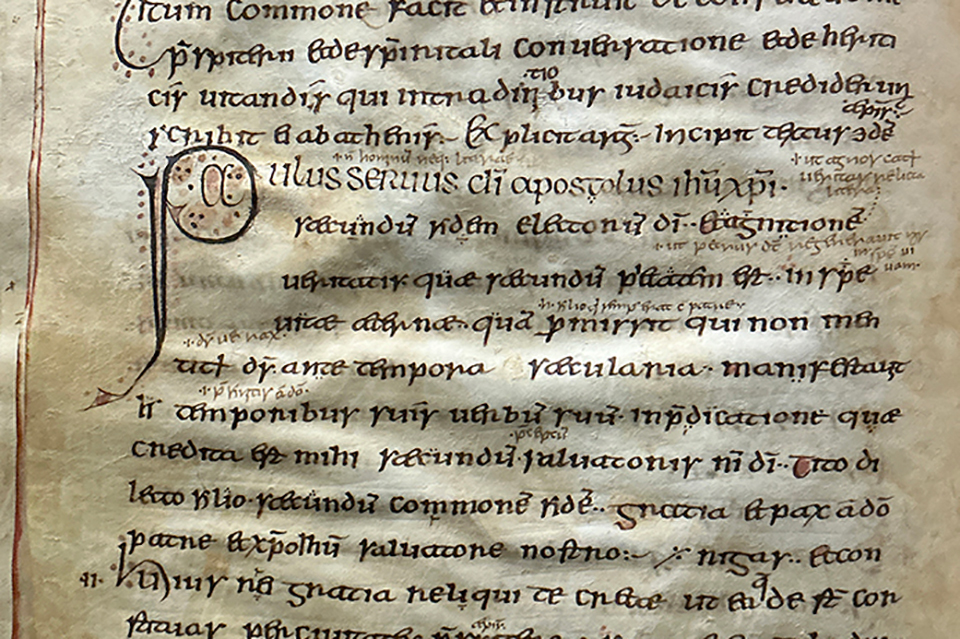
Medieval parchment tells a story of how murrains among sheep must have been recurring scourges, threatening the livelihoods of peasants and lords alike.
“In that year (1274) a disastrous plague of sheep seized upon England, so that the sheep-folds were everywhere emptied through the spreading of it. It lasted for twenty-eight years following, so that no farm of the whole kingdom was without the infliction of that misery. Many attributed the cause of this disease, which the inhabitants had not been acquainted with before, to a certain rich man of the Frankish nation, who settled in Northumberland, having brought with him a certain sheep of Spanish breed, the size of a small two-year-old ox, which was ailing, and contaminated all the flocks of England by handing on its disease to them.”
From: De prima Peste ovium in Anglia. In: Willelmi Rishanger, quondam monachi S. Albani, et quorundam anonymorum: chronica et annales, regnatibus Henrico Tertio et Edwardo Primo. Published by the authority of the Lords Commissioners of Her Majesty’s Treasury, under the direction of the Master of the Rolls, 1865, p. 84.
Unfortunately, this was probably not the first time that such devastating pox hit the English countryside. From the accounts preserved from the episcopal manor at Crawley, we know that sheep-pox hit the flocks regularly – in 1245–46, 1251–52 and again in 1314–15. In these accounts, the disease was indicated as “verola”, terminology associated with pox, variola (Stone 2003).
Parchment – a hidden cache
Recently, new research was published documenting the prevalence of sheep-pox in a wider context. Simply told, some of Europe’s most well-known historic manuscripts, including the York Gospels, have proven to be biological capsules for uncovering the 3,500-year history of the sheep-pox virus.
By extracting DNA from the animal skins used to make the documents’ centuries-old parchment, an international team of geneticists, historians, virologists, protein chemists and conservators, led by University College Dublin, have provided the first genetic evidence of how this devastating disease plagued European farmers’ herds long before the modern era.
A highly contagious disease, sheep-pox spreads rapidly and can affect large portions of a flock in a short time. The disease is particularly dangerous because it can cause very high mortality rates, especially in young animals, and dramatically reduce productivity by damaging wool, meat and milk yields.
Even today, sheep-pox is a highly contagious viral disease of sheep, caused by Capripoxvirus. Its most characteristic feature is a combination of fever and distinctive skin lesions, although severe cases become systemic. Young lambs are particularly vulnerable and may die before the characteristic skin lesions become fully developed. Today, the disease is particularly virulent around the large religious feasts in geographical areas where highly regulated livestock-trading systems and strict biosecurity protocols at farm level are absent. In the Middle East and the Eurasian steppes, the virus is near-endemic. It is especially prevalent around Eid al-Adha, when large flocks are moved around the landscape to provide lambs for slaughter. Much like today, seasonal transhumance in the Middle Ages included mobile pastoralist households undertaking seasonal movements, which may have facilitated the transmission of sheep-pox through flock-to-flock contact along exchange and mobility corridors.
3,500 years of evidence
In the study, the scientists present 21 ancient sheep-pox genomes spanning the Eurasian steppe and covering the period from the Bronze Age (c. 1700 BC) to the Early Modern period in Western Europe. The study includes multiple genomes obtained from 17 medieval parchments, from York in the north to Vienna in the south, covering the period c. 700–1450. The findings reveal that the food security of Eurasian communities would have been threatened by sheep-pox for more than 3,700 years, while also providing insights into genomic evolution and potential host adaptation.
From a medieval historical point of view, the studies of the sheep parchments show how infection among sheep was a frequent challenge to European societies at this time.
This study was funded by Taighde Éireann–Research Ireland and the European Research Council and led by researchers at UCD in collaboration with over 30 Irish and international institutions, including Trinity College Dublin, the Helmholtz Institute for One Health, Université Paris 1 Panthéon-Sorbonne, the University of Leicester, the University of Cambridge and the University of Copenhagen.
SOURCE:
Three thousand five hundred years of sheeppox virus evolution inferred from archaeological and codicological genomes
By Louis l’Hote et al
Science advances 2026
Press release:
Hidden DNA in medieval gospels reveal history of deadly livestock virus
By: David Kearns, Digital Journalist / Media Officer, UCD Marketing and Communications
READ MORE:
Medieval Shepherd: Jean de Brie’s Le Bon Berger (1379)
Series: Medieval and Renaissance Texts and Studies 424
State University of New York at Binghamton 2012
The productivity and management of sheep in late medieval England
by David Stone
In: The Agricultural History Review
Volume 51 Part I 2003


