


Medieval Paris was not simply a royal capital, a university town or a city of magnificent churches. It was also a crowded and constantly changing urban landscape, shaped by the Seine, its bridges and islands, the expansion of markets and neighbourhoods, and the competing interests of kings, bishops, monasteries, merchants and ordinary householders.
Between the twelfth and fifteenth centuries, Paris’ population grew dramatically reaching 200.000. Following this, its boundaries were repeatedly redefined, and its streets became home to an extraordinary variety of professions and communities. The following selection brings together fourteen works approaching this history from different perspectives. Some explore the emergence of Paris as Europe’s greatest medieval metropolis, while others concentrate on its architecture, artistic production, aristocratic residences and bourgeois society. Together, they offer an opportunity to reconstruct not merely the appearance of medieval Paris but also the lives of the people who inhabited, worked in and transformed its urban spaces.
Guide Books
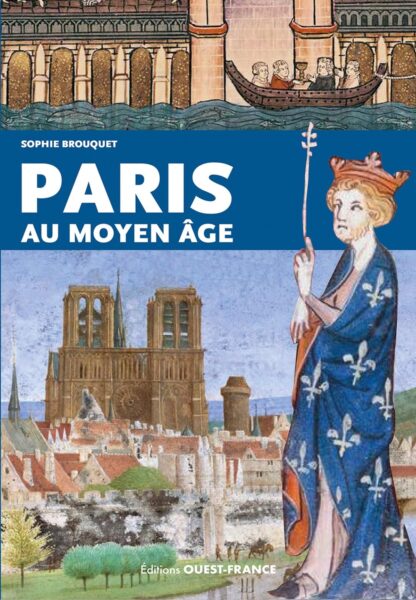
Sophie Brouquet (Sophie Cassagnes-Brouquet). Éditions Ouest-France, 2024. ISBN 9782737390364.

The familiar monuments of medieval Paris represent only fragments of a city whose history extends from the early Frankish kingdoms to the closing centuries of the Middle Ages. In this illustrated introduction, Sophie Brouquet surveys approximately a millennium of Parisian history, beginning with the city associated with Clovis and following its development into the political and cultural centre of the French monarchy. Rather than concentrating on a single institution or neighbourhood, she offers a broad chronological framework within which the city’s changing architecture, population and social life can be understood. Consequently, the reader encounters Paris as a succession of overlapping urban landscapes, in which ancient structures, early medieval religious foundations and later royal building projects contributed to the formation of the capital.
The book is particularly suitable for readers seeking an accessible introduction to the historical development of the city before approaching more specialised archaeological and topographical studies. At 128 pages, however, it is necessarily selective and cannot offer the documentary detail found in the works of Oberste, Roux or Hayot. Its principal value therefore lies in providing a compact historical orientation, connecting the surviving remains of medieval Paris with the successive transformations that produced them.
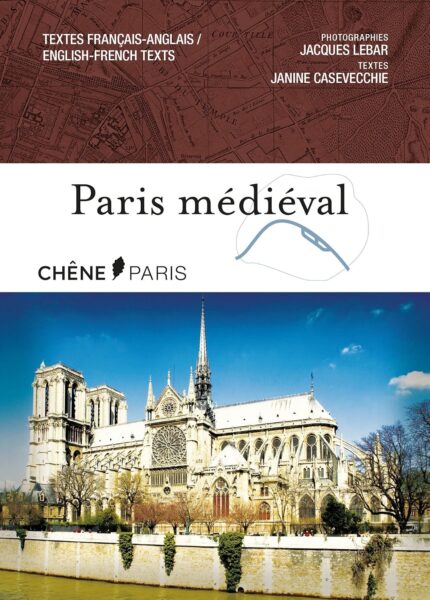
Janine Casevecchie, with photographs by Jacques Lebar. Éditions du Chêne, Paris Balades, 2016.

Much of medieval Paris has disappeared beneath later streets, buildings and urban improvements, yet fragments of its earlier history remain scattered throughout the modern capital. In this illustrated guide, Janine Casevecchie invites readers to rediscover these surviving traces, moving between major monuments and less conspicuous buildings that preserve something of the city’s medieval appearance.
Alongside the familiar splendour of the Sainte-Chapelle and Notre-Dame, the book draws attention to places such as the Tour Jean-sans-Peur, the church of Saint-Julien-le-Pauvre, the cloister of the Billettes and the surviving medieval fabric of Saint-Germain-des-Prés. Through the combination of historical commentary and photography by Jacques Lebar, the reader is encouraged to recognise the medieval city within the modern streetscape.
Indeed, the book’s particular attraction lies in this encounter between past and present, since the surviving buildings can often be difficult to interpret without an understanding of their original surroundings. Although intended primarily as an accessible guide rather than an academic study, it nevertheless offers a useful introduction to the material remains of medieval Paris. Furthermore, its emphasis on buildings that can still be visited makes it especially valuable for planning an itinerary through the historic city and connecting documentary research with places that remain visible today.
The City and Its Inhabitants
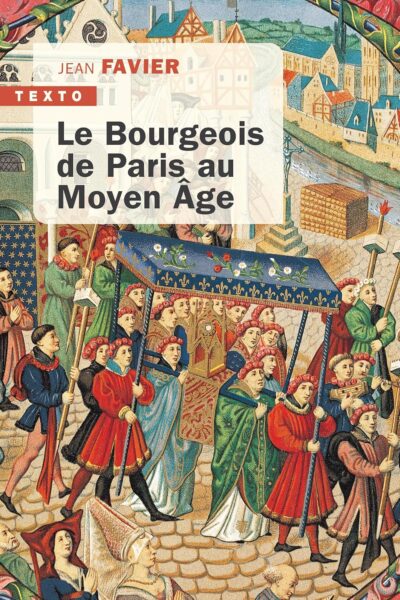
Jean Favier. Tallandier, Texto, 2015. ISBN 9791021008472.

Paris became the largest city in medieval Europe not merely through the patronage of its kings but also through the activities of its merchants, officials, craftsmen, financiers and prosperous householders. In this wide-ranging history, Jean Favier places these inhabitants at the centre of the city’s development, tracing the emergence of a bourgeois society whose members increasingly shaped its economic, political and institutional life. Rather than treating the bourgeoisie as a narrowly defined social class, Favier explores the remarkably varied occupations and networks through which individual Parisians acquired wealth, standing and influence. Consequently, his account moves between commercial enterprise, property ownership, royal administration, ecclesiastical institutions and the legal professions, revealing how closely these different worlds were connected.
Of particular interest is the relationship between private fortunes and public authority, since the expansion of the monarchy created opportunities for men whose expertise and financial resources were indispensable to government. At the same time,
Favier pays considerable attention to the texture of urban life, incorporating anecdotes and personal histories that give substance to otherwise abstract social categories. The result is a substantial portrait of the people who occupied the city’s houses, conducted business in its streets and helped establish Paris as a centre of European commerce and administration.
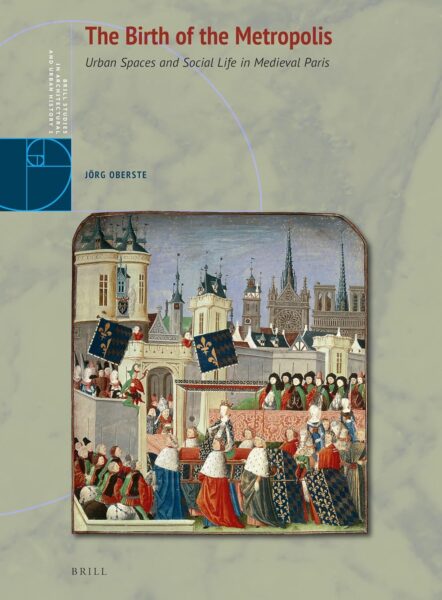
Jörg Oberste. Brill Studies in Architectural and Urban History, vol. 1. Brill, 2021.

Between 1150 and 1350, Paris underwent one of the most remarkable episodes of urban growth in medieval Europe, developing from a comparatively modest episcopal city into a metropolis of perhaps a quarter of a million inhabitants. Jörg Oberste investigates how this transformation occurred, arguing that the management and appropriation of urban space were central to the process. Rather than describing the expansion of Paris simply as a consequence of royal government or demographic growth, he examines the interactions between landowners, religious institutions, settlers and emerging urban communities.
Particular attention is devoted to the neighbourhood surrounding Saint-Martin-des-Champs, where the priory’s property records make it possible to reconstruct the formation of streets, plots, houses and commercial spaces. Through this detailed case study, Oberste shows how decisions concerning rents, jurisdiction, construction and access to land contributed to the gradual development of an increasingly complex city. Furthermore, he explores the roles of markets, churches, centres of learning and suburban settlements in creating the distinctive geography of medieval Paris.
The result is a study of urbanisation as a social process in which everyday negotiations over property and authority helped determine the physical appearance of the metropolis. For readers interested in medieval topography and the relationship between institutions and neighbourhoods, this is one of the most directly relevant books in the selection.
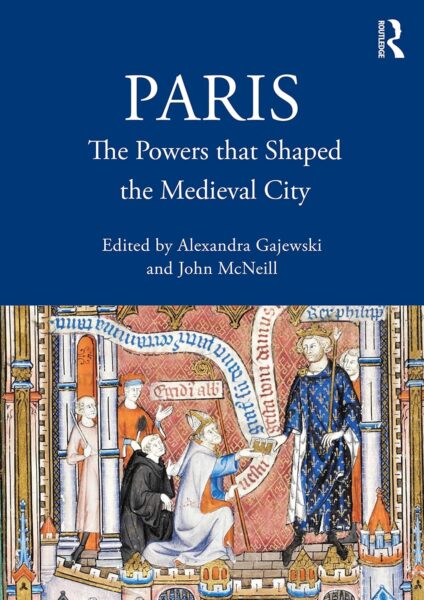
Edited by Alexandra Gajewski and John McNeill. British Archaeological Association Conference Transactions. Routledge, 2023.

The transformation of medieval Paris was shaped by a succession of powerful institutions, each leaving its imprint on the city’s buildings, streets and sacred spaces. Bringing together ten specialist studies, this collection examines how royal, monastic and secular patrons contributed to the architectural and artistic development of the capital between approximately 1100 and 1500. Although major monuments such as Notre-Dame, Saint-Denis and the Sainte-Chapelle occupy an important place, the volume also moves beyond the familiar landmarks to investigate the less conspicuous structures and communities that sustained urban life. Particularly revealing is Jana Gajdošová’s study of the buildings constructed on Parisian bridges, where commercial activities and everyday habitation occupied spaces that simultaneously served as essential routes through the city. Terryl Kinder’s investigation of Cistercian property in Paris likewise demonstrates how a religious order associated primarily with rural monasteries participated in the urban property market. Meanwhile, William Chester Jordan explores the disciplinary and sensory dimensions of royal authority in thirteenth-century Paris, while other contributions examine the connections between liturgy, architecture, manuscript production and images of the city. Together, these studies reveal a landscape in which political ambition, religious devotion and economic interests continually intersected. Consequently, the book offers much more than a survey of medieval Parisian architecture: it demonstrates how urban space became an expression of competing forms of power.
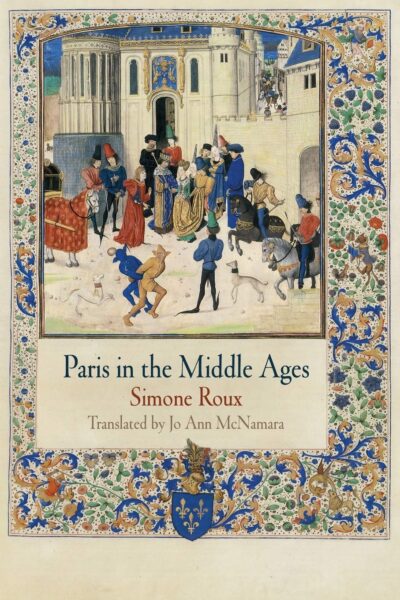
Simone Roux. Translated by Jo Ann McNamara. University of Pennsylvania Press, 2009.

What did it mean to live in medieval Paris, and how did its inhabitants experience a city whose population, institutions and physical surroundings were continually changing? Simone Roux approaches these questions through a social history of Paris during the thirteenth, fourteenth and fifteenth centuries, concentrating particularly on the people whose daily activities animated its streets and neighbourhoods. Beginning with the development of urban space, she examines the changing boundaries of the city, the character of its streets and the coexistence of religious, political and commercial activities. From there, the narrative moves into the social hierarchies of Parisian society, distinguishing between wealthy financiers, merchants, craftsmen, servants and the urban poor, while also considering the place of royal officials and ecclesiastical communities. Yet the most revealing chapters concern the organisation of everyday life. Houses emerge not simply as private residences but as workshops, shops and places of employment, while families, confraternities and professional associations provide networks of support in an often precarious urban environment. Drawing on judicial, administrative and other documentary sources, Roux reconstructs the habits, conflicts and relationships of ordinary Parisians, including aspects of life that rarely appear in conventional political histories. Her account is particularly valuable because it connects the city’s physical environment with the social practices through which its inhabitants occupied and understood it.
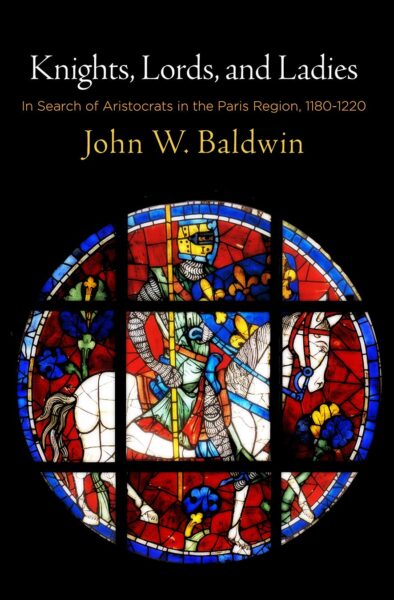
John Wesley Baldwin. With a foreword by William Chester Jordan. The Middle Ages Series. University of Pennsylvania Press, 2019.

The emergence of Paris as the centre of the Capetian monarchy cannot be understood without considering the aristocratic families who controlled the surrounding countryside. In this posthumously published study, John W. Baldwin reconstructs the lives of knights, lords and noblewomen inhabiting the Paris region during the reign of Philip Augustus. Working from charters, inventories of fiefs, seals, literary texts and archaeological evidence, Baldwin identifies seventy-five individuals belonging to thirty-three aristocratic families and examines their relationships with land, lordship, royal authority and religious institutions. His approach is deliberately personal, allowing the reader to follow individual families through their marriages, inheritances, military obligations and religious benefactions. At the same time, the book investigates the material circumstances of aristocratic life, including castles and residences, household arrangements, horses, armour and the equipment associated with warfare. Consequently, it places the consolidation of royal power within the broader transformation of aristocratic society, as powerful local families increasingly became integrated into the structures of Capetian government. Although the focus lies primarily on the Île-de-France rather than the city itself, the book is nevertheless essential for understanding the landscape surrounding medieval Paris. It also demonstrates that the growth of the capital depended on political and economic relationships extending far beyond its walls.
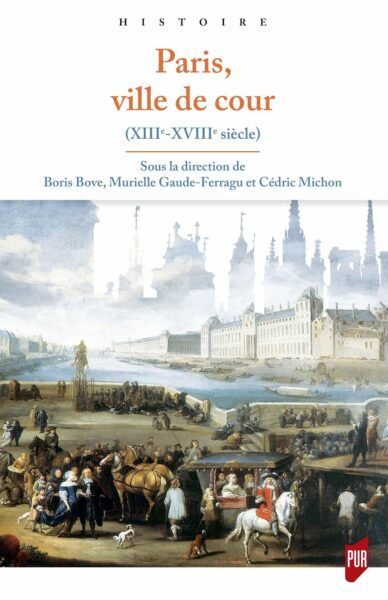
Edited by Boris Bove, Murielle Gaude-Ferragu and Cédric Michon. Presses universitaires de Rennes, 2017.

Although Paris became the capital of the French monarchy during the Middle Ages, the relationship between the city and the royal court was neither simple nor constant. Kings travelled, royal households moved between residences, and the political importance of Paris did not always depend on the physical presence of the sovereign. This collection of essays, edited by Boris Bove, Murielle Gaude-Ferragu and Cédric Michon, investigates how the court nevertheless shaped the city’s economic, social and cultural life between the thirteenth and eighteenth centuries. Instead of treating royal residence merely as a matter of palace architecture, the contributors examine the wider consequences of courtly consumption, patronage and administration. The presence of princes, courtiers and royal officials generated demand for housing, food, luxury goods and specialised services, while their investments in urban property and religious institutions altered the city’s social geography. Furthermore, the volume considers the relationship between courtly and urban cultures, including theatrical performances, public ceremonies, literary representations and artistic commissions. Particularly relevant to medieval Paris are the contributions on the residences and burial places of courtiers, the patronage of the royal entourage and the representation of Paris in fifteenth-century literature. The resulting picture is one of a city profoundly influenced by the monarchy, even when its rulers were physically absent.
Architecture, Urban Space and the Making of Medieval Paris
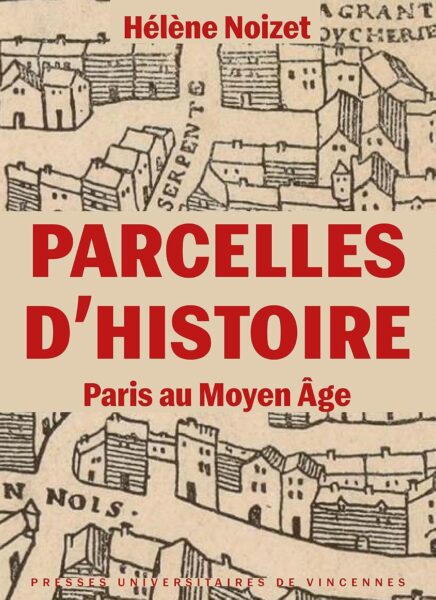
Hélène Noizet. Presses universitaires de Vincennes, 2026. 348 pages. ISBN 9782379246012.

How much of medieval Paris survives beneath the nineteenth-century boulevards and the familiar façades of the modern capital? According to Hélène Noizet, considerably more than might be imagined. In this innovative study of Parisian urban morphology, she explores how the activities of medieval inhabitants shaped a network of streets, property boundaries and neighbourhoods whose underlying structures have survived for centuries. Combining archaeological evidence, written documents, historical maps and digital spatial analysis, Noizet traces the development of the city between the ninth and fourteenth centuries, demonstrating how religious institutions, landowners and ordinary householders contributed to its gradual transformation. Of particular interest is her examination of the contrasting effects of secular and regular ecclesiastical communities on the surrounding urban fabric, as well as her reconstruction of medieval property divisions and planned developments around the Halles. Furthermore, she investigates the historical street network, revealing how particular routes and intersections emerged as enduring elements of the city’s geography. Finally, by mapping the itinerary described in Guillot de Paris’s Dit des rues de Paris, composed around 1300, she introduces a more subjective dimension to the study of urban space, connecting the physical city with the ways in which its inhabitants experienced and imagined it. Consequently, the book offers an unusually rich account of medieval Paris as an evolving landscape, demonstrating how social practices, property relations and everyday movement helped shape the city whose outlines remain recognisable today.
The Disputed City: Art, Architecture, and the Performance of Argument in Scholastic Paris (c. 1120–c. 1320)
Martin Schwarz. PhD dissertation, University of Chicago, 2020.
During the twelfth and thirteenth centuries, Paris emerged as the intellectual capital of medieval Europe, attracting scholars whose arguments about theology, philosophy and the nature of knowledge transformed European intellectual life. Yet these debates did not take place in an abstract world of texts and ideas. Instead, as Martin Schwarz argues, scholasticism developed within a particular urban environment, whose buildings, institutions and visual culture played an active role in shaping intellectual exchange. His dissertation therefore explores the relationship between scholarly argument and the physical spaces in which such arguments were formulated and performed. By examining individual sites and communities, Schwarz places the schools of Paris within a changing architectural and urban landscape, revealing how the pursuit of knowledge depended on the interaction between people, buildings and institutions. Furthermore, the investigation challenges the conventional separation between intellectual history and the history of material culture, suggesting that scholastic practices cannot be adequately understood without considering their spatial setting.
Of particular relevance is the period during which the schools associated with the cathedral and other religious institutions gradually developed into the University of Paris. Consequently, this study offers a distinctive perspective on the emergence of the Latin Quarter and the relationship between the expanding city and its intellectual communities. The dissertation is available through the University of Chicago’s institutional repository.
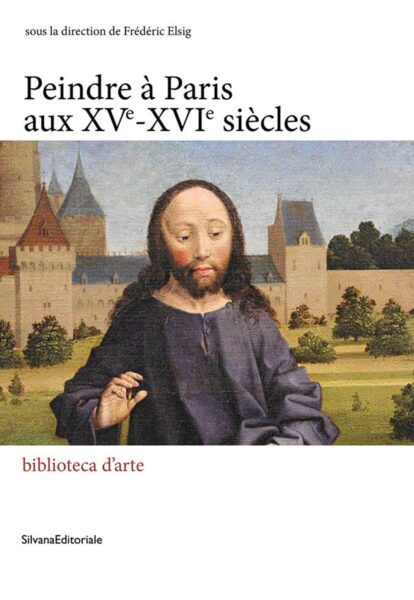
Edited by Frédéric Elsig. Peindre en France à la Renaissance, vol. 12. Silvana Editoriale, 2024.

Although Paris is celebrated for its Gothic architecture and medieval manuscript illumination, its history as a centre of painting during the fifteenth and sixteenth centuries is considerably less familiar. This substantial collective volume, edited by Frédéric Elsig, seeks to reconstruct the artistic production of the French capital during a period of profound cultural transformation. Drawing on the methods of connoisseurship, technical investigation and art-historical analysis, the contributors examine the artists, workshops and artistic traditions that operated in Paris between the late Middle Ages and the Renaissance.
Among the figures discussed are the Master of the Très Petites Heures of Anne of Brittany, Gauthier de Campes, Noël Bellemare, Jean Cousin and Antoine Caron. Furthermore, the volume extends beyond panel painting to consider manuscript illumination and stained glass, thereby approaching painting as a profession practised across several different media. Contributions on Parisian church paintings, Flemish artistic influences and the production of stained glass are particularly revealing, since they illuminate the networks connecting artists, religious patrons and individual commissions.
Although the book is not primarily concerned with urban topography, it nevertheless contributes to the reconstruction of Paris as a centre of skilled craftsmanship and artistic exchange. Thus, it offers an important complement to studies of the city’s scribes, illuminators and commercial workshops.
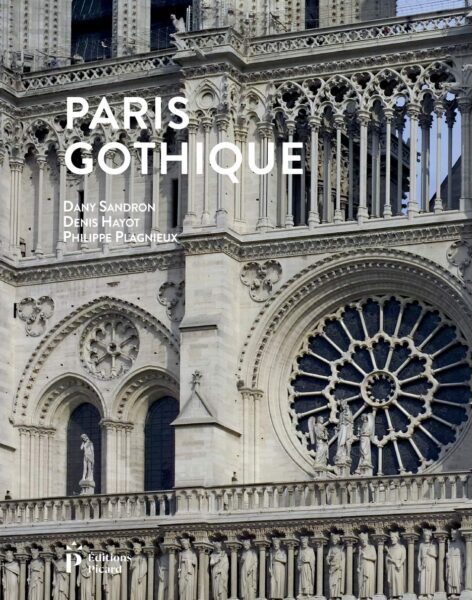
Edited by Dany Sandron, with contributions by Denis Hayot and Philippe Plagnieux and the collaboration of Grégory Chaumet. Éditions Picard, 2020.

Few European cities played so decisive a role in the development of Gothic architecture as medieval Paris. Nevertheless, the surviving monuments offer only a partial impression of the architectural wealth that once characterised the capital, where churches, chapels, residences, fortifications and public buildings formed a remarkably varied urban landscape. In Paris gothique, Dany Sandron, Denis Hayot and Philippe Plagnieux bring together thirty-six studies of the principal Gothic monuments of Paris, incorporating the results of recent architectural and historical research.
While Notre-Dame and the Sainte-Chapelle naturally occupy important places, the volume also examines less familiar buildings, including Saint-Germain-l’Auxerrois, Saint-Eustache, the Hôtel de Cluny and the medieval house of Ourscamp. Furthermore, the authors consider the city’s military architecture, notably the fortifications constructed under Philip Augustus and Charles V, thereby extending their investigation beyond ecclesiastical monuments.
The result is an architectural portrait of medieval Paris in which buildings are understood as parts of a changing urban environment rather than as isolated masterpieces. Particularly valuable is the attention given to structures that have been substantially altered or destroyed, since these help restore the density and variety of the medieval city. For anyone attempting to reconstruct the appearance of Paris before the early modern and nineteenth-century transformations, the volume provides an indispensable architectural reference.
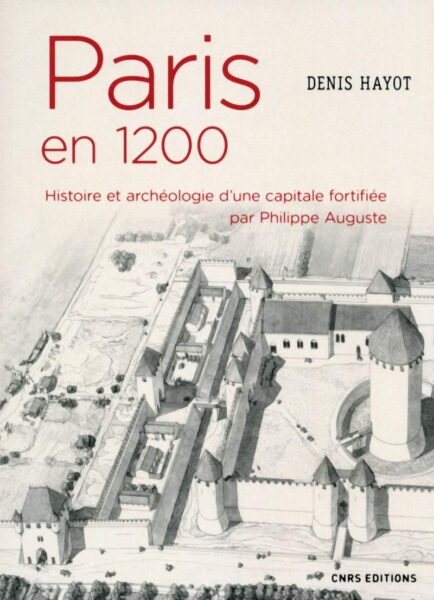
Denis Hayot. CNRS Éditions, L’Esprit des lieux, 2018. ISBN 9782271121448.

Around the year 1200, Paris was undergoing a transformation that would establish the foundations of its future development as the capital of France. Under Philip Augustus, the construction of a new circuit of defensive walls, together with the fortress of the Louvre and improvements to the city’s infrastructure, fundamentally altered its appearance and organisation. In this richly illustrated study, Denis Hayot examines the architectural programme through which the king sought both to protect Paris and to reinforce the authority of the Capetian monarchy.
Drawing on archaeological investigations, surviving masonry, historical documents and earlier representations of the city, Hayot reconstructs the fortifications and places them within the wider development of the urban landscape. Particular attention is devoted to the relationship between the walls and the spaces they enclosed, since the new enceinte did more than establish a military boundary: it also influenced patterns of construction, movement and settlement.
Meanwhile, the simultaneous development of Notre-Dame, the Halles, paved streets and the royal palace reveals the extent to which Paris was being reshaped around the turn of the thirteenth century. The study is complemented by architectural reconstructions and illustrations by Jean-Claude Golvin, which help visualise structures that have largely disappeared. Consequently, this book is of particular importance for understanding how royal ambition, urban planning and military architecture combined to create the medieval capital.
Representations, Courtly Life and the Surviving City
L’image de Paris et de l’Île-de-France au Moyen Âge (fin XIIe–début XVIe siècle)
Judith Guéret-Laferté Förstel. PhD dissertation, Université Paris 1 Panthéon-Sorbonne, 2017.
Paris was not only a place of residence, commerce and government but also a city whose significance was continually constructed through descriptions, images and representations. In this doctoral dissertation, Judith Guéret-Laferté Förstel investigates the image of Paris and the surrounding Île-de-France between the late twelfth and early sixteenth centuries. The study’s geographical and chronological scope provides an opportunity to examine the relationship between the capital and the region in which it developed, rather than treating the urban centre as an isolated phenomenon. Equally important is the distinction between the physical city and the ways in which contemporaries chose to represent it, whether through geographical description, historical narrative or other forms of testimony. Such representations inevitably involved selection, emphasising particular places, institutions or characteristics according to the purposes of their authors.
Consequently, the dissertation is potentially important for investigating how Paris acquired its reputation as a royal, religious and intellectual capital and how that reputation related to the actual urban landscape. It should be approached as a study of historical representations rather than as a straightforward architectural guide. The dissertation is available through the French HAL thesis repository, although its complete argument and detailed findings require consultation of the full text.
SOURCES
Guillebert de Mets. Edited and translated by Evelyn Mullally. Textes vernaculaires du Moyen Âge, vol. 14. Brepols, 2015. ISBN 9782503554969.
Among the surviving descriptions of medieval Paris, few sources are as revealing as the account composed by Guillebert de Mets in 1434. Originally from Geraardsbergen in Flanders, Guillebert had spent time in Paris as a young man and subsequently became a professional copyist and an important figure in the civic life of his native town. His description combines material drawn from earlier chronicles with personal recollections of the city, particularly as he had known it around 1407, before the political and military crises that transformed Paris during the following decades. The first part presents the history and legendary origins of the French monarchy, while the second turns to the physical appearance of the capital. Here, Guillebert describes the Île de la Cité, the royal palace, the bridges, the university quarter, the streets of the Right Bank, and the city’s walls and gates.
Particularly fascinating are his observations concerning prominent inhabitants and their residences, including wealthy bourgeois whose houses reflected the importance of property and social standing within the medieval city. Moreover, his descriptions of scribes, scholars and other notable figures provide glimpses of the intellectual and professional communities that made Paris distinctive.
Evelyn Mullally’s edition supplies the medieval French text, an English translation, extensive commentary and an introduction to Guillebert’s sources and background. Consequently, the volume is not merely a useful historical account but a primary source through which aspects of the urban landscape of early fifteenth-century Paris can be reconstructed.
FEATURED PHOTO:
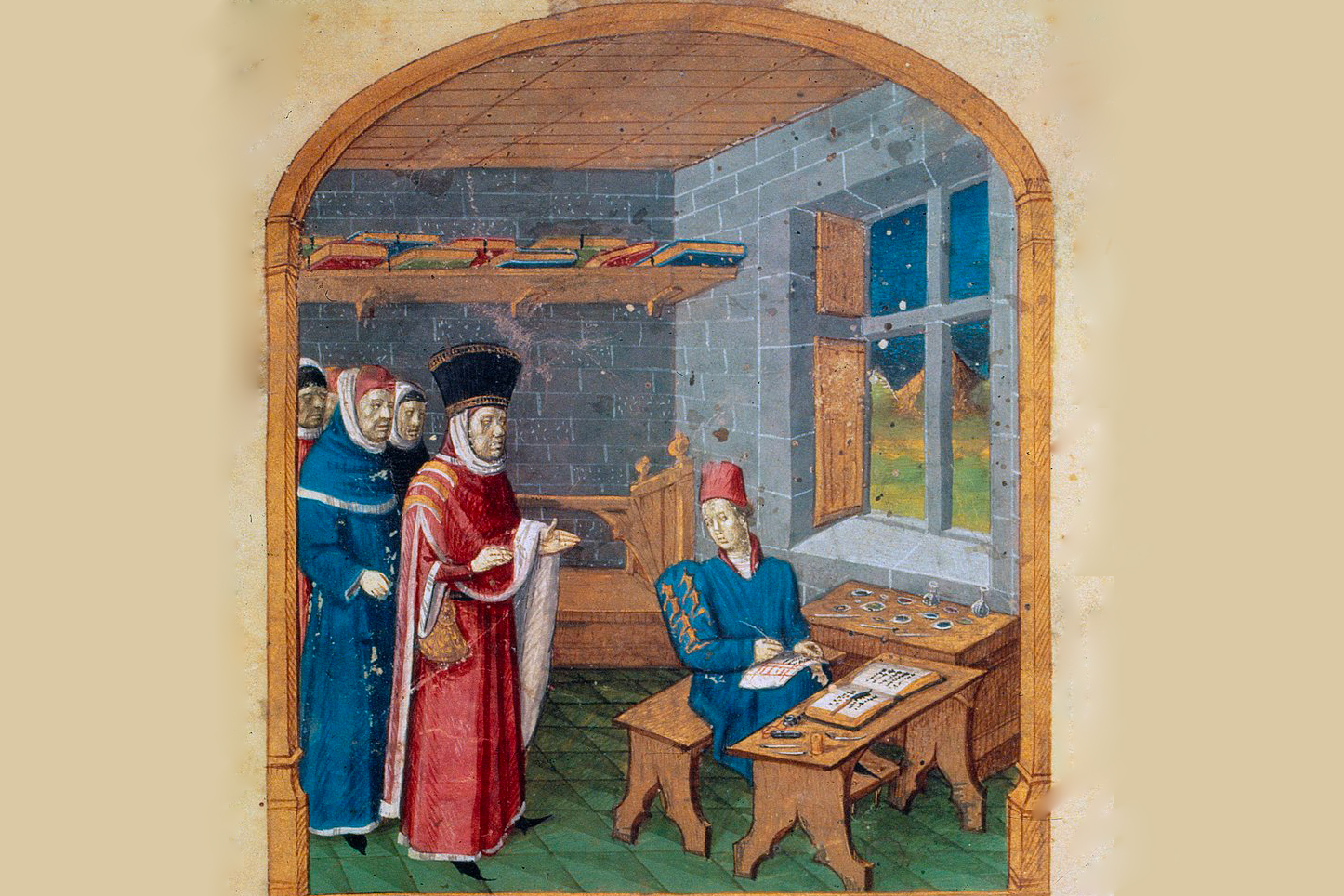
This 15th-century illumination from the Mare Historiarum (MS Latin 4915, folio 1) at the Bibliothèque nationale de France depicts the chancellor Guillaume Jouvenel des Ursins visiting a scribe and illuminator in his workshop. Painted between 1447 and 1455 by the Master of Jouvenel, it offers a rare window into medieval book production. Source; © BnF/Wikipedia


