


Dominated by articles on medieval manuscripts, liturgy and literature, the new issue of Speculum is out on the street.
Speculum 2015, Vol 90, no 4 includes five articles, none of which cover medieval history per se. Rather, focus is on manuscripts, preaching, literature and liturgy.
Table of Contents
Ecce patet tensus: The Trentham Manuscript, In Praise of Peace, and John Gower’s Autograph Hand
By Sebastian Sobecki
ABSTRACT:
Among those witnesses of John Gower’s works that are known to have been produced during his lifetime, the Trentham manuscript (London, British Library, Additional MS 59495) stands out for its remarkable design as a seemingly planned trilingual collection. The manuscript, usually dated to the first year of Henry IV’s reign, exclusively contains Gower’s poetry—showcasing his virtuosity in English, French, and Latin. A number of its poems are either addressed to or invoke Henry, yet nothing is known about the history of this manuscript before the seventeenth century. As a result, scholarship on the Trentham manuscript (henceforth Trentham) tends to foreground the question whether this compilation was ever presented to Henry. I will adduce fresh evidence to establish the early provenance of Trentham and show that the manuscript remained in Southwark until the middle of the sixteenth century. Second, I will offer a new context for the composition of Trentham by reading the collection against the background of Anglo-French relations during the first months of Henry’s rule. Finally, I will argue for Gower’s personal involvement in and continued ownership of this manuscript.
Remembering Last Things and Regulating Behavior in the Early Fourteenth Century: From the De consideratione novissimorum to the Speculum morale
By Constant J. Mews and Tomas Zahora
ABSTRACT:
Discourse on last things (novissima) has been a long-standing theme of Christian preaching. Yet preachers have not always mentioned last things as four in number, namely as death, judgment, hell, and heaven. This study explores how the interpretation by Bernard of Clairvaux of the verse of Ecclesiasticus (Ben Sira) 7.40, “In all your works, remember your last things, and you will not sin forever,” as an injunction to recall death, judgment, and hell, was transformed in the early fourteenth century by the addition of a fourth element, namely beatitude. We argue that this transformation reflects a new way of thinking about ethical behavior and ultimate destiny. Two treatises in particular, both from the early fourteenth century, reveal how different traditions of thought could be combined by bringing together Franciscan ways of thinking (in particular of Bonaventure) and Aristotelian reflection. One is the De consideratione novissimorum, an anonymous treatise about the four last things. The other is the Speculum morale, an encyclopedic compilation that was printed in the fifteenth century under the name of Vincent of Beauvais, alongside his three authentic works, the Speculum naturale, Speculum doctrinale, and Speculum historiale. The Speculum morale combines almost the entirety of the De consideratione with extended extracts from the Speculum dominarum of Durand of Champagne, Franciscan confessor to Jeanne, queen of France and Navarre (1285–1305), the Summa theologiae of Thomas Aquinas (1225–74), and many exempla drawn from another Dominican, Stephen of Bourbon (d. 1261). While the De consideratione is more homiletic in character than the more scholastically organized Speculum morale, they both bring together Franciscan and Dominican ideas in ways that reflect the complexity of ethical discussion about intellect, will, and grace in the decades after 1274. We argue that this fusion of ideas reflects a conscious desire to overcome the factionalism that had prevailed in mendicant circles on these issues, shaped by the political circumstances of the early fourteenth century.
The Politics of the Tunic in Antelami’s Deposition in Parma
By Elizabeth C. Parker
ABSTRACT:
An inscription on the marble Deposition relief (Fig. 1) now lodged in the western wall of the south transept of the Cathedral of Santa Maria Assunta in Parma reads, on the left: “In the second month of the year 1178 the sculptor completed it [the work]”; on the right: “This sculptor was Benedict known as Antelami.” Thus, we are fortunate to have a date and the name of the sculptor. Other than an inscription naming Benedict on the Parma baptistery, all other references to the sculptor (also architect) in which he is named Benedetto degli Antelami are sixteenth century at the earliest. We have no information as to his biography, or indeed the degree to which these and other works attributed to him can be understood as the work of one person. But in the beginning of the nineteenth century some writers began making Benedetto Antelami famous by pronouncing him the precursor of Giovanni Pisano, who led the way to the work of the great Italian Renaissance sculptors
Dante’s Staircase and the History of the Will
By John Bugbee
ABSTRACT:
In a text as heavily glossed as the Commedia, proposing a wholly new understanding of even a short passage is something of a risky venture. But there are cases where new interpretations are invited, not by an individual reader’s whimsy, but by the whole critical community—cases where its lasting exasperation with a textual crux makes itself evident in the behavior of critics as a group, whose profound dissatisfaction with available readings shows itself by a seemingly interminable search for better ones. When the crux falls in a passage both structurally and philosophically central to the work as a whole, the invitation might even be held to have a certain urgency about it.
The Language of the Liturgy in the Life and Miracles of William of Norwich
By Heather Blurton
ABSTRACT:
When Thomas of Monmouth first felt compelled to record for posterity the Life and Miracles of William of Norwich, the vita of a boy purported to have been ritually murdered by Jews in Norwich, England, in 1144 (thus becoming the victim of the first recorded accusation of ritual murder in Western Europe), he chose to do so in language replete with typological and liturgical resonance:
Or, as I rather believe, because by the ordering of divine providence he had been predestined to martyrdom from the beginning of time, and gradually step by step was drawn on, and chosen to be made a mock of and to be sacrificed by the Jews, in scorn of the Lord’s Passion.
[Sed, quod magis credo, diuine nutu prouidentie ad martyrium ad quod a seculis predestinatus fuerat quibusdam ita paulatim gradibus trahebatur, et a iudeis in dominice passionis obprobium deludendus et immolandus.]
This language is significant for the way in which it emphasizes William’s typological relationship to Christ: just as Christ was anticipated by the Old Testament prophets, the passage implicitly claims, so too was the martyrdom of William of Norwich anticipated in Christ’s own death. It has long been recognized that hagiography in general, and the Life and Miracles of William of Norwich in particular, construct both the personal characteristics and the life experiences of their protagonists ultimately on the model of Christ, and that these hagiographies are often informed by liturgical imperatives: as Beryl Smalley noted long ago, “both the language and the content of Scripture permeate medieval thought.” These liturgical imperatives depend in large measure on typological allegory. That is, they draw connections between the Old and the New Testaments, emphasizing the fulfillment of the promise of the Old in the New. In this hermeneutic perhaps lay the appeal of thinking the story of William of Norwich through liturgical language—the liturgy relies upon an established typological hermeneutic for making sense of the place of Jews in Christian society. However, this process has rarely been made explicit or systematically brought to light in the scholarship on the Life and Miracles of William of Norwich. This is in part because we are most used to thinking about the Life and Miracles of William of Norwich as a primary document in the history of anti-Semitism, and perhaps secondarily as a useful source for twelfth-century urban history. Scholars have been most interested in the historical aspects of the text: its origins, its possible sources, and the social function the work performed in its contemporary context. The seminal scholarship of Gavin Langmuir, John McCulloh, Israel Yuval, and Jeffrey Jerome Cohen has largely focused on discovering the origin of the accusation of ritual murder. For example, Langmuir located its origin with Thomas of Monmouth, Yuval with crusader massacres of Rhineland Jews, and Cohen with the need of Normans and English in post-Conquest Norwich to unite culturally against a common foe, while McCulloh uncovered what he argued to be the earliest evidence of the accusation not in England at all, but rather in a German martyrology. This study seeks to supplement these important analyses by suggesting that the articulation of the ritual murder accusation as it appears in the Life and Miracles of William of Norwich needs to be understood just as much as a response to liturgical expression in the long twelfth century as to socioeconomic or political friction between Christian and Jewish neighbors. In order to fully understand the Life we must be attentive to the ways in which it borrows consistently from the language and the context of the liturgy, especially in those moments when it is most at pains to make the case that William is truly a martyr and a saint.
Including 69 reviews, brief notices and a list of books received.
SPECULUM is published by The Medieval Academy
FEATURED PHOTO:
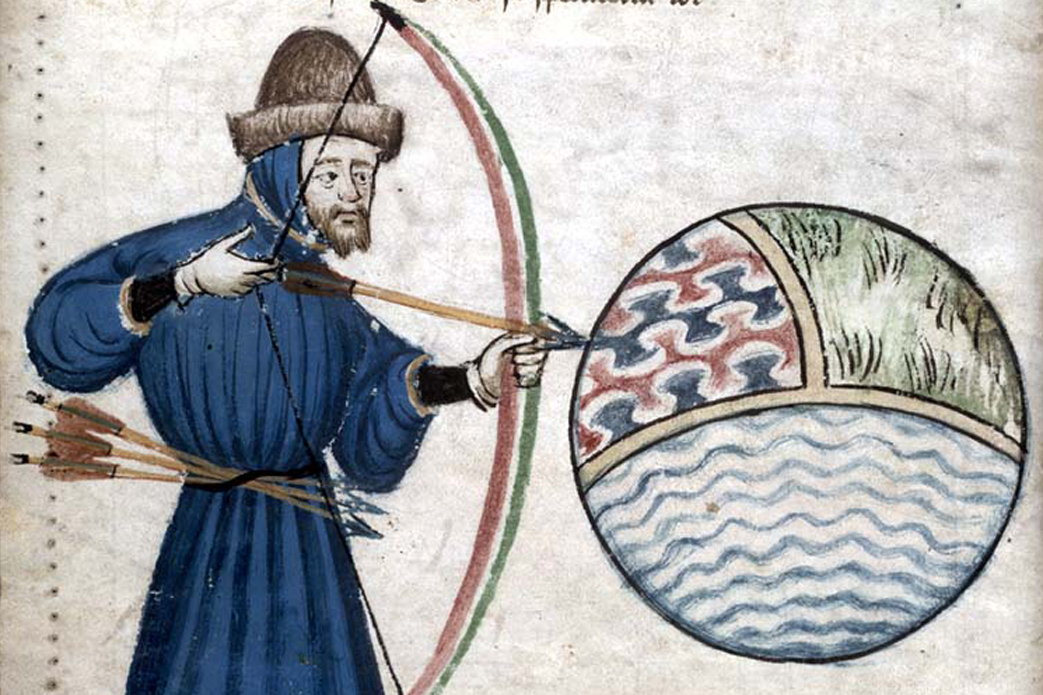
John Gower shooting the world, a sphere of earth, air, and water (from a manuscript of his works ca. 1400). Source: Wikipedia


