


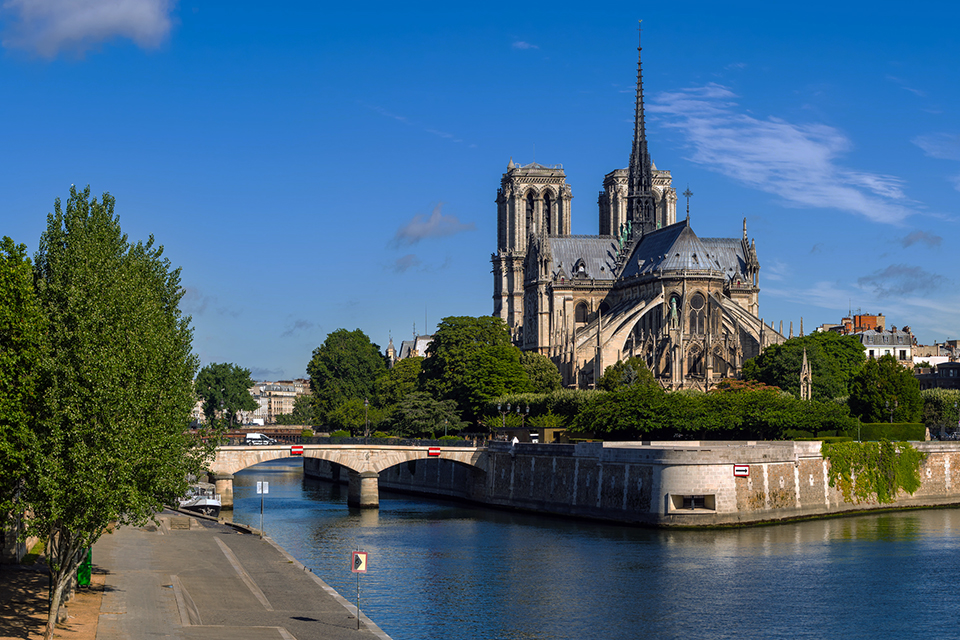
A Journey Through Time on Île de la Cité invites you to step into the heart of Medieval Paris

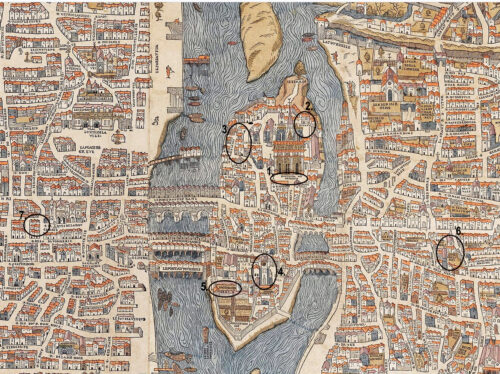
Paris was one of the greatest cities of medieval Europe. By the early fourteenth century, its population may have approached 200,000, making it a major European centre of commerce, royal administration, learning and religious life. At the heart of this expanding metropolis lay Île de la Cité, the island in the Seine where the bishops of Paris presided over their cathedral and the kings of France maintained their principal palace.
Yet medieval Paris looked very different from the city we know today. Instead of broad boulevards and monumental squares, narrow streets wound between churches, workshops, markets and timber-framed houses. Bridges crowded with buildings crossed the Seine, while boats delivered food, wine, timber, firewood and other commodities to the bustling riverbanks.
Much of this landscape disappeared during the eighteenth and nineteenth centuries, particularly during the reconstruction of Paris under Napoleon III and Baron Haussmann. Nevertheless, enough remains to make a journey through medieval Paris possible.
Some buildings, such as Notre-Dame and Sainte-Chapelle, have survived for centuries. Others, including the houses of wealthy canons, survive only in historical documents and archaeological traces. Still others, like the house traditionally associated with Héloïse and Abelard, have become places of remembrance.
Imagine strolling along these cobblestone streets, the air thick with history, as you find yourself transported back to the Middle Ages. This isn’t a fantasy – it’s the reality of exploring the medieval wonders of Île de la Cité in Paris. Let’s embark on a captivating journey through time and discover the enchanting remnants of Medieval Paris that still stand proudly today. And then make a few detours From Notre-Dame to the Houses of Abelard, Héloïse and Nicolas Flamel.
1. Notre-Dame: the cathedral at the heart of medieval Paris


Our walk begins at Notre-Dame de Paris, one of the most celebrated monuments of Gothic architecture.
Construction began around 1163 under Bishop Maurice de Sully, whose ambition was to create a cathedral worthy of an increasingly prosperous city. Although the principal structure was largely completed during the thirteenth century, alterations and embellishments continued for generations.
The cathedral was much more than an architectural masterpiece. It was the religious heart of medieval Paris, a centre of episcopal authority, ceremonial life and theological learning.
Its western façade presents an elaborate programme of religious sculpture. Above the portals stands the Gallery of Kings, with its 28 figures representing the kings of Judah. During the French Revolution, these sculptures were mistakenly identified with the kings of France and destroyed. The present figures are nineteenth-century replacements. Inside, the soaring vaults and stained-glass windows demonstrate the architectural ambitions of the Gothic builders. The great rose windows, particularly those in the transepts, remain among the cathedral’s outstanding medieval treasures.
Following the devastating fire of April 2019, Notre-Dame underwent an extensive programme of conservation and reconstruction. The cathedral reopened in December 2024. However, to understand medieval Notre-Dame, visitors must look beyond the building itself. In the Middle Ages, the cathedral did not stand beside the enormous open square we see today. Instead, it was surrounded by a densely inhabited neighbourhood of churches, houses, narrow streets and ecclesiastical buildings. To the southeast lay the privileged residential quarter of the cathedral chapter, while immediately to the west, streets and commercial establishments connected the cathedral with the wider city.
Returning towards the western façade of Notre-Dame, we encounter another way of exploring the vanished medieval city. Beneath the modern cathedral square lies the Crypte archéologique de l’île de la Cité, an archaeological site preserving remains discovered during excavations between 1965 and 1972.The excavations there have uncovered successive phases of occupation extending from Roman Lutetia to medieval and modern Paris. Of particular interest are the remains of the rue Neuve-Notre-Dame, a street laid out in connection with the construction of the Gothic cathedral. This street ran towards Notre-Dame’s western entrance and formed part of the reorganisation of the urban landscape surrounding the new building.
Archaeologists have also uncovered medieval cellars, the foundations of vanished buildings and traces of the Hôtel-Dieu, the great hospital associated with the cathedral. These discoveries offer something that the monumental architecture above ground cannot: an opportunity to explore the ordinary material framework of medieval life. New archaeological investigations undertaken around Notre-Dame in 2026 have added further evidence for the island’s long history, revealing structures and deposits associated with successive phases of urban occupation reaching back into Roman time.
2. The houses of the canons: a miniature aristocratic quarter

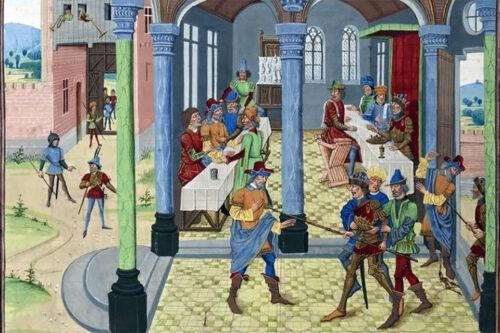
Turning towards the southeastern end of Île de la Cité, we enter what was once the cloître Notre-Dame, the precinct associated with the cathedral chapter.
Unlike the modern meaning of cloister, this was not simply a covered walkway surrounding a monastic courtyard. Rather, it was an extensive ecclesiastical neighbourhood, containing houses, gardens, courtyards and buildings belonging to the canons of Notre-Dame. These canons were powerful and wealthy men. Some were scholars and theologians, while others held important offices in the royal administration or possessed substantial private fortunes.
Their houses could be remarkably luxurious. One particularly revealing example is the Hôtel du Terrail, the residence of Étienne de Montdidier, a canon of Notre-Dame and president of the Chambre des enquêtes of the Parlement of Paris. Although the house no longer exists, its probable location near the eastern end of the cathedral precinct has been reconstructed through property records and historical maps. More importantly, an exceptionally detailed inventory compiled after Montdidier’s death in 1468 allows us to explore its interior.
The residence contained no fewer than 28 rooms distributed over several storeys. Arranged between a courtyard and a garden, it included reception rooms, private apartments, kitchens, storage areas and studies. The largest reception room was furnished with substantial benches, tables, dressers and fireplaces. Elsewhere, a gallery overlooking the garden contained furniture for relaxation, together with a birdcage. Other rooms were devoted to intellectual activities. One study contained thirteen writing desks, providing space for approximately fourteen people to work simultaneously. The researchers who examined the inventory have suggested that part of the residence may have functioned as a private school, although this remains uncertain.
Montdidier’s house was no isolated exception. Research into the homes of other canons has revealed a neighbourhood of substantial residences, often with gardens, courtyards, private chapels and elaborate domestic furnishings. This was effectively a small aristocratic enclave within one of Europe’s most densely inhabited cities. Standing in the streets near the eastern side of Notre-Dame, visitors can therefore imagine a landscape quite different from the present one: large private houses concealed behind walls and gateways, with gardens, galleries, servants and scholars occupying the space between the cathedral and the Seine.
3. Héloïse and Abelard: love and learning in the cathedral quarter
Not far from the vanished Hôtel du Terrail, the streets of the former cathedral precinct preserve memories of one of the most celebrated intellectual and personal relationships of the Middle Ages. Here, in the early twelfth century, the philosopher Peter Abelard became tutor to Héloïse, the exceptionally learned niece of Canon Fulbert. While Abelard was already renowned as a brilliant and controversial teacher, Héloïse, possessed an unusual education for a young woman of her time, including a command of Latin and an extensive knowledge of classical literature. Their intellectual relationship developed into a love affair, followed by a secret marriage, the birth of a son, and a series of events that eventually separated them.
The story became famous through Abelard’s autobiographical account and the correspondence associated with the couple. Yet it was more than a medieval romance. Their writings raised profound questions about marriage, love, scholarship, religious vocation and the relationship between individual conscience and institutional authority.
Traditionally, Canon Fulbert’s residence has been associated with the area around rue Chanoinesse, rue des Chantres and the present quai aux Fleurs. At 9–11 quai aux Fleurs, a nineteenth-century building bears commemorative decorations recalling Héloïse and Abelard. The original medieval structures have disappeared, and the precise identification of their residences remains disputed. Nevertheless, the neighbourhood itself is historically significant. The rue Chanoinesse, whose name recalls the cathedral canons, preserves part of the old street network of the ecclesiastical precinct. The nearby rue des Chantres similarly recalls the singers attached to the cathedral. These streets allow visitors to imagine the setting in which clerics lived, scholars gathered and teaching took place before the University of Paris developed into a formally organised institution. Here, intellectual life was closely connected with domestic life. Teaching could occur in houses, rented rooms and religious institutions, while students and masters moved between the cathedral, the Left Bank and the commercial quarters of the city on the Right Bank
4. Sainte-Chapelle: the royal vision of a heavenly Jerusalem


A short walk westwards brings us to Sainte-Chapelle, another masterpiece of Gothic architecture. Built for Louis IX, later canonised as Saint Louis, the chapel was consecrated in 1248. Its principal purpose was to house some of Christianity’s most precious relics, including the Crown of Thorns, acquired by the king in 1239. The acquisition of the relics and the construction of the chapel were acts of extraordinary religious and political significance. By bringing these treasures to Paris, Louis IX strengthened the city’s position as a sacred centre of Christian kingship. Sainte-Chapelle became, in effect, a monumental reliquary at the heart of the royal palace.
The chapel consists of two levels. The lower chapel served members of the royal household, while the upper chapel was closely associated with the king and the sacred relics. Entering the upper chapel is still an extraordinary experience. Fifteen enormous stained-glass windows rise towards the vaulted ceiling, transforming the walls into a shimmering enclosure of light. Here, biblical narratives encompass the history of the world from Creation onwards, culminating in scenes associated with the arrival of the relics in Paris. Finally Royal symbols, including fleurs-de-lis and Castilian castles, connect sacred history with the Capetian dynasty. The chapel illustrates how medieval architecture could embody political theology. Here, the king presented himself not merely as a secular ruler but as a guardian of Christianity’s most sacred treasures.
5. The Conciergerie: inside the royal palace
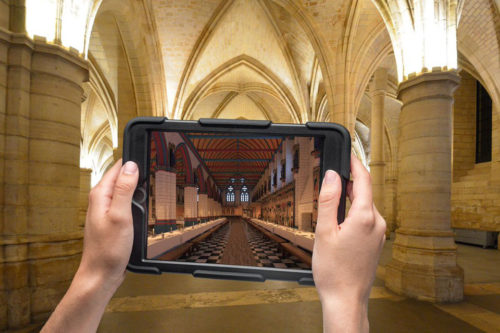
Sainte-Chapelle originally formed part of a much larger architectural complex: the Palais de la Cité, the principal royal residence in medieval Paris. Although most of the medieval palace has disappeared or been extensively transformed, important sections survive within the Conciergerie.
During the reign of Philip IV, known as Philip the Fair (1285–1314), the palace underwent major rebuilding. Its monumental halls proclaimed the authority of the French monarchy at a time when royal administration was becoming increasingly elaborate. The most impressive surviving interior is the Salle des Gens d’Armes, an enormous vaulted hall supported by rows of stone columns. This was not the king’s ceremonial hall. Instead, it formed part of the working infrastructure of the palace, serving the royal household and its numerous attendants. Nearby are the Salle des Gardes and the medieval kitchens, which illustrate the practical demands of maintaining a great royal residence.
The palace was also a place of extraordinary political theatre. Here, elaborate ceremonies and royal banquets were staged demonstrating the wealth, sophistication and political ambitions of the French monarchy. By the later fourteenth century, however, the kings increasingly preferred their residences at the Louvre and Vincennes. Judicial and administrative institutions remained on the island, and parts of the palace gradually became associated with imprisonment. Later, the Conciergerie later acquired particular notoriety during the French Revolution, when it housed prisoners awaiting trial and execution, including Marie Antoinette.
Today, the building combines these two very different histories. For visitors interested in the Middle Ages, the surviving Gothic halls offer a rare opportunity to experience the scale and organisation of a royal palace.
At the western end of the island, the Square du Vert-Galant offers a peaceful view of the Seine and the bridges connecting Île de la Cité with the rest of Paris. Here lay the royal gardens attached to the Conciergerie, where we might join the French kings while considering the importance of the river. The Seine supplied the capital with food, raw materials and manufactured goods while connecting Paris with the countryside and the wider trading networks of northern France. Boats carried grain, wine, timber, firewood and building stone into the capital. Meanwhile, the riverbanks provided landing places, warehouses and workshops. Unlike most modern Parisian bridges, some medieval bridges were lined with houses and shops. Crossing the river could therefore feel like passing through another narrow urban street rather than moving across an open structure. The Île de la Cité was consequently both a geographical centre and a commercial crossroads binding together the religious and learned quarters on the Rive Gauche with those on the mercantile side of the Rive Droite. While the Îls de la Cité offers some possibilty to revoke medieval Paris, the challenges are greater leaving. Nevertheless, two destinations are worth visiting.
6. Across the Seine to the Rive Gauche: the Hôtel de Cluny
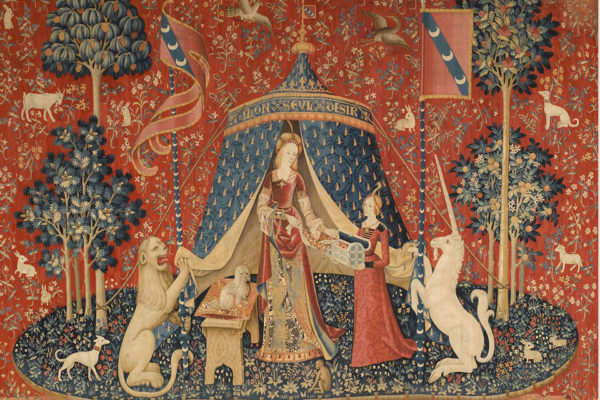
Crossing Pont-l’Évêque to the Left Bank at the Hôtel de Cluny, one of the finest surviving examples of late medieval domestic architecture in Paris. Built mainly between 1485 and 1510 for the abbots of Cluny, the residence reflects the wealth and status enjoyed by powerful ecclesiastical institutions towards the end of the Middle Ages. Unlike the soaring architecture of Notre-Dame and Sainte-Chapelle, the Hôtel de Cluny offers a more intimate impression of medieval architecture withits courtyard, elaborate stonework, domestic rooms and private chapel illustrate the surroundings in which wealthy and influential members of medieval society lived.
Today, the building houses the Musée de Cluny – Musée national du Moyen Âge, one of Europe’s most important collections of medieval art. Among its treasures are the celebrated Lady and the Unicorn tapestries, examples of Gothic sculpture, illuminated manuscripts, stained glass, ivories and objects associated with religious and domestic life.
The museum also incorporates remains of the Roman baths of ancient Lutetia, making the site an unusually rich place in which to explore the successive historical layers of Paris. For anyone wishing to understand medieval life beyond the great monuments, the Musée de Cluny is an indispensable destination.
7. The houses of Nicolas Flamel: charity and property in medieval Paris
Source: Wikipedia
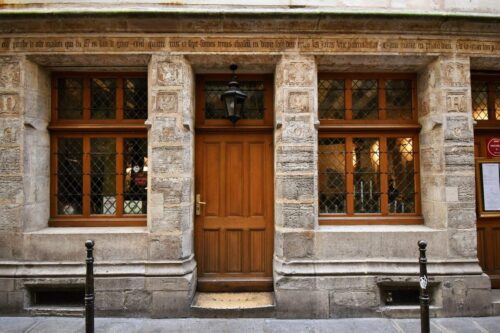
Finally, leaving the island for the Rive Droite, we move from the world of bishops and kings into the commercial neighbourhoods of late medieval Paris. At 51 rue de Montmorency stands one of the city’s most remarkable surviving medieval domestic buildings: the house built by Nicolas Flamel in 1407. Flamel is best known today as a legendary alchemist, but the historical Nicolas Flamel was a prosperous Parisian escrivain, involved in the business of writing, property ownership and charitable foundations. Together with his wife Pernelle, he accumulated a substantial portfolio of houses and rents in Paris. The building in rue de Montmorency, traditionally known as the Grand Pignon, was not his private residence. Rather, it was a house intended to accommodate poor inhabitants, with commercial premises on the ground floor. The surviving façade provides an extraordinary glimpse of late medieval urban architecture. Its stone pillars are decorated with carved figures and inscriptions. Above the ground floor, a long inscription records the date of the foundation and the religious obligations associated with the accommodation. Simply put, the inhabitants were expected to pray for the dead, including the benefactors whose wealth supported the establishment. Here, the architecture of charity was closely connected with the medieval economy of remembrance, according to which property could generate revenue, provide accommodation and secure prayers intended to benefit the souls of the founders after death. Its original appearance has been altered, including the loss of the prominent gable from which it derived its name, but the surviving medieval elements remain remarkable.
Flamel himself lived elsewhere, in the neighbourhood of Saint-Jacques-de-la-Boucherie, where he worked and acquired property (marked on the map above. However, this private residence has disappeared, as has the church of Saint-Jacques-de-la-Boucherie, apart from its celebrated tower. Thus, the surviving charitable house provides the only material connection with one of the best-documented inhabitants of late medieval Paris. It also reminds us that the medieval city was sustained not simply by royal and ecclesiastical institutions but by an active property market, private investment, commercial enterprise and religious charities.
Rediscovering the lost city
What survives of medieval Paris is only a fraction of the city that once existed, a fate it suffers with most larger European capitals. Nonetheless, Notre-Dame and Sainte-Chapelle preserve the religious and political ambitions of medieval bishops and kings. The Conciergerie reveals the monumental setting of royal government. The archaeological crypt offers glimpses of ordinary houses and streets, while the city walls bear witness to the expanding metropolis.
Yet perhaps the most revealing encounters are those with the city’s domestic landscape. The vanished Hôtel du Terrail demonstrates the wealth and intellectual activities of the cathedral canons. The streets associated with Héloïse and Abelard remind us that Paris was already a great centre of scholarship during the twelfth century. And finally, the surviving house of Nicolas Flamel reveals how property, charity and religious commemoration were woven into the everyday fabric of the late medieval city.
Finally, the Hôtel de Cluny provides an opportunity to explore the material culture of wealthy ecclesiastical households towards the end of the Middle Ages. Together, these places reveal a city inhabited by scholars, clerics, officials, craftsmen, merchants, servants and the poor – people whose lives unfolded in the spaces between the great monuments.
FEATURED PHOTO:
Île de la Cité. Detail. From Les Tres Riches Heures du Duc du Berry. Source Wikipedia


