


New book on the Angevin World circumvent a touchy English question. Was there ever an “Angevin Empire”?
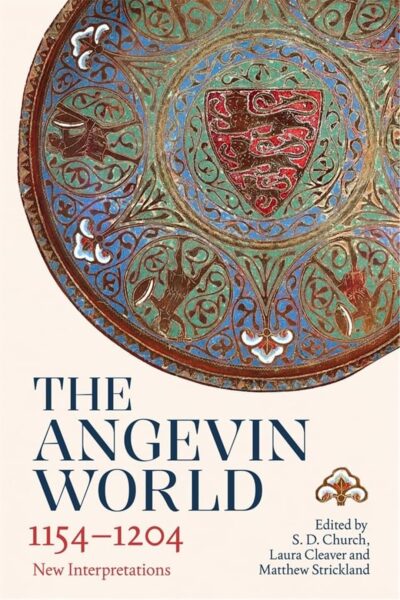
The Angevin World, 1154-1204. New Interpretations
Edited by Stephen D Church, Laura Cleaver, Matthew Strickland. Contributions by Antonella Liuzzo Scorpo, Bernardo Santano Moreno, Colin Veach, Frederic Boutoulle, Jitske Jasperse, Kathryn Dutton, Laura Cleaver, Mai͏̈té Billoré, Matthew Strickland, Michael Staunton, Sigbjørn Olsen Sønnesyn, Stephen D Church, Alheydis Plassmann, Martin Aurell
Boydell & Brewer 2026
REVIEW

Reaching from Northumbria to Gascony and partly encompassing Wales, Ireland, and Scotland, the French call it l’espace Plantagenêt, while the English, since the days of Queen Victoria (launched in the writings of Kate Norgate in 1887), have preferred to talk about the “Angevin Empire”. This is indeed still the name of the relevant article in Britannica as well as Wikipedia, thus contributing to the continuing English idea of being a world power on a par with other – more or less evil – “empires”, such as the USA, China, Russia, and Europe (the latter being, in its own understanding, the true heir of Charlemagne).
Looking from a wider European perspective, this seems decidedly odd. At this point in time, there were two recognised empires in Europe: Byzantium and the Holy Roman Empire. While the first was a direct heir to the Roman Empire, the latter was a fascinating construct moulded on Charlemagne’s bold drive to supersede the emperor in Constantinople, whose chair might have been considered vacant in AD 800. Having established Francia as the centre of the Roman Empire, this overlordship was inherited by his heirs after a short lapse between 924 and 954, continuing up to the Napoleonic era. During the tenth to thirteenth centuries, a system was established echoing the Church’s organisation, whereby German kings were more or less in the manner of popes elected as overlords – that is, as a kind of primus inter pares operating among lesser princes in the German realm. Thus, not just dukes but also minor kings were considered enfeoffed. For instance, the kings of Bohemia, Hungary, and initially Poland were also seen as dependants.
As is well known, and noted in the present book, Henry II and his sons did not formally fit this mould, nor did they apparently seriously consider that they did. Part of this was that these rulers were well aware of the fact that a vast territories in their realm was held as a fief. The Plantagenet dynasty may de facto have ruled England as kings; however, their French duchies and counties were on the other hand de jure held as fiefs, with the French king as overlord. It appears that all the Angevins did homage to the French king, whether willingly or otherwise. It has also been suggested that Henry II was careful not to overstep towards ‘the real emperor’, Frederick Barbarossa, who was violently protective of his title and his honor imperii.
Nevertheless, Henry II and his sons did for a long time succeed in wielding their might across most of western and northern France. At the time of his death in 1189, the lands which Henry II had brought under his rule through inheritance, marriage, and military might stretched from Northumbria to Gascony and across the Irish Sea. This vast agglomeration was a dominant force in the politics of western Europe until its fragmentation under John, beginning with the loss of Normandy to the French king Philip Augustus in 1204. Yet beyond the forceful personalities of its rulers, what – if anything – bound these wide and disparate lands together? To what extent were they interconnected politically, economically, and culturally?
This is the wider question which the book raises and seeks to illuminate through a number of articles presenting different aspects, approaches, and scholarly traditions. Published in 2026, it appears the question was first voiced at a conference in 2013, which led to a broader widening of the circle to encompass scholars from other traditions – for instance the Annales tradition and historical anthropology.
Along these lines, ‘this multi-disciplinary volume brings together specialists in history, literature, material culture, art history, and manuscript studies to approach these questions from a range of different perspectives. From the cultural interactions of courts to political thought and symbols of power, the diffusion of historical writing, and practical responses of the Angevins to the challenges of governing – whether in Aquitaine or in Ireland – and of waging war in expansion or defence of their territories, this book aims to provoke fresh thinking regarding how we understand the complex nature of the Angevin lands.’
Indeed, this is a solid introduction to the themes touched upon in the collection. Although varying in quality, some of these essays offer both delightful overviews and succinct introductions to parts of the Angevin world. And yet it is also somewhat unsatisfying.

The reason is that while the volume does indeed cover this ground, the editors have nevertheless organised the material in a very traditional way. Whilst the list above mentions “cultural interactions at court” first, the organisation of the papers is predictable and hence somewhat disappointing, placing the two contributions touching directly upon these aspects at the end, although they obviously present symbolic keys to the enactment of rule in the 13th century.
Instead, we start out with armies and their recruitment, move on to practices of government in the form of law and inquests, and further on read about the social fabric of networking as evidenced by charters, before moving on to the image and experience of what it might mean to operate as king in some contexts and count in others. Further chapters deal with how rule was enacted in Britain and Ireland. Only then, as said, do we meet papers dealing with the cultural setting of the Angevin world – covering gift-giving, artefacts, swords, myths, and story-telling. The volume ends with two chapters outlining the view from abroad, that is from Spain. (The question of what the Germans or the French ‘thought’ is not covered.)
This ordering would not in itself be problematic, as it nicely reproduces the traditional format for such overviews. The point, however, is that the introduction “promises” another and more cultural-historical approach.
Does this matter? Yes, in so far as this turns out not to be a book about the Angevin world as the title suggests. Using the concept of ‘world’ in the heading indicates that this book might have been about something quite different: an encapsulated rendition of a lifeworld and mentality, totally different from our own, a distinctive world of life and thinking. Instead, we get a traditional “English Whitehall” take on the Angevin “empire”, focusing on the administration and more or less smooth running of the wider realm.
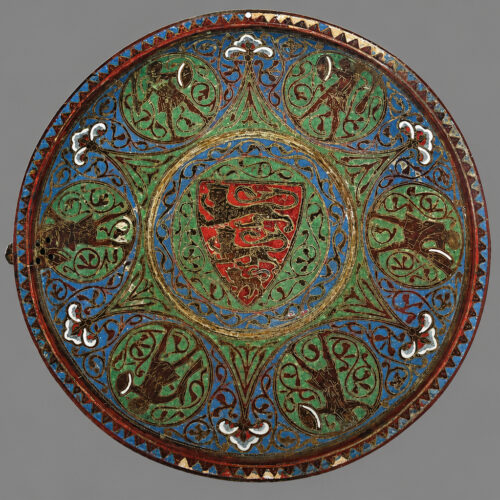
Which is, of course, interesting in itself. However, the title and cover promise us something else — perhaps in the style of Fredric L. Cheyette’s book on Ermengard of Narbonne and the World of the Troubadours (Cornell University Press, 2001).
However, anyone aiming to write this future book, will get much substantial ground to work from in this new book. As such, it is definitely worth reading.
TABLE OF CONTENT
- Introduction, by S. D. Church.
- Armies of Empire? Military Interconnectivity in the Angevin Lands, by Matthew Strickland.
- Practices of government: power and rule in the continental possessions of the Angevin Empire under the early Plantagenets, by Maité Billoré and Frederic Boutoulle.
- Henry II’s networking on the continent, by Alheydis Plassmann.
- The image and experience of Angevin power in Anjou before and after 1154, by Kathryn Dutton.
- The Angevin Empire in Britain and Ireland, by Colin Veach.
- Gerald of Wales on Imperial Clemency and Angevin Tyranny in De principis instructione, by Sigbjørn Olsen Sønnesyn.
- Is it all about Empire? The Angevins through the Lens of Gift Giving, by Jitske Jasperse.
- History Books in the Angevin World: Culture, Communication and Community, by Laura Cleaver.
- The Sword in the Angevin Empire: Myth, Legend, Theology, by Martin Aurell.
- Challenging “exceptionalism”: Re-assessing twelfth-century Angevin-Aragonese relationships, by Antonella Liuzzo Scorpo.
- The Image of the Angevin Kings and the “History” of the Histories of England in the Spanish-Speaking World, by Bernardo Santano Moreno.
FEATURED PHOTO
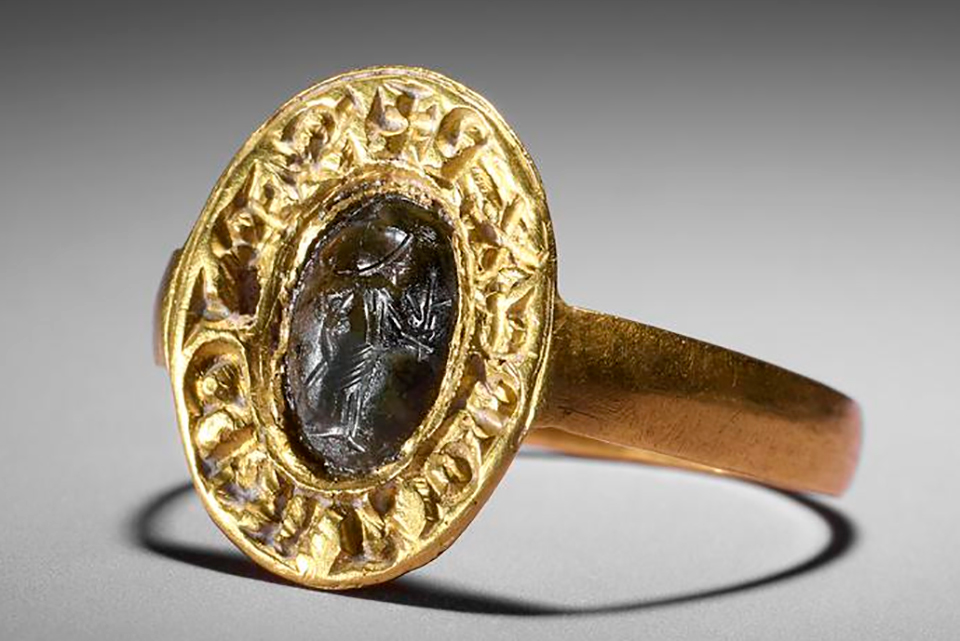
Ring allegedly belonging to Richar the Lionheart British Museum 1613188845/CCBYSA40. The ring is discussed in the paper by Jitske Jasperse.


