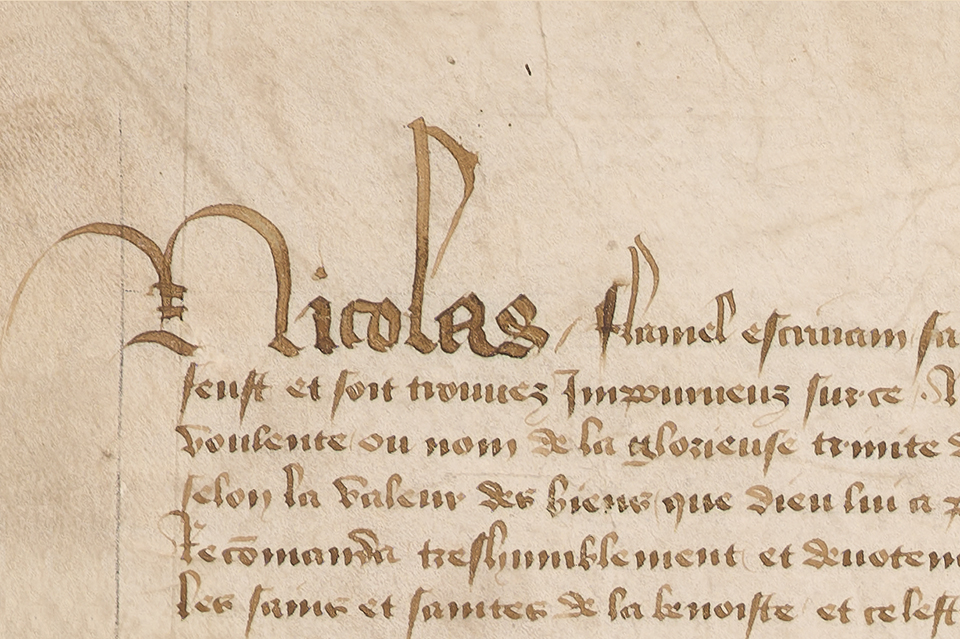
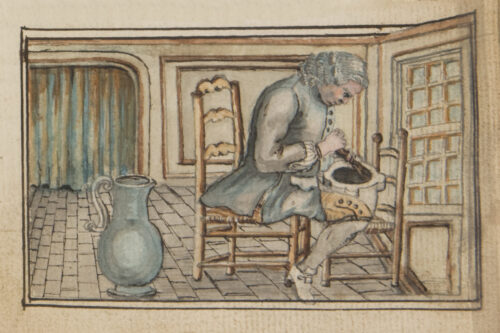
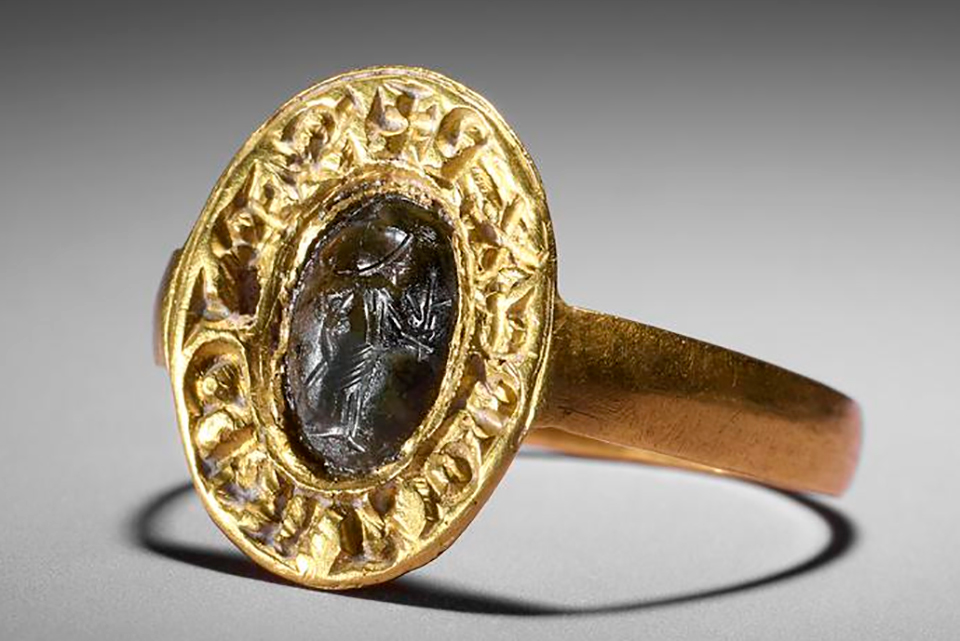
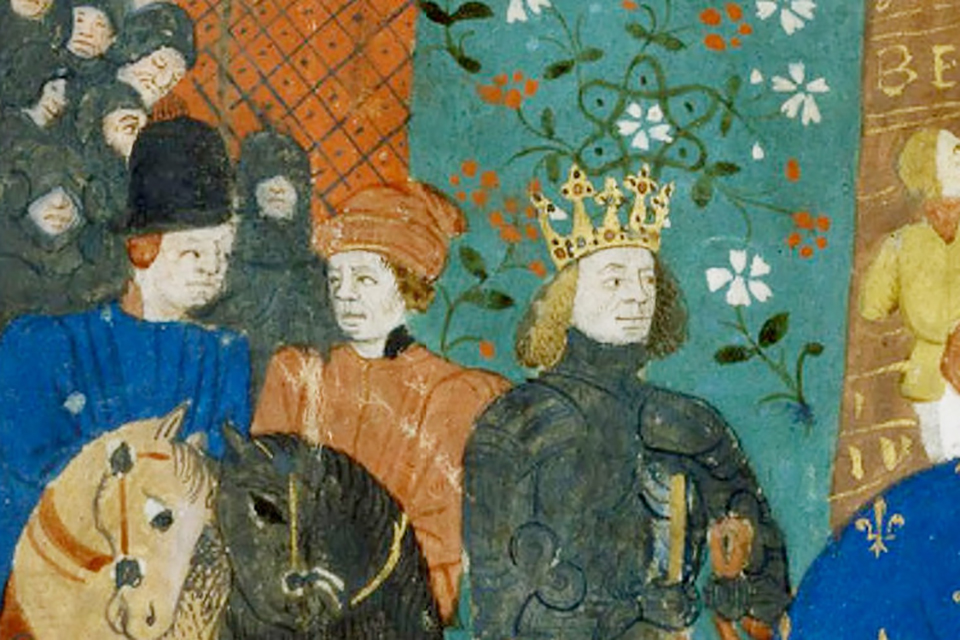
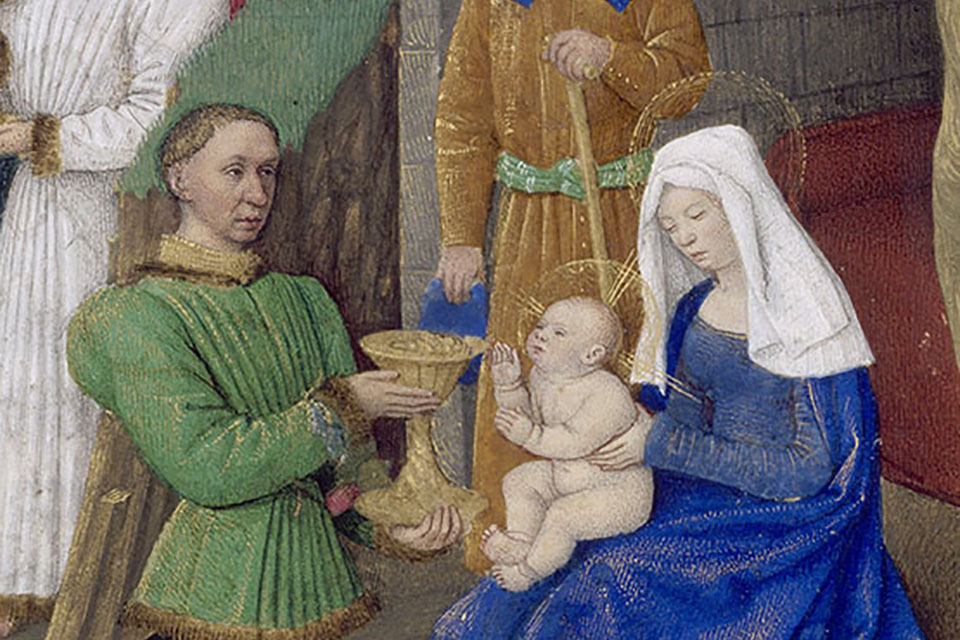
Nicolas Flamel, was a very wealthy Parisian slumlord making his living from renting out rooms and apartments in houses build on the right side of the Seine in the fourteenth and fifteenth centuries. Upon his death, he donated his entire wealth to churches and hospitals to atone for his sins.
How did a wealthy Parisian property investor and benefactor become one of the most famous alchemists in history? A new exhibition at the Musée de Cluny in Paris explores the extraordinary transformation of Nicolas Flamel from a medieval businessman into an immortal magician
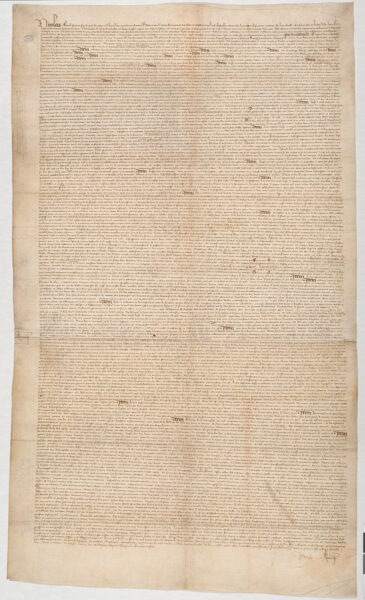
He could hardly have imagined what would happen next. Within a century, this respectable Parisian businessman had begun to acquire an entirely different reputation. According to increasingly elaborate accounts, Flamel had discovered the secret of the philosopher’s stone, mastered the transformation of base metals into gold and perhaps even achieved immortality. By the seventeenth century, he had become one of the most celebrated alchemists in Europe. Later, his legend would attract the attention of scientists, philosophers, poets and novelists, eventually securing him a place in the magical universe of Harry Potter. Yet there is a curious problem with this remarkable story. Apparently nothing in the surviving documentation from Flamel’s lifetime suggests that he ever practised alchemy. At least, this is the impression we are left with in the new exhibition, recently opened. Running from 13 October 2026 to 24 January 2027, Nicolas Flamel, alchimiste de papier, at the Musée de Cluny – Musée national du Moyen Âge, explores the historical man behind the legend. The exhibition brings together approximately fifty objects, manuscripts, archival documents and other materials, including Flamel’s epitaph, his 1416 testament and important alchemical texts attributed to him after his death.
A Man of Property in Medieval Paris
Born around 1330 or 1340, Nicolas Flamel lived through some of the most turbulent decades in the history of medieval France. His lifetime encompassed the devastation of the Black Death, the Hundred Years’ War, repeated outbreaks of plague, political upheavals and the growing instability of the French monarchy. Nevertheless, Paris remained a major European metropolis, with its markets, churches, university, monasteries and expanding urban neighbourhoods. For those with sufficient capital and commercial acumen, the city also offered considerable opportunities. Flamel belonged to this prosperous urban world. In contemporary documents, he was described as an escrivain and bourgeois de Paris – a Parisian burgher. Traditionally, this designation has led historians to identify him as a professional copyist, bookseller or producer of legal documents. However, as the exhibition emphasises, no surviving examples of his professional work have been securely identified. Consequently, the precise nature of his occupation remains uncertain. What seems certain according to his testament is, that his income primarily derived from his activities as a harsh slumlord or rack-rent landlord involved in developing the quarters on the Eastern side of the Seine, La Rive Droite.
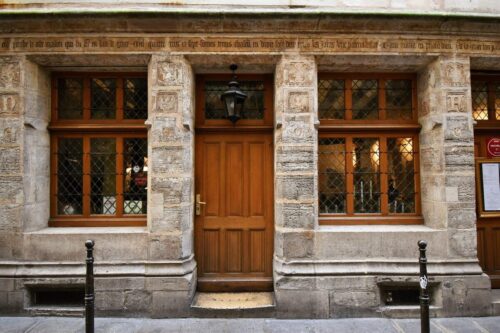
Nicolas Flamel’s House in Rue de, Montmorency in Paris. The House is generally regarded as the oldest house in Paris. Just below the corniche, an inscription in old French (here translated) sounds: demourans ou porche de ceste maison qui fut faite en l’an de grâce mil quatre cens et sept somes tenus chascun en droit soy dire tous les jours une paternostre et un ave maria en priant Dieu que sa grâce face pardon aus povres pescheurs trespasses Amen. In translation it reads: “We, men and women, workers living in the porches of this house that was made in the year of grace one thousand four hundred and seven are, each of us, required by law to say every day one Our Father and one Hail Mary while praying to God that his grace brings forgiveness to the poor deceased sinners, amen”. Source: Wikipedia
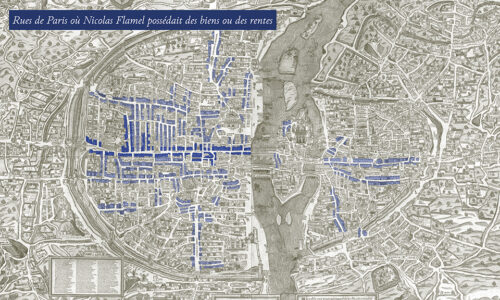
What we also know is that he was an extraordinarily successful investor, known to have lent or gifted substantial sums to the French King. Around 1363, Flamel married Pernelle, who became his partner in the acquisition and management of property. Likely, their accrued wealth derived from her inheritance. Twice widowed, she does not seem to have been very pleased with her third marriage. According to law, though, she was obliged to suuport her man. Their first documented purchase, in 1375, was a house known as the Fleur de lys, where they subsequently lived. Over the following decades, the couple steadily accumulated houses and, more importantly, rents secured on properties throughout Paris and its suburbs. By the time Flamel died, his estate included approximately ten houses and nearly 300 separate rents. These were concentrated particularly on the Right Bank, in areas south of the priory of Saint Martin des Champs and within the new city walls, completed around 1380.
This was a shrewd choice. Parts of the district were still relatively undeveloped, but the expansion of Paris promised increasing demand for housing and commercial premises. In effect, Flamel had invested in the future growth of the city. One of his more substantial building projects was a house constructed in 1407 in what is now the rue de Montmorency. Still standing at number 51, it remains one of the most evocative material reminders of his presence in medieval Paris. Yet Flamel’s prosperity was not simply a matter of accumulating wealth. Like many affluent medieval townspeople, he used his fortune to establish himself within the religious and social landscape of the city.
To understand Nicolas Flamel, we must remember that medieval property ownership was not solely concerned with financial security or social standing. Wealth could and would also be converted into spiritual benefits. For prosperous Christians, the foundation of masses, charitable donations and the construction or embellishment of churches offered opportunities to secure prayers for their souls. Such arrangements created enduring relationships between donors and religious institutions. They also allowed wealthy individuals to inscribe themselves into the fabric of their communities. Flamel was particularly energetic in this respect. Together with Pernelle, he financed improvements to churches, chapels and religious buildings across Paris. In 1389, the couple contributed to the refurbishment of the church of Saint Jacques de la Boucherie, their parish church, where they were subsequently depicted kneeling before the Virgin Mary on a thympanum.
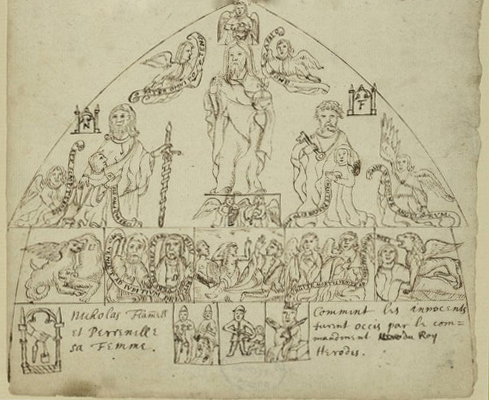
Elsewhere, their images appeared on an arcade in the cemetery of the Saints Innocents, where they were represented praying before Christ, surrounded by angels. Following Pernelle’s death in 1397, Flamel continued these activities. In 1402, he contributed to the restoration of Sainte Geneviève des Ardents, where another representation showed him in prayer, wearing a long hooded tunic.
These were not incidental decorations. They belonged to a carefully organised culture of commemoration in which images, inscriptions, donations and prayers reinforced one another. Indeed, Flamel appears to have been especially conscious of the importance of ensuring that his presence remained visible. His initials and likeness were displayed on portals, arcades and buildings, while his charitable foundations were intended to preserve his name within the liturgical memory of the city. At his death he donated a number of chalices to religious foundations and churches in Paris, which were emphatically ordered to be decorated with his initials NT.
His final arrangements were equally elaborate. In his will, drawn up in 1416, Flamel designated his parish church as his universal heir. He also made provisions intended to preserve the charitable and religious foundations established by himself and Pernelle. Yet there was a complication. A surviving codicil shows that he wished to combine the resources of both estates to ensure that their respective commemorative obligations would continue. Unfortunately, the her will had not been properly notarised and was therefore legally ineffective.
Consequently, the commemorative masses established by Pernelle eventually ceased for want of sufficient funds. Those founded by Nicolas, however, continued to be celebrated until shortly before the French Revolution. There is something revealing about this imbalance. Even in a marriage characterised by substantial joint investment, the mechanisms of inheritance and religious patronage could preserve the memory of one spouse more successfully than the other.
In a wider perspective, Flamel’s arrangements illustrate how much effort a wealthy medieval individual might devote to controlling the circumstances of his remembrance. He did not merely wish to leave money behind. He wished to ensure that his name would remain associated with piety, generosity and the salvation of his soul. In this endeavour, he was remarkably successful. His donations intended to secure him a deliverance from purgatory continued up to the French Revolution.
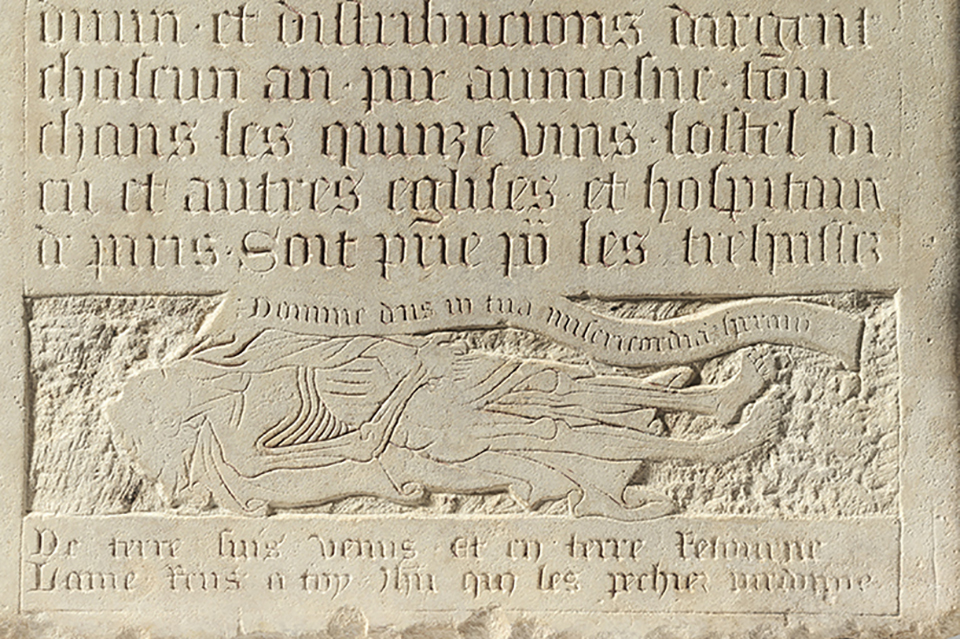
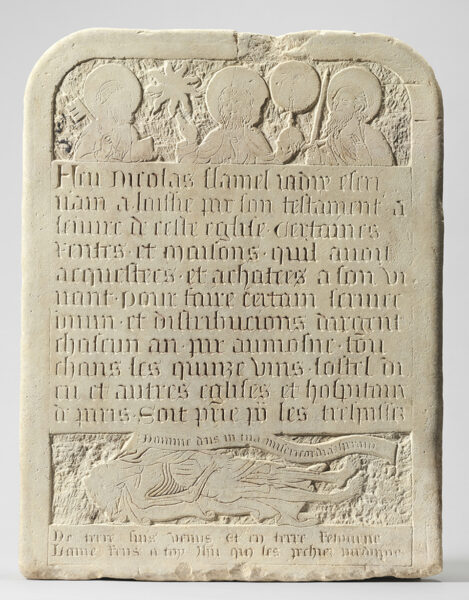
Perhaps the most remarkable surviving testimony to Flamel’s concern with posterity is his epitaph, now preserved in the Musée de Cluny. According to his testament, Flamel commissioned the stone during his lifetime and kept it in his house until his death on 22 March 1418. It was then installed above his grave inside Saint Jacques de la Boucherie.
The stone records his charitable foundations and commemorates his concern for the poor and the religious institutions of Paris. Decorated with religious imagery, it reflects the world of late medieval piety. Its subsequent history is almost as improbable as the legends attached to its owner. Following the demolition of Saint Jacques-de la Boucherie in 1797, the epitaph disappeared. Eventually, a dealer in curiosities and shells discovered it in the possession of a Parisian fruit seller, who was using the medieval funerary slab to display spinach. The stone subsequently passed through the hands of several dealers before attracting the attention of the authorities in 1839. The City of Paris purchased it for 200 francs, initially intending todisplay it in the restored Tour Saint-Jacques, the surviving tower of Flamel’s former parish church. In the end, though, it entered the collections of the Musée de Cluny in 1845. This epitaph provides the starting point for the new exhibition, which brings together approximately fifty manuscripts, archival records, objects and other materials to reconstruct the history of Flamel. And not least, his subsequent transformation into an alchemist.
This is a curious story. To put it simply, at some point this Late Medieval pious man was turned into the epiphenomena of an alchemist.
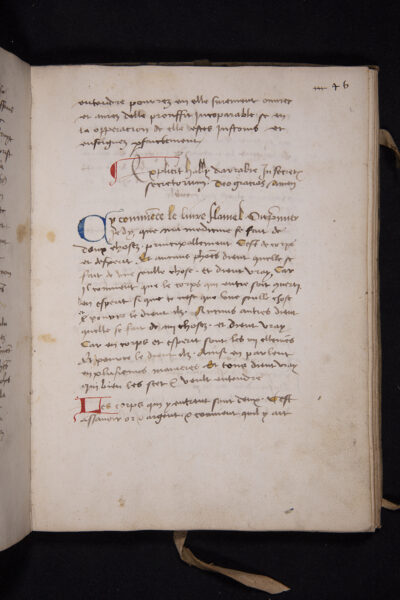
According to the sources, it appears that 60 to 80 years after his death, Flamel emerged as a man with a distinctly different reputation, that of an alchemist. The first signs of Flamel’s transformation emerged towards the end of the fifteenth century, several decades after his death. A manuscript now preserved in the University Library of Bologna, known as the Livre Flamel, is perhaps the earliest surviving alchemical work associated with his name. Written in French and dated to the late fifteenth century, it consists of two parts: a Theorica, discussing the principles of metallic transmutation, and a Practica, outlining a complicated procedure for achieving it. It is part of the exhibition in Paris.
Its instructions were sufficiently obscure to leave considerable room for interpretation. Nevertheless, the work circulated, was copied and translated, and gradually contributed to the reputation of Flamel as an authority on alchemy. Crucially, however, there is no evidence that the historical Nicolas Flamel wrote it. This phenomenon is known as pseudepigraphy – the attribution of a text to someone other than its actual author; and within medieval and early modern intellectual traditions, pseudepigraphic writings were particularly common in fields where authority depended on the possession of ancient or secret knowledge. A treatise attributed to a respected historical figure could thus acquire a credibility that an anonymous text might otherwise lack. Moreover, once such an attribution had entered the manuscript tradition, subsequent copyists and authors could reinforce it simply by reproducing the name.
Over time, however, Flamel’s supposed writings multiplied. In 1561, the Sommaire philosophique appeared in a collection devoted to the transmutation of metals. Written in verse, it presented alchemical teachings through metaphors, alliteration and personification. However, the decisive transformation occurred in 1612, with the publication of the Livre des figures hiéroglyphiques – the Book of Hieroglyphic Figures. This work did something fundamentally different from the earlier treatises. Rather than merely presenting alchemical instructions under Flamel’s name, it transformed him into the protagonist of an extraordinary autobiographical adventure. According to the account, Flamel had purchased a mysterious illustrated manuscript known as the Book of Abraham from an unknown stranger for two florins. For twenty-one years, he struggled to decipher its enigmatic images and instructions. Finally, he undertook a pilgrimage to Santiago de Compostela. During his journey, he encountered a Jewish physician named Master Canches, who helped him understand the mysterious text. Returning to Paris, Flamel devoted another three years to study, prayer and experimentation. Finally, on 17 January 1382, he succeeded in transforming mercury into silver. Then, on 25 April 1382, at approximately five o’clock in the afternoon, he accomplished the ultimate feat: the transmutation of mercury into gold. He had discovered the philosopher’s stone.
With this revelation, the entire history of the medieval businessman was transformed. His wealth no longer needed to be explained through property investment, commercial success or the accumulation of rents. Instead, it could be attributed to his mastery of the most elusive secret of nature. Following this, his charitable foundations acquired an equally remarkable explanation. Having produced gold through alchemy, Flamel had generously distributed his riches among the churches and hospitals of Paris. Even the religious images with which he had adorned the city were reinterpreted. According to the Livre des figures hiéroglyphiques, the sculptures on the arcade he had commissioned at the cemetery of the Saints-Innocents concealed alchemical secrets.
The anonymous author had taken authentic elements of Flamel’s biography – his wealth, charitable foundations, pilgrimage associations and commemorative sculptures – and rearranged them into a narrative of secret knowledge and miraculous discovery. In other words, the very monuments Flamel had commissioned to preserve his memory as a pious Christian benefactor became the evidence used to establish his reputation as an alchemist.
What Was Medieval Alchemy?
To understand why the story proved so compelling, it is necessary to consider what alchemy meant to medieval scholars. Today, alchemy is frequently dismissed as an irrational attempt to manufacture gold. Yet this interpretation overlooks the intellectual and practical complexity of the discipline. Medieval alchemy developed within a tradition of natural philosophy concerned with the properties of matter, the processes of transformation and the relationship between the visible world and the principles thought to govern it. Alchemists experimented with heating, distillation, dissolution and the combination of substances. Their workshops contained crucibles, mortars, vessels, furnaces and alembics. Some of their techniques contributed to the development of later chemical practices, even though their theoretical understanding of matter differed fundamentally from modern chemistry.
Central to many alchemical traditions was the idea that metals could undergo processes of purification and perfection. Gold, being resistant to corrosion and possessing distinctive physical properties, was often regarded as the most perfect of metals. Accordingly, the transformation of less perfect metals into gold could be understood as the acceleration or completion of a natural process. The philosopher’s stone was believed to possess the power to bring about this transformation. Furthermore, alchemical literature frequently described the process through symbolic stages, particularly blackening, whitening and reddening – nigredo, albedo and rubedo. These transformations were represented through elaborate imagery involving death, purification, resurrection and renewal. Consequently, alchemy occupied an ambiguous intellectual territory, combining practical experimentation, natural philosophy, cosmological speculation and religious or spiritual symbolism.
It is within this wider intellectual setting that the legend of Flamel must be understood. By attributing obscure alchemical writings to a successful medieval Parisian, later authors created an apparently historical example of someone who had achieved what generations of alchemists hoped to accomplish.
From the Philosopher’s Stone to the Immortal Magician
During the seventeenth and eighteenth centuries, Flamel finally became increasingly established within the European alchemical tradition as the epiphenomenon of an “alchemist” . Texts attributed to him appeared in major collections, including the Musaeum Hermeticum, the Bibliotheca Chemica Curiosa and the Bibliothèque des philosophes chimiques. Through these publications, the supposed writings of the Parisian alchemist reached readers far beyond France.
Among those who studied the Flamel tradition was Isaac Newton. The exhibition notes that Newton made a study of the Livre des figures hiéroglyphiques and produced a drawing of one of the monuments raised to commemorate the man. This should not surprise us. Newton’s extensive engagement with alchemical literature belongs to a period when the boundaries between chemistry, natural philosophy and older theories of transmutation were still being negotiated.
However, Flamel’s legendary career did not end with his incorporation into the history of alchemy. As the Enlightenment increasingly challenged the authority of alchemical writings, the Parisian began to acquire a different kind of existence: that of a literary character.
In the nineteenth century, Romantic writers then discovered in Flamel an ideal figure through whom to explore forbidden knowledge, ambition, mystery and the disturbing possibilities of human transformation. Gérard de Nerval drew on the traditions surrounding Flamel in dramatic works, while Victor Hugo incorporated him into the imaginative world of Notre-Dame de Paris. In Hugo’s novel, Flamel becomes associated with the alchemical interests of the tormented archdeacon Claude Frollo. Also, Alexandre Dumas repeatedly reinvented him, eventually portraying him as a physician involved in the treatment of the mentally troubled King Charles VI. By this point, the historical Nicolas Flamel had become little more than a distant starting point for successive literary inventions.
Further on, the legend continued to evolve. In the twentieth century, the Surrealists rediscovered alchemy as a language of imaginative and spiritual transformation. For André Breton, the philosopher’s stone could serve as a metaphor for the transmutation of experience, the liberation of thought and the reconciliation of apparent opposites, and Flamel accordingly acquired yet another identity, becoming an emblem of the creative imagination rather than a historical practitioner of natural philosophy.
Finally, contemporary fantasy literature transformed him into an immortal magician.In Harry Potter and the Philosopher’s Stone (1997), J. K. Rowling presented Flamel as the creator of the philosopher’s stone, whose elixir could prolong life. Other novels, films and video games subsequently drew upon the same tradition.
An Extraordinary Story
During his lifetime, Flamel devoted considerable resources to ensuring that his memory would survive. His donations, buildings, funerary monuments and commemorative foundations were all intended to preserve his reputation as a respectable Christian benefactor and secure the salvation of his soul. In this respect, he was entirely a man of his time. Wealthy medieval Europeans regularly invested in such arrangements, creating elaborate networks of obligations between the living and the dead. Through prayers, charitable foundations and visible monuments, they sought to extend their social identities beyond the limits of their earthly lives.
Yet the subsequent history of his reputation demonstrates how little control an individual ultimately possesses over the memory he leaves behind. His images, originally intended to demonstrate humility and devotion, became supposed repositories of secret knowledge. His wealth, painstakingly accumulated through investment, became evidence of miraculous transmutation. His charitable activities, designed to secure prayers for his soul, were reinterpreted as the generous distribution of alchemically manufactured gold. Even his marriage to Pernelle acquired a new significance, eventually becoming part of a legend involving eternal life and enduring love.
And finally, he gradually became a figure who could escape death itself. Thus, the man who had devoted so much of his fortune to ensuring that he would be piously remembered after his death had finally achieved a curious form of immortality. Albeit in quite a different disguise.
The exhibition at the Musée de Cluny invites visitors to retrace these successive transformations and rediscover the historical man beneath the accumulated legends. And that is in itself very interesting.
Nevertheless, the exhibition appears not to raise a question that is begging to be asked: why was this – admittedly very wealthy – Parisian slumlord clad in such an elaborate disguise? How did he come to appointed the alchemist par excellence among so many other notable and prominent figures in fifteenth-century France? At least, the question begs an answer.
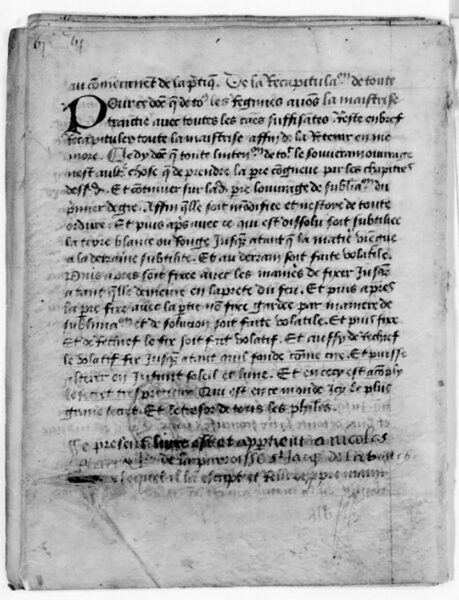
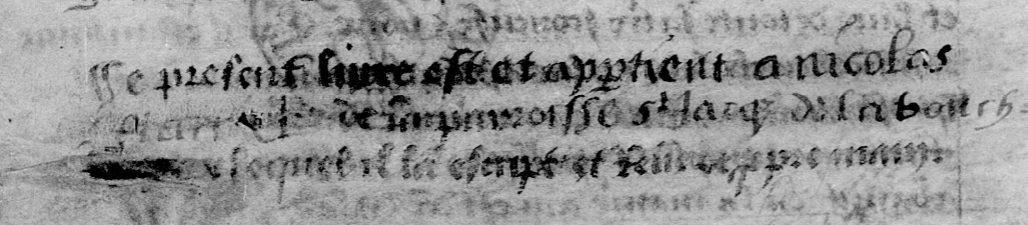
The exhibition at Cluny wisely refrains from offering an explanation for this conundrum. The evidence simply does not seem to allow for an answer. Nevertheless, an answer may be hidden in a manuscript preserved in the Bibliothèque nationale de France, BnF MS français 19978, entitled La Vraie pratique de la noble science d’alkimie (The True Practice of the Noble Science of Alchemy), also known by its alternative title, Le Livre des laveures. This manuscript is broadly dated to 1401–1500. However, the script appears compatible with the first half of the fifteenth century; and closer to 1400 than 1500. The challenge is posed by an inscription on the last page of the book, where an earlier inscription has been erased and the following ex libris entered:
“Se present Livre est appartient á Nicolas Flamel de la Paroisse St. Jacques de la Boucheri, lequel il l’a escript et relié de propre main.”
Generally, because an earlier inscription has been erased beneath it, the Flamel inscription is considered to be the work of someone who, at a later date, sought to attribute the manuscript to Flamel, thereby taking part in the general recasting of him as an alchemist. This is the interpretation presented by the BnF and adopted in the limited literature dealing with the manuscript (2).
Nonetheless, both the visual appearance and the wording of the inscription leave open the possibility that Nicolas Flamel did indeed own this manuscript. First of all, the erasure of the earlier inscription may have been carried out by Flamel himself. After all, other fifteenth-century manuscripts preserve successive ownership inscriptions, sometimes recording several owners.
However, this hypothesis appears to be countered by the wording of the inscription itself, which might be translated thus: “This book belongs to Nicolas Flamel of the parish of St Jacques de la Boucherie, which [book] he had written and bound with his own hand.”
Obviously, Flamel could not both have written the manuscript (l’a escript) and subsequently erased the inscription of a previous owner. On the other hand, we do not know exactly what was erased. Nor do we know exactly how this text should be understood. It might, hypothetically, be read in another way:
“This book belongs to Nicolas Flamel of the parish of St Jacques de la Boucherie, as he has written [here]; and bound with his own hand.”
The semicolon inserted in the second translation is intended to indicate this possible alternative reading. What if Flamel is claiming to have written the notice of ownership himself, just as someone might have concluded a letter at this time by adding “[signed] with my own hand”?
In that case, the inscription would not necessarily claim that Nicolas Flamel had written, or rather copied out, the entire manuscript himself. Instead, it might refer to his having written the ex libris after erasing the previous owner’s inscription (or whatever text had been erased). He may then have bound the manuscript himself as he claims.
Interestingly, the verb escrire could inLate Medieval France express responsibility for a written communication as well as the physical act of writing. Context determines whether a statement concerns composition, copying or the production of a document. Consequently, the wording of the ownership inscription may not, in itself, constitute a decisive argument against Nicolas Flamel having acquired the book and subsequently having it bound – perhaps even “with his own hands”.
But what about the palaeography? Does it offer any conclusions? Unfortunately, the question cannot be answered satisfactorily at present. We lack the results of a proper multispectral imaging (MSI) examination that might reveal what was erased and help distinguish the inks used in different parts of the inscription. Moreover, a careful examination of the name “Nicolas” might reveal whether it belongs to the same writing campaign as the surrounding text.
Finally, it would be worthwhile to compare the handwriting of the ex libris with authenticated signatures or other specimens of Nicolas Flamel’s handwriting. If, indeed, any such specimens survive.
To conclude: it is fascinating to follow the fate and fame of a man such as Nicolas Flamel. Such microhistories really do make the Middle Ages come alive. And as opposed to “finished” stories about the beginning, middle and end of a proper history, there are always new questions, which might be raised.
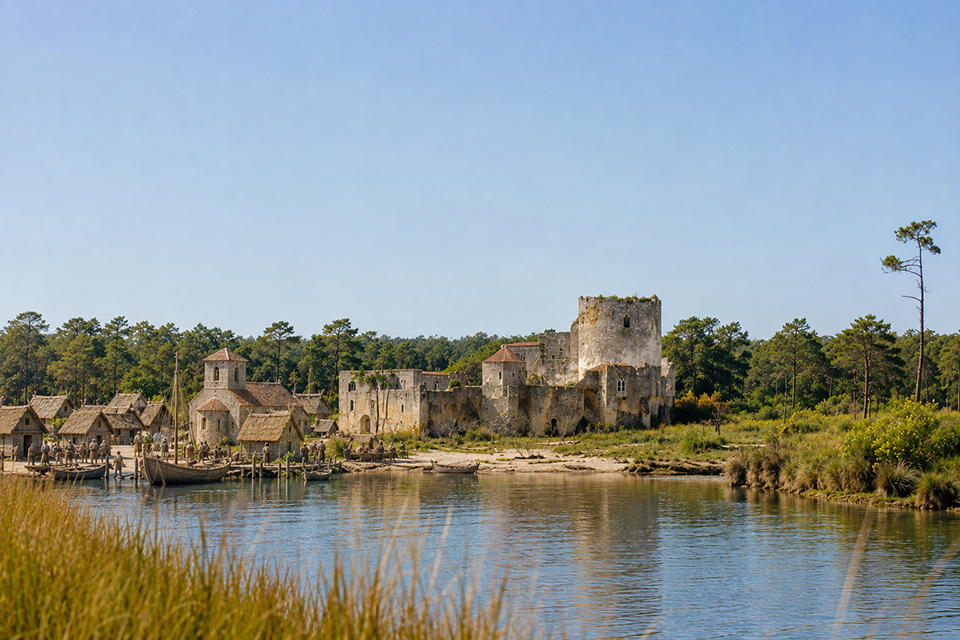
At the head of the Bay of Arcachon, west of Bordeaux, lies the small town of Lège, nestled within a nature reserve that still preserves something of the landscape that characterised this corner of the Atlantic coast in the Middle Ages
Are the devastating wildfires of this summer the result of the shifting climate? Of human greed and stupidity? Or simply of a decline in extensive husbandry and pastoralism?
At the upcoming celebrations of the restored Cathedral of Notre-Dame in Paris, one of the highlights will be the consecration of the new altar in Notre-Dame de Paris, scheduled to take place on Sunday, December 8th, 2024, during the first Mass to be celebrated in the restored Cathedral.
This date coincides with the second Sunday of Advent and is part of the reopening festivities for Notre-Dame following its extensive restoration after the devastating fire in April 2019. The consecration will be a significant moment in the reopening celebrations, marking the return of religious services to the Cathedral. Archbishop Laurent Ulrich of Paris will preside over this ceremony.
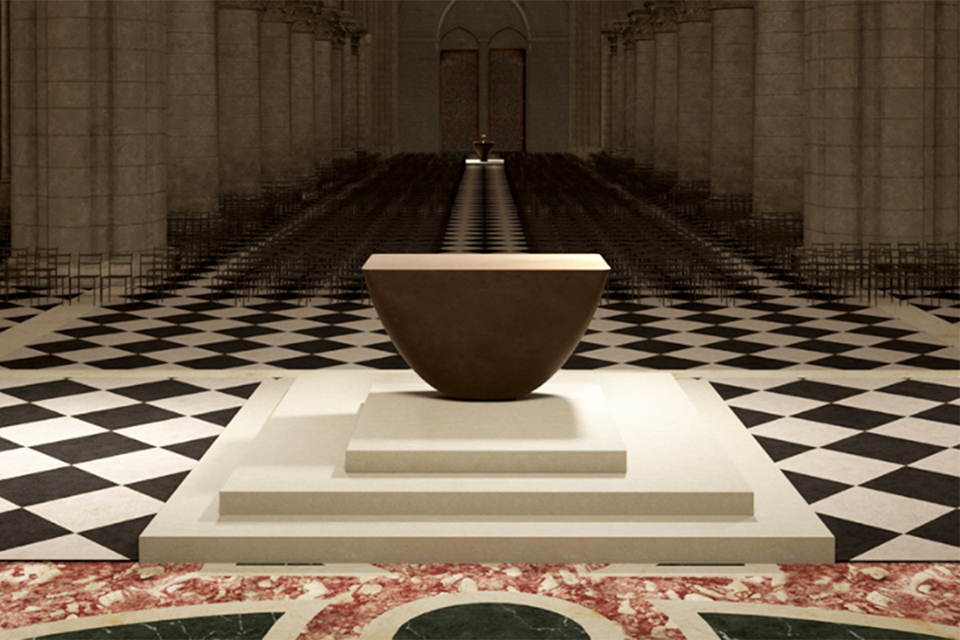
The new altar, designed by French designer and sculptor Guillaume Bardet, is described as having a sober, bowl-shaped form crafted in sculpted bronze. This choice of material is intended to offer a “powerful, timeless and luminous aesthetic” while maintaining a “noble simplicity” in line with the Second Vatican Council’s guidelines for liturgical elements
The consecration of the altar will be part of a larger series of events surrounding the Cathedral’s reopening. To what extent will these celebrations in 2024 echo the events nearly 850 years ago? This is a moot point. We don’t know much, only that the choir was completed in 1177, and the high altar was consecrated on May 19th, 1182, by Cardinal Henri de Château-Marçay, the Papal legate in Paris, and Maurice de Sully, the Bishop of Paris.
Likely, Philippe Auguste – Philip II – was also present as the Cathedral was known to receive generous donations from the King on several occasions. Following his father’s death, he was even designated successor to his father in the great hall of the episcopal palace adjacent to the new church. Later, his first wife was buried in front of the altar from 1182.
Likely, htough, the consecrations was followed by a grand feast celebrated in the episcopal hall next door. What might have been served on this occasion?
A Medieval Feast
We do not have any cook books with collections of recipes preserved in French manuscripts from the 12th century, neither from royal nor episcopal courts. However, in 2013, a small collection of French recipes in a manuscript from approximately 1140 resurfaced in Durham.
These recipes for cooking were hidden among others for medical ointments and cures. Terse in tone, the recipes mainly provide directions for how to cook sauces to accompany mutton, chicken, duck, pork and beef, but there is also a recipe for cooking “Hen in Winter”. The sauces include some Mediterranean flavours, featuring ingredients like parsley, sage, pepper, garlic and coriander. Also, the text describes one recipe as deriving from Poitou in central Western France.
Much ink has been spilt on whether these recipes witness a distinct culinary culture or represent dietetic advice intended to help combat the lack of appetite among ill and feeble persons.
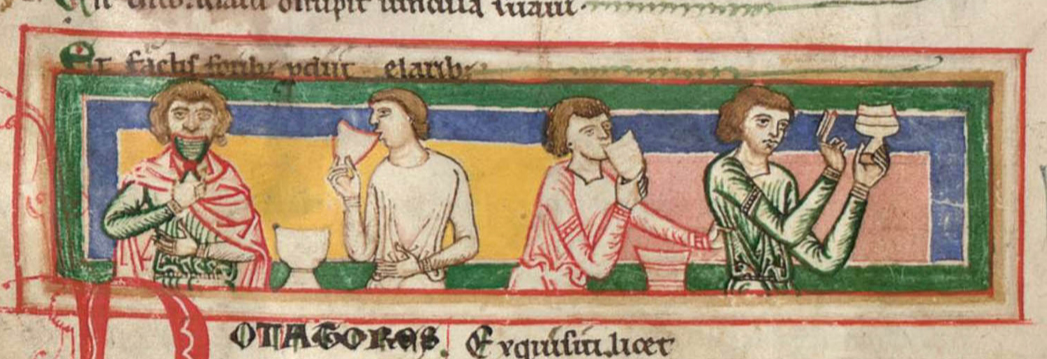
From the manuscript at the Cambridge_SSC_MS_51_f_39r. Source: wikipedia
Arguments indicate the former was the case. In the manuscript, the recipes point to the particular dishes they were intended to accompany – beef, chicken etc. Also, one of the recipes is specifically said to derive from Poitou,the salsamentum pictauensium, which is also known from other recipe collections. And Poitou was already in the 12th century known from the gastronomic pleasures, one might look for in the culturally vibrant centre of Aquitaine fostered by the Poitivin dukes. Aquitaine was the inheritance of Eleanor married to first Louis VII and later Henry II, mother of Richard II (Lionheart). She was in constant residence there with her son until 1174, when she was imprisoned in England.
We don’t know many details about these Poitivin delights. However, we know that royal residences at that time were furnished with spectacular kitchens intended to cook for large households and on a grand scale. Thus, John Lackland (another son of Henry II and Eleonore), is known to have ordered the installation of a so-called furnesium at both Marlborough and Ludgershall where two to three oxen might be cooked simultaneously. (1) There is no doubt that bread and meat were the two main ingredients at these royal tables. Most likely, the feast in Paris in 1182 would have served a multitude of fish, but also deer, beef, and fowls.
Also, these meats would have been served with the condiment of a sauce, such as the salsamentum pictauensium.
This classical sauce is a mixture of sage, thyme, pepper, garlic, salt, and parsley pounded in a mortar and mixed with vinegar. A modern version calls for a mixture of two parts fresh thyme to one part sage mixed with garlic, pepper and cinnamon to taste. The recipe claims that mixed with vinegar the sauce might keep for eight days. This version is also especially recommended for being served together with boiled mutton.
Mayhap, the version which might have been served at the celebratory dinner following the consecration of Notre-Dame in 1182, was more delicious. At least, the variety from Durham called for one mixed with verjus (juice from raisins) and was intended to be served with beef. As an especially festive dinner, veal may have been on the menu.
Were the sauces boiled or served fresh, like modern mustard or Italian pesto sauces? It depends! We are taught by Le Ménagier de Paris (2), who admonishes his wife to master both versions. If boiled, he explains how a thrifty woman would steep some bread in verjus and then pound it in the mortar after the spices and herbs had been grinded together. This would soak up the expensive spices and help smooth the sauce. Vinegar may be rather harsh, and any modernised “Medieval Kitchen” should be familiar with verjus produced from highly acidic juice made by pressing unripe grapes, crab apples or other sour fruit. Sour, unsweetened apple juice is often as good.
Whichever, the exact recipe followed, it appears that at the court of King John, the sources refer specifically to Geoffrey, his sauce maker, who was in charge of the spices in the royal household. He was paid handsomely for his services in 1204, when he received remuneration equalling urban property to the sum of well over 7 £, on par with the minor gentry, writes Thomas (2020, p. 132).
Perhaps we can imagine that King John inherited a passion for grand cuisine from Southern France, whence the first cookbooks are believed to have been produced? And that he shared this with his step-sibling, Philippe Auguste?
The consecration of the altar in 1182 was celebrated on May 19th in Paris. December, however, calls for a winterly recipe. Why not try out the Gallinam in Hieme? Not a difficult recipe, it suggests you cook your hen in a winterly soup seasoned with copious amounts of garlic, sage and whole pepper corn while adding some verjus. You can also use non-sweetened or tangy apple juice. When the hen is boiling, and the pan is hot, let it stand for hours and hours in the hay box. Or wrap the pot in a towel and place it beneath your duvet in your bed. The heat kills off any bedbugs. The trick is not to slush soup on the mattress. Haybox or retained heat cooking is used to cook a liquid-based food like a soup or stew in its own heat. An ancient cooking method, it became popular as a way to conserve cooking fuel during WW2. They used hay in a box because the air spaces in the hay were trapped in heat, and the soup or stew was allowed to cook in its own heat. Anything like hay, shredded newspaper, rice hulls, cotton balls, corn husks, etc., would work as long as it was packed loose and created air spaces.
After cooking, the pieces of the hen might be lifted out, and the breast cut off and served aside accompanied with salsamentum pictauensium. The remains are shredded in the soup and should be served in silver bowls with silver spoons.
Why not celebrate the reopening of Notre- Dame with your own medieval feast? Here is a menu suggested in one of the earliest cooking books preserved in Denmark (Vejrup 1993)
Small patés with marrow from deer
Lamprey filets in their own sauce
Hen pastry with thyme sauce
Hare served in a hot sauce served with walnut bread
Hot scorzonera roots served with cold almondbutter
Raisins marinated in verjus
Almond dessert served with plum compote
(Recipes in the many medieval cookbooks on the market)
Charles Gilles le Bouvier (1355 - 1456) served as herald to the French King, Charles VII. In this role, he kept up the Grandes Chroniques while authoring several other important historical works.
Gilles le Bouvier (1386 -1455) was the senior herald to the French king, Charles VII. In his lifetime he wote a geographical treatise based on his travels. New English edition offers a fascinating view of Europe in the beginning of the 15th century
The French king, Charles VII is known for his long reign and his success in ending the Hundred years' War. But he also presided over the gradual employment of numerous bourgeois jurists and merchants paving the road for the shift from charismatic to bureaucratic leadership.
In the Early Middle Ages, the Vosges were regarded as a wilderness - by elites, poets and priests. However, the ideas about how to live in and utilise this wilderness were contested.