
Since the fire in 2019, archaeologists have been busy uncovering the history of the medieval Cathedral
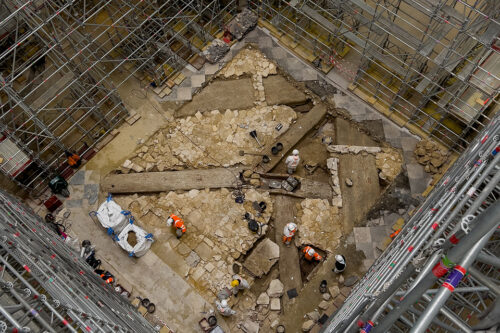
Following the devastating fire, archaeologists arrived early in the morning to help preserve the scorched remains of Notre-Dame, and to plan for future excavation. As expected, the job was turned over to INRAP. Since then, a wide-ranging study of the physical remains has been undertaken. Recently, the results of more than 14 distinct operations were published at a major conference.
The oldest level, located more than 3.5 metres below the crypt, dates back to the beginning of Antiquity. Here, the archaeologists uncovered floors from a house dated to the early first century. For the Late Empire, remains related to housing and crafts (burnt floors and wood) were discovered beneath the forecourt.
The excavations also made it possible to uncover remains from the Middle Ages, which were dated prior to the construction of the Cathedral, including a vast Carolingian building and one or more monumental buildings.
The research, however, also revealed new information about the construction of the Cathedral itself. Its foundations could be observed for the first time, both the monumental foundation blocks that supports the towers, but also the foundations of the pillars-
The rood screen: conservation and studies
A significant find was the remains of the medieval rod screen from ca. 1230. ,The rod was destroyed at the beginning of the 18th century as part of a liturgical renewal. Only about fifteen fragments of sculptures had previously been found by Viollet-le-Duc. In 2022, more than 1,000 fragments of sculptures were unearthed, including more than 700 elements presenting their original polychromy with additions, repairs, the application of gold leaf, etc. They represent religious figures and architectural elements. The treatment of the plant decorations, faces, hair and draperies made it possible to attribute them to the 13th century.
Medieval Cathedrals were painted, but at Notre-Dame almost nothing of the original painted decoration remained. This exceptional discovery will allow a restoration of the rood screen, a masterpiece of medieval Gothic sculpture, and help to
These polychrome sculptures still retain the brilliance of the 13th-century painting. Preservation was the first priority since, after the actual excavation, the paint no longer adhered to the stone. The sculptures, buried for centuries, were suddenly subjected to different conditions, revealing the extreme fragility of the painted decorations. On the other hand, the stones were healthy, not very humid, and no pathogenic fungus had developed there. The emergency operation to fix the polychromy and clean the blocks started in 2024 and will be completed in spring 2025. Thirty of the the restored blocks will be exhibited at the Musee de Cluny 2024-25 in the exhibition “Making the stones speak”
The Burials
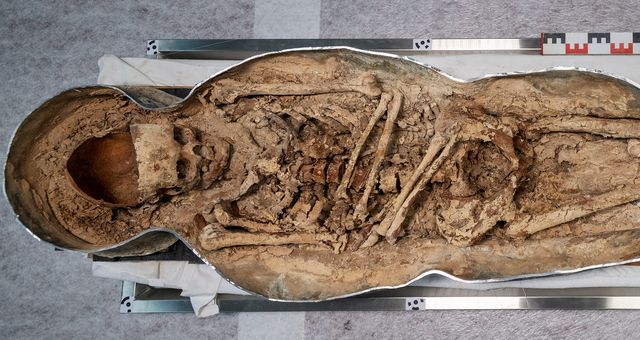
Finally, like all Catholic religious buildings, Notre-Dame de Paris was a place of burials. Numerous graves were unearthed as part of the excavation and restoration. More than a hundred graves were identified, and eighty were excavated. Individuals were buried in shrouds, of which sometimes some traces of fabric or copper alloy pins remained. Almost all the individuals unearthed inside Notre-Dame were adults. Most of them present pathologies linked to senescence, such as osteoarthritis, edentulation or ossification of cartilages, which testify to a rather elderly population. Finally, with one exception, all the skeletons were male. Unsurprisingly, this observation reflects a population expected in a cathedral: religious or lay people from the privileged classes.
All exhumed skeletons have been subjected to an exhaustive anthropological study. In addition, radiocarbon dating, paleogenomic analyses, and isotopic analyses will be undertaken to reconstruct individuals’ geographical origins and mobility.
FEATURED PHOTO:
Head found as part of the Gothic Rod Screen © Inrap
SOURCE:
Press release: Archéologie de Notre-Dame de Paris: Avancées des recherches.
READ ALSO: