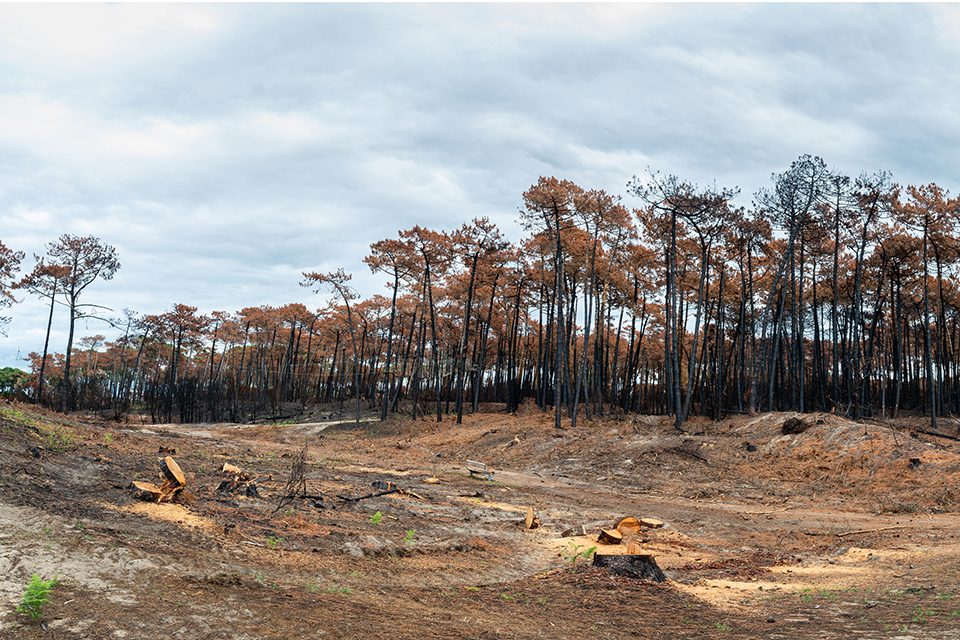
Are the devastating wildfires of this summer the result of the shifting climate? Of human greed and stupidity? Or simply of a decline in extensive husbandry and pastoralism?
Plans are currently being drawn up to evacuate the city of Bordeaux, home to a million people. Already, 220,000 residents have been moved out of their homes as they fear further devastation. Among the general public, the explanation most often offered is climate change, Added to this, the authorities are also actively investigating the role of careless smokers and deliberate arsonists. Thus, the spread and severity of the fires are commonly presented as an unavoidable fate: wildfires happen, and the warmer and drier the conditions, the wilder they become.
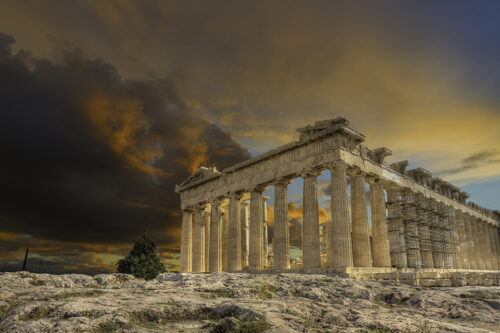
Occasionally, though, reporters shift their focus from drought, electrical storms, or simple carelessness (such as wild camping) to the extent to which plain old greed may lie beneath it all. This, at least, was the explanation offered a few years ago when Athens was struck in 2018, when 104 people died in a conflagration that gutted a holiday resort near the capital, along with more than 500 homes belonging to squatters living in the surrounding forests. In the first twenty-four hours, forty-seven new fires broke out, leading officials to suspect that arsonists were at work. It was later suggested that insurance fraud lay behind the tragedy, as the resort in question was one of the many properties left dilapidated and abandoned by the economic crisis of 2008–2014. In August 2023, wildfires once again swept across the Greek countryside; nine of them were identified as coordinated arson attacks on the northern foothills of Mount Parnitha, some thirty miles north of Athens. That year, according to ABC News, the authorities made 140 wildfire-related arrests, of which 117 were classified as negligence and 23 as deliberate arson, allegedly carried out by large developers seeking to profit from urban sprawl near the capital.
Granted, then, that both carelessness and coordinated arson offer sufficient explanations on their own terms, politician and journalists rarely pause to consider why such wildfires spread so rapidly once ignited — or what might be done to stop them. This job is carried out by scientists and historians providing an alternative explanation of wideranging consequences.
The Decline of Livestock in Attica and the Wildfires
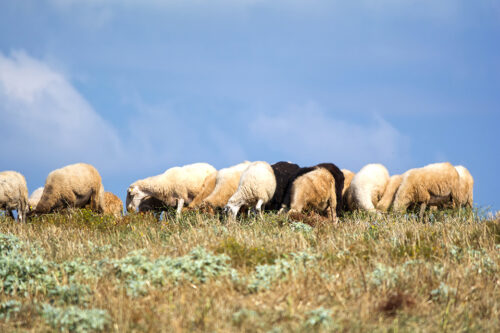
This question has been carefully studied by a group of Italian scientists led by Andrea Colantoni. They concluded, as have numerous other studies, that the most significant factor was the massive proliferation of shrubbery, debris, and leaf litter following the abandonment of the traditional animal-based system of husbandry.
The empirical evidence from Attica demonstrates a clear trend of livestock decline. In 1961, the density of sheep and goats in Attica was 60.5 animals per square kilometre, half of which were cared for as part of traditional pastoralism (nomadic transhumance). By 2017, that density had halved, while transhumance had disappeared entirely.
Colantoni and his colleagues concluded that, although the number of animals — the density per square kilometre — mattered, the more relevant factor was the number of animals cared for by nomadic pastoralists. One significant indicator of this was the shift in where wildfires erupted: between 2000 and 2008, the main location of fires in Attica were forests, followed by pasture; between 2009 and 2018, fires in pasture increased by a factor of four. To this must be added the fact that the traditional collection and use of firewood as fuel had also nearly disappeared over the same period.
Thus, the near-total disappearance of nomadic livestock from the peri-urban landscape of Athens in the decades after the Second World War represented a fundamental transformation in land management, with direct implications for wildfire risk. Unsurprisingly, this process led to the accumulation of biomass, particularly in the most fragile sites along the urban–rural interface, where conflicts over land use became more frequent and fire risk correspondingly greater. The principal conclusion, then, was that a significant relationship does exist between livestock management and wildfire indicators, and that this relationship has contributed to the destruction of the landscape around Athens in recent years.
Back to Bordeaux and the Landes
To some extent, this summer’s wildfires around Bordeaux appear to fit the explanatory model developed for Attica above.
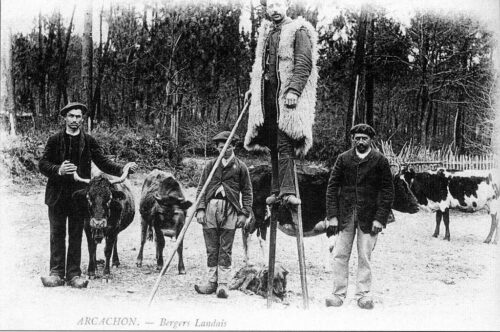
As can be seen on maps of the affected district, the Landes, lies to the west of Bordeaux, between the sea and the city. Until the mid-nineteenth century, this landscape was a marshy foreland dominated by dunes and drifting sand, across which shepherds on stilts – the échassiers – tended large flocks of animals over open heathland.
In 1857, however, Napoleon III had a law passed requiring the drainage of the Landes and encouraging the systematic planting of maritime pine on the reclaimed wetlands. Although the draining goes back to the 18th century, the law speeded up the process while effectively dismantling the traditional agro-pastoral economy based on common grazing, sheep manure, rye, and millet. Within a generation, the shepherds had largely been replaced by resin tappers – gemmeurs – and forestry workers.
Where the old landscape had been characterised by open heaths, grazed commons, scattered oak woodland, cultivated patches, and extensive sheep grazing, the new landscape came to be dominated by people harvesting resin from pines, by timber production, sawmills, wood-processing industries, charcoal-burning, and forestry in general. As history has shown, this new landscape proved to be a highly combustible one.
Naturally, this left its mark on the region’s fire record. The first major wildfire was recorded in 1893; thereafter, the statistics show roughly one major fire per decade, culminating in the catastrophe of 1949, when more than 130,000 hectares went up in smoke and 82 people were killed. Since 2015, further major fires have occurred in 2017, 2018, 2020, 2021, 2022, and now again in 2026 — those of 2022 and 2026 having struck almost exactly the same area.
Over this same period, the number of sheep fell from 1 million in 1850 to 300,000 around 1890. By the end of the Second World War, the flock had fallen further, to perhaps 80,000–120,000 animals, before declining gradually to some 10,000–20,000 by 1990 and 8,000–12,000 by 2000. By 2010 the number had roughly halved again, leaving only 5,225 animals by 2020. One might well speculate, at first glance, that there is a direct statistical correlation between the disappearance of the sheep and the recurrence of these wildfires.
Closer examination, however, shows that the recurrence of wildfires in the Gironde does not directly reflect the disappearance of the flocks, but rather the drainage and the monocultural shift towards a combustible land cover — the pine forests. One telling argument is that the explosion in wildfires occurred before the landscape had been emptied of animals: when the great wildfire of 1949 burned a total of 131,300 hectares in the Landes forest massif — a record never subsequently exceeded in Europe — the flocks had not yet disappeared from the landscape entirely, but had only been decimated.
Bordeaux 2026
It is more likely that what happened in 1949 reflected the decline of resin-tapping, itself linked to labour shortages during and after the Second World War — a mechanism echoed in 2022 by the CNPF (Centre National de la Propriété Forestière) in its analysis written shortly after that year’s Gironde fires. It is a striking fact that, while the resin industry supported tens of thousands of people as late as 1950, it had disappeared completely from the landscape by 1990. After this point, the forest floor was no longer maintained by resin tappers as it once had been. Part of their work had involved clearing the understorey — the forest’s well-developed layer of strawberry tree, blackthorn, gorse, fern, holly, and butcher’s-broom. Hence, this vegetation now forms a continuous and very dense mass that, under current drought conditions, becomes a considerable fuel load.
Thus, while in Attica the task of clearing the land fell traditionally to the shepherd and his flocks of sheep, in the Bordeaux case it fell to the résinier, the resin tapper. Today, both have disappeared as land managers. It is a striking coincidence that the recent surge in wildfires took off after 1990 — precisely when the resin industry totally disappeared — culminating in near-annual events since 2015 and, so far, in the two great conflagrations of 2022 and 2026, in almost exactly the same area.
The Blame Game
Following this, locally elected officials and representatives of the forestry sector have argued that part of the explanation for these recent disasters lies in environmental lobbying for ‘untouched forests’, which has made fire management more difficult. They point, in particular, to how the widening of firebreaks, extensive brush clearance, and necessary tree felling have all been hindered by environmentalist campaigning. These officials contend that the present devastation is driven by ideological choices, compounded by the pressures of climatic change.
Also, any “new” philosophy of rewilding clashes with the official history of the present landscape as a beautiful example of how deserted and decrepit moorland of the Landes in
southwestern France was turned from a maligned and haunted “wilderness” or “empty space” to a forested landscape coveted for its productive potential as well as its civilised aesthetic beauty. This story is beautifully told by Caroline Ford end exhibited at the iconic l’Écomusée de Marquèze à Sabres, and in the naturalisation of this highly artificial landscape ensconced in the creation in 1970 of the regional park, the Parc Naturel Régional des Landes de Gascogne with the mission of preserving the nation’s natural heritage or patrimoine.
It is perhaps curious, in this light, that the same lobbyists do not appear en masse to have considered reintroducing flocks of grazing animals to carry out the work once done by the résiniers, given that this seems traditionally to have formed part of the solution. However, this would, of course, require reversing the very drainage regime on which the region’s forestry and tourism industry now depends – hardly a change the forestry sector and the second-home business itself is likely to welcome. Nevertheless, after the devastation in 2022, small flocks of semi-feral local cattle – the small Vache Marine Landaise were sent into the devastated countryside. Unfortunately not a concerted effort. Nonetheless, it is pertinent to note that searching for the keyword “Marine Landaise”, no hits are delivered on the museums webpage.
Extensive Grazing in the Wine District
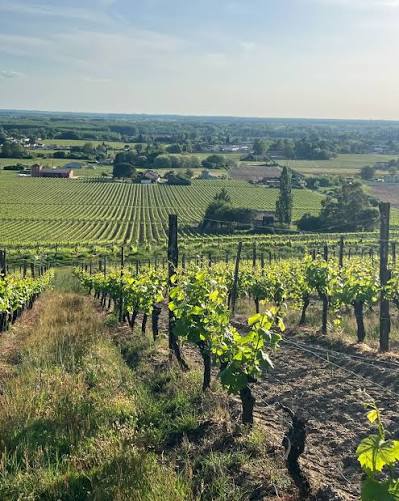
This possibility becomes all the more pertinent in light of another change currently under way in the district, one that may have inadvertently contributed to this summer’s disaster. To grasp this, we need to look more closely at the disaster zone itself.
At the apparent epicentre of the wildfires lies the village of Saumos. Although some 99 per cent surrounded by forest and semi-forest consisting of pine, the explanation here would seem straightforward enough: too much litter, and too little effort expended in clearing it. Saumos, however, also lies directly on the border of the peri-urban agricultural zone south of Bordeaux, an area of vineyards of markedly lesser repute than the famous vignobles to the north.
As is well known, this is currently a landscape mosaic in a state of widespread abandonment. Since the 1980s, villages and vineyards across the district have seen a steady exodus of people towards the city and away from rural life. More recently, the wine-growing industry itself has all but collapsed, making the situation considerably more dire.
Thus, one contributing factor to the fires that has gone largely unremarked in the news might be the wide-scale crisis in Gironde’s wine-growing sector — a crisis driven by international competition from high-end producers worldwide, as well as from the beer and soft-drinks industries. The diminishing role of wine in the daily life of the French has also been noted, along with a shift in taste: red wine’s share of consumption, which stood at around 90 per cent in the 1970s, has since fallen as sweeter, softer, and more floral styles have gained ground. Also, the ethnic and religious shift in the French population has been noted as part of the explanation.
This devastation of the wine-growing business in the Bordeaux region has so far resulted in widespread abandonment, government-backed vine-uprooting and removal programmes, and the establishment of a fund to buy up affected land; applications have reportedly flooded the relevant administration. Local authorities have also proposed fines of up to €5,000 ($5,416) per hectare for wine-growers who wholly neglect and abandon their vine plots, given the risks of disease and landscape degradation this poses. What can be observed at present, however, is the spread of tall grasses, bramble, broom, young pine, and scrub oak.
This is precisely the kind of situation which historical studies tell us creates landscapes prone to conflagration whenever fires are lit. In view of this, it is a moot question whether the current fires erupted spontaneously, owing to a combination of drought, heat, wind, and electrical storms — or whether the actions of one or two desperate wine-growers, seeking to alleviate their economic ruin by setting a match to their dry, soon-to-be-abandoned life’s work, have contributed to the conflagration of the neighbouring pine forests west of Saumos. The fact remains that, of the 42,000 hectares consumed by wildfire in the Gironde this summer, some may have burned because the small and little-known wineries south-west of the city — adjoining the district of Graves — are likely to have been overflowing with uncleared debris and leaf litter, and feeding into the pine-forests further to the west.
That Dreadful Year…
turning to the Middle Ages, a somewhat similar conclusion was reached by David Peterson in his study of the causes and socio-economic consequences of a Castilian wildfire of AD 949, described in a contemporary source thus:
A flame emerged from the sea and consumed many cities, towns, men and beasts, and even the rocks of the sea itself. In Zamora a suburb [barrio] was burnt, and in Carrión and Castrojeriz, too; in Burgos a hundred houses, and also in Briviesca, Calzada, Pancorbo, Buradón and many other villages were burnt.
Quoted in Peterson, p. 468
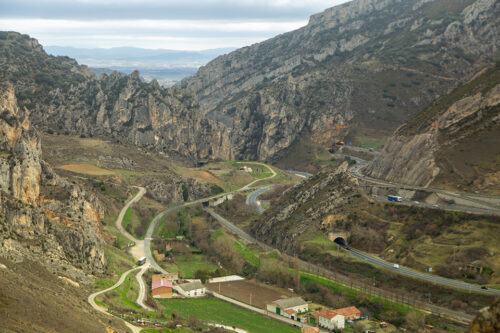
According to contemporary medieval records, this devastating wildfire swept across the northern Meseta, with particular intensity in the Bureba region of north-eastern Castile and a distinct centre at Briviesca. Peterson has examined the possible causes of the conflagration, with special emphasis on the changing agricultural practices that accompanied the Christian expansion of the frontier region in the tenth century. On the basis of a careful reconstruction of local micro-history, he argues that the lowland areas flanking the Roman road through Briviesca had, until the early tenth century, remained vulnerable to Muslim incursions; settlements were consequently confined to the heavily forested hills above, while the river valley itself lay empty. Once the Muslim frontier was pushed back, however, Briviesca re-emerged as a vibrant frontier district in which local lordships worked to control resources while promoting the intensive establishment of vineyards. Despite the fragility of the documentary record, at least three monasteries can be identified as active in the land clearances, while the king and other lords are recorded as having pursued similar interests in the area. Vineyards accordingly became scattered around Briviesca, associated with a range of apparently suburban churches and lesser settlements.
Part of this process is likely to have involved a marked shift in agricultural practice. It seems probable that the move from a pastoral, forest-based economy in the secluded hills to one based on cash-cropping vineyards in the valley was accompanied not only by serious deforestation but also by a decimation of livestock: intensive viticulture depends on people rather than draught animals, and flocks of sheep and goats become an encumbrance under such a regime. It is likely, then, that the number of grazing animals was significantly curtailed.
Peterson rightly observes that this deforestation would have left the landscape littered with wooden debris and shrubbery, thereby creating conditions ripe for a wildfire such as the one that struck in 949. One additional factor not addressed in his argument, however, may have been the decimation of grazing livestock that accompanied the shift from hillside to valley floor. This absence of grazing animals might plausibly have contributed further to the disaster.
Conclusion
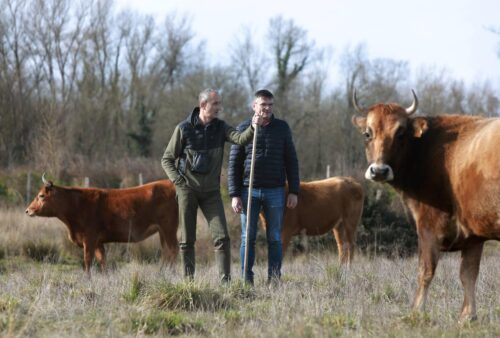
There is ample evidence that free-ranging or semi-feral animals once did quietly, and for free, what fire brigades and water-bombers now do at enormous cost and under enormous strain: they kept the undergrowth down. The mechanism differs from place to place — a flock in Attica, a résinier‘s blade in the Landes, a vineyard’s edge in Castile — but the underlying story is the same one, told three times across a thousand years. Wherever animals and people stop clearing the land for a living, the landscape grows a memory of its own, in the form of litter, brush, and resin-soaked debris, and eventually asks to be burned.
Accordingly, what is smouldering above Bordeaux this summer is not only pine and gorse. It is the accumulated cost of absences we stopped noticing decades ago — the échassier gone from the heath, the résinier gone from the pines, the viticultor gone from a slope no longer worth the harvest. None of them left because of the coming fires. But their leaving is, in each case, why the fires came.
In all this, the more elegant solution is to let semi-feral animals once again roam the countrysides of the Mediterranean, blazing trails and grazing down the litter, thereby creating a more liveable and safer world in a situation where the abandonment of intensive agricultural practices has opened the way to yet more devastating wildfires. On a promising note, this is a debate currently running through the corridors of Brussels.
SOURCES:
Sustainable land management, wildfire risk and the role of grazing in Mediterranean urban-rural interfaces: a regional approach from Greece
By Andrea Colantoni; Gianluca Egidi; Giovanni Quaranta; Roberto D’Alessandro; Sabato Vinci; Rosario Turco; Luca Salvati
MDPI (2020) 14 January.
Causes and socio-economic implications of the Castilian wildfire of 949
By David Peterson
Journal of Medieval Iberian Studies (2023) Volume 15, 2023 – Issue 3
The Environmental Transformation of “Empty Space”: From Desert to Forest in the Landes of Southwestern France
By Caroline Ford
Comparative Studies in Society and History
Cambridge University Press (2023) 20 January 2023