Archaeological excavations of the medieval fortifications in Caen is yielding new knowledge about the city before and during the hundred years war
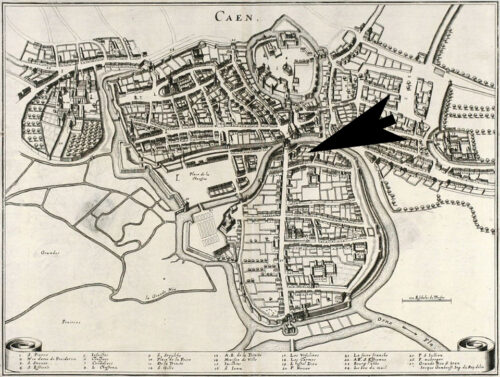
Archaeologists from Inrap have just concluded an excavation on Boulevard Maréchal Leclerc in Caen, carried out as part of a development project led by the “Vinci Immobilier”. Covering an area of more than 900 m², the operation has revealed several elements of the northern medieval fortifications of the Île Saint-Jean district, including a monumental section of the rampart previously known only from historical texts and plans, as well as a series of masonry structures and embankments dating from the 13th to the 19th centuries.
The archaeologists uncovered an imposing wall over 20 metres in length, three metres thick and preserved in places to a height of up to 3.5 metres. This substantial masonry, built on the alluvial deposits of the Odon and the Orne, is interpreted as part of the medieval rampart of Île Saint-Jean.
Constructed from limestone blocks bonded with shell-lime mortar, the wall uncovered is of notably high quality. Two outer faces enclose a carefully laid rubble core composed of stone and mortar. The foundation blocks are roughly squared, while those used in the upper courses are finely cut. The wall also bears evidence of consolidation, restoration or reinforcement phases.
The dating of these interventions still requires refinement, in order to determine whether they post-date 1346 — when the city was captured by the English. Were the ramparts constructed at this time or were they alterations to earlier masonry.
In the 12th century, the son of William the Conqueror ordered the excavation of a canal between a branch of the Odon and the Orne, transforming the Saint-Jean district into an island. Both historical sources and archaeological research indicate that the area under study was unurbanised at the beginning of the 13th century and largely consisted of marshland. During the second half of the 13th century, the first masonry structures were built there. And indeed, in front of the rampart, archaeologists have identified an earlier structure, for which several hypotheses have been proposed: it may represent the remains of a tower associated with the rampart, a quayside installation along the Petite Orne and the Odon, or a bridge pier. Further studies will aim to clarify its function.
Also, in this eastern sector, archaeologists uncovered two masonry structures as well as a layout comprising two walls and a trampled surface. These elements may correspond either to riverbank developments intended to drain the area and reclaim land from the marshes, or to early defensive works foreshadowing the construction of the rampart after 1346. In any case, these structures served to enclose the Île Saint-Jean district.
The excavations also yielded a wide range of archaeological artefacts. For instance, ceramic remains, including glazed and tableware vessels, were recovered from the embankments where domestic refuse accumulated. Preliminary analysis suggests a relatively high social status for the inhabitants and highlights the influence of the Castle of Caen. The study of animal remains will help to clarify dietary practices and confirm this hypothesis.
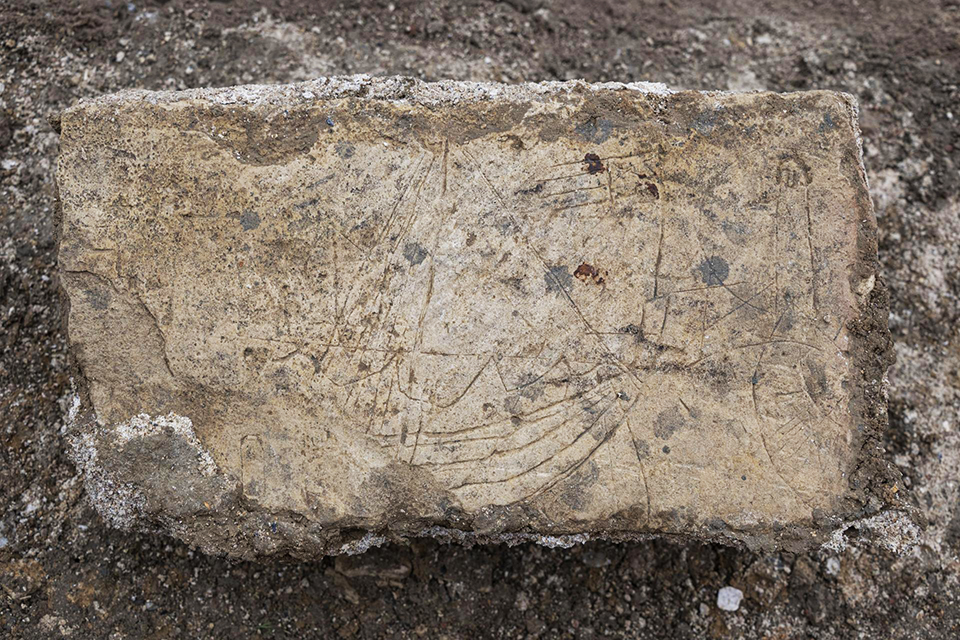
Small finds — such as a seal, pendants, needles, decorative ceramic beads and coins from both the medieval and modern periods — were also discovered, providing valuable insight into everyday life in the neighbourhood. Finally, a remarkable graffito depicting a highly detailed sailing vessel was found engraved on a reused block from the rampart; it undoubtedly dates from the Middle Ages.
This research significantly enhances our understanding of the development of Caen’s fortifications during the Middle Ages, particularly in the context of the Hundred Years’ War. In light of the importance of the discoveries, the developer, in consultation with the City and State authorities, has decided to incorporate a section of the rampart into the future development. The dismantling of the wall has therefore been carried out with great care, so that it can later be reassembled in accordance with the original arrangement of the facing stones.
Hitherto, this rampart left no visible trace in the modern city of Caen, apart from the Leroy Tower to the east also known as the Tour Guillaume-le-Roy. Constructed from Caen stone, it rises to a height of 79 metres, it comprises four levels: a lower hall, two upper floors and a platform at the summit.
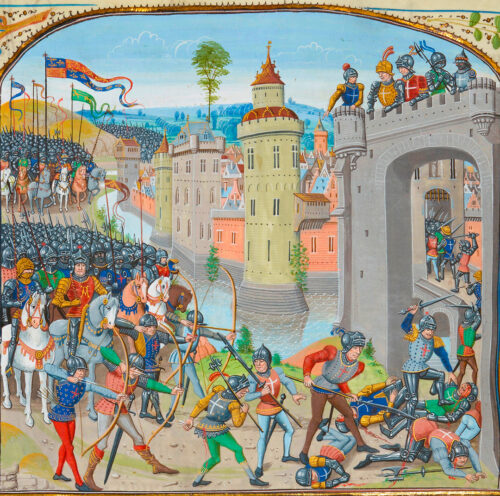
The tower is believed to have been built shortly after the capture of Caen by the English in 1346. This successful Anglo-Norman assault marked one of the first major engagements of the Hundred Years’ War and represented a pivotal moment in the conflict. King Edward III of England consolidated his influence, giving the English a lasting foothold in France from which to pursue further military campaigns.
At the time, it formed an integral part of the city’s fortifications and was accessible from the ramparts via external staircases. Positioned at the entrance to the Bassin Saint-Pierre, it was once linked by a chain to another tower on the opposite bank, enabling access to the port to be blocked when required. This second structure, known as the Landais Tower, has since disappeared.
The Leroy Tower is now listed as a historic monument, although it is only open to the public on rare occasions, such as during Heritage Days.
FEATURED PHOTO
Graffiti from the excavated ramparts at Caen showing a sailboat © Inrap/Emmanuelle Collado
SOURCE:
Press release: Des fortifications médiévales à Caen