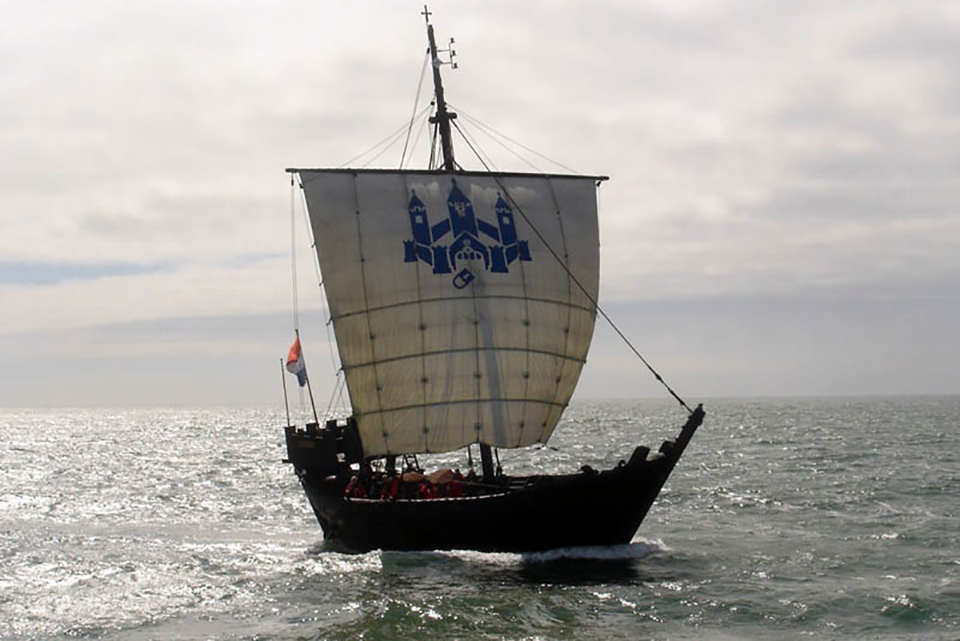
A 28-metre-long medieval trading ship has been discovered in the Sound off Copenhagen, making it the largest cog ever found in Northern Europe.

The newly discovered cog does not seem to have been engaged in warfare as the cog in this illumination. Nevertheless, it belongs to the same type of ships.
Until now, the Bremen Cog from around 1380 has been considered the largest known medieval trading vessel. The newly discovered wreck, however, surpasses it in size and significance. Measuring 28 metres in length, the ship is now regarded as the world’s largest known cog. The find provides unprecedented insight into medieval shipbuilding techniques, maritime technology, and the trade networks that connected Northern Europe during the Middle Ages. Its exceptional scale highlights the level of organisation and economic ambition that characterised medieval trade.
The wreck was uncovered in the Sound – the strait between Denmark and Sweden – during seabed investigations connected to the construction of Copenhagen’s new district, Lynetteholm. From the first dive, maritime archaeologists suspected the find was extraordinary. As layers of sand and silt were removed, the outline of a remarkable vessel emerged: not merely another wreck, but the largest cog ever discovered and a prime example of one of the most advanced ship types of its time.
“The find is a milestone for maritime archaeology. It is the largest cog we know of, and it gives us a unique opportunity to understand both the construction and life on board the biggest trading ships of the Middle Ages,” says maritime archaeologist and excavation leader Otto Uldum.
Cogs – the draught horses of the North Sea

The earliest written reference to cogs dates to the early 11th century glossary Heinrici Summarium. However, evidence suggests that the ship type emerged earlier. As early as the 9th century, copies of Dorestad coins found at Haithabu depict ships whose hull forms appear to have been altered from hulks to cogs. By the 12th century, town seals from Lübeck, Kiel, Elbing, Wismar, and Stralsund provide clear visual evidence of cogs and underscore their central role in the rise of prosperous Baltic merchant communities.
These seals also document an important technological transition. The cog depicted on the early Lübeck seal from 1223 is steered with a side rudder, whereas the later Stralsund seal from 1265 shows a vessel equipped with a fixed stern rudder—generally regarded as a defining feature of the mature cog type.
The cog was a clinker-built ship type that came into widespread use from the 12th century onwards. Typically fitted with a single mast, it differed markedly from earlier shipbuilding traditions through its straight keel, high sides, raking stemposts, overlapping clinker planks, fixed stern rudder, and large square sail. Together, these features made the cog a robust and efficient cargo vessel.
Archaeological finds from Kollerup and Kolding in Denmark, dated to approximately 1150 and 1189 respectively, can be compared with the new discovery. These relatively flat-bottomed ships exhibit fairly straight, raking stems, while their sternposts show traces of rudder fittings. In later developments, cogs were equipped with timber-built castles and galleys, significantly improving living conditions for both crew and accompanying merchants.
Svælget 2 – A medieval Super Ship
The vessel, named Svælget 2 after the channel in which it was found, measures approximately 28 metres in length, 9 metres in width, and 6 metres in height. It is estimated to have had a cargo capacity of around 300 tonnes. Built around 1410, it represents the largest cog of its kind ever discovered anywhere in the world. According to the archaeologists, a ship of this size reflects a Northern European society dependent on trade in victuals and raw meterial; and not just luxury items . Constructing and operating such a vessel required a well-developed and reliable trade system to supply cargoes from the hinterland.
“A ship with such a large cargo capacity is part of a structured system where merchants knew there was a market for the goods they carried. It shows that everyday goods were being traded. Shipbuilders increased the size of vessels to transport bulky cargo such as salt, timber, bricks, and basic foodstuffs,” says Uldum. Thus, Svælget 2 is a tangible example of how trade developed during the later Middle Ages,” explains Otto Uldum.
Cogs were also efficient vessels that could be sailed by relatively small crews, even when heavily laden. Large examples such as Svælget 2 were designed for the hazardous voyage around Skagen, sailing from what is now the Netherlands through the Sound and onward to the Baltic trading towns. The ship offers clear evidence of the extensive trade networks that linked Northern Europe in the 15th century.
International connections in the ship-building industry
Dendrochronological analyses show that Svælget 2 was built around 1410 using timber from two different regions: Pomerania (modern-day Poland) and the Netherlands. By comparing tree-ring patterns with reference data, researchers were able to date the wood and identify its origins. The planking was made from Pomeranian oak, while the frames—the ship’s ribs—came from the Netherlands.
This combination suggests that heavy planking timber was imported, while the frames were cut locally at the shipyard. The construction reflects both practical decision-making and a complex trade network in which large quantities of timber moved across Northern Europe. Svælget 2 is more than an important technological find; it is a concrete reflection of a society undergoing change. “The evidence shows timber exports from Pomerania to the Netherlands and indicates that the ship was built in the Netherlands, where the expertise required to construct such large cogs existed,” says Otto Uldum. “A vessel of this size could only exist within a well-developed economic system capable of financing, building, and operating such ships”, he adds.
Unprecedented preservation
Svælget 2 is not only one of the largest cogs ever found; it is also exceptionally well preserved. The wreck lay at a

depth of 13 metres, protected from the destructive forces that usually affect coastal shipwrecks. Sand had preserved the starboard side from keel to gunwale—something never previously documented in a cog. In this area, archaeologists also discovered remarkable remains of the ship’s rigging.
The finds provide new insight into how complex rigging systems were designed and used. Rigging was essential for controlling the sail, securing the mast, and protecting the cargo—without it, the ship could not function.
The ship’s components are currently undergoing conservation at the National Museum in Denmark.
One of the defining features of the later medieval cogs are their high castles at the bow and stern—timber-built platforms long known from illustrations. Until now, however, there has been no definitive archaeological evidence that these structures actually existed in the form depicted in contemporary illuminations and wall-paintings.
The scale of the Svælget 2 find changes this. Archaeologists have uncovered extensive remains of a real timber-built stern castle: a covered deck where the crew could seek shelter and protection. The amount of material recovered far exceeds anything previously found, allowing researchers to study how these castles were constructed and used.
“We now have twenty times more material than ever before. It was not comfort in a modern sense, but it represented a major improvement compared to Viking Age ships, which had completely open decks in all weather conditions,” Uldum notes.
Brick-built galley revealed

Another major discovery was a brick-built galley—the earliest example of its kind found in Danish waters. This was the ship’s cooking area, where meals were prepared over an open fire. The galley consisted of around 200 bricks and 15 tiles. Nearby, archaeologists found bronze cooking pots, ceramic bowls, and remains of fish and meat.
“We have never previously identified a brick galley in a medieval shipwreck from Danish waters. It indicates a high level of organisation and a degree of comfort on board,” says Uldum. The galley meant that sailors could enjoy hot meals similar to those on land, rather than relying solely on dried or cold food. In the same area, researchers also uncovered tableware, cooking vessels, and hundreds of finely cut sticks that may have been used in the preparation of stockfish.
The excavation have also revealed rare traces of everyday life at sea, including painted wooden dishes, shoes, combs, and rosary beads, alongside galley equipment such as bronze pots and ceramic bowls. Together, these finds provide a vivid picture of daily routines and the organisation required to operate such a large vessel.
What was the cargo?
One of the key questions remains unanswered: what was Svælget 2 carrying? So far, no trace of the cargo has been found– only objects associated with the crew or the ship’s equipment. It is likely that the hold was uncovered, meaning barrels of salt, bundles of cloth, or timber would have floated away when the ship sank. The absence of ballast suggests, however, that the vessel was fully laden with heavy trade goods at the time.
SOURCE:
Press release from Vikingskibsmuseet
Arkæologer afslører middelalderligt superskib: “Det er verdens største kogge”
VIEW MORE:
The discovery of Svælget 2 is featured in Gåden i dybet (Mystery in the Deep), a documentary series produced by DR, Denmark’s national public service broadcaster. The series premieres on DR2 on 30 December and will be available for streaming on DRTV from 28 December (worldwide access via dr.dk, geo-restrictions may apply).
READ ALSO:
READ MORE:
 Large Cargo Ships in Danish Waters 1000-1250: Evidence of specialised merchant seafaring prior to the Hanseatic Period
by Anton Englert
Series: Ships & Boats of the North, vol 7.
The Viking Ship Museum 2025