


New essay by Robert North revisits the hypothesis that Bede in AD 610 modelled his story of Cædmon on that of Muhammad
The story of Cædmon and his poetic aspirations is well known. Arguably, the story of the illiterate cowherd who came to sing the praise of God the Creator, and how He went about His work, reverberates in the beauty of the text. Bede tells how the illiterate herdsman at Whitby Abbey woke one morning with his mind filled with a beautiful poem in Old English venerating the Lord God as creator and guardian. While Bede rendered the poem in a Latin translation, the Old English version was soon added, and is known from at least 23 manuscripts, of which the oldest surviving copy dates to c. 737. Apart from Bede’s Latin version, it is preserved in five distinct recensions and two Northumbrian dialects.
One of the linchpins in Bede’s story is the motif of the cowherd receiving the words in a nightly dream in the byre. In 2007, the scholar O’Donnell worldwide noted 44 different stories of how artistic inspiration comes to people in dreams in the early morning. Among these were of course the story of how the herdsman Muhammad received his nightly revelations around AD 610 in a cave outside Mecca.
In a learned and exciting new study, Richard North explores how this common motif was noted more than seventy years ago and later studied in detail by scholars such as Francis P. Magoun Jr., G. A. Lester, Sean W. Anthony, and others, who were however unable to address the obvious misalignment with the fact that Bede later in life expressed a very critical stance towards the “Saracens”, labelling them heretics. Also, Cædmon’s Hymn has been compared to both the Old Icelandic Völuspá and the Old High German Wessobrunner Gebet, offering other lines of enquiry.
Enters Richard North, who introduces an exciting and plausible account of how Bede might have heard of Muhammad’s dreams and perhaps even adapted the narrative structure for his own purposes. He argues that the pilgrim Arculf, who visited the religious melting pot of Jerusalem around 680, transmitted the Prophet’s story to Abbot Adomnán in Iona in 683–6, and that Adomnán subsequently passed it to Bede with his work De locis sanctis in Jarrow in 688. He also shows how Bede’s knowledge of the religion that became Islam at this point must have been limited, and that his attitude towards the “Saracens” remained neutral until around 715, when news of the Arabs’ occupation of Seville, the city of Isidore, would have reached him in Northumbria. He may also, at this time, have encountered reports of how Muslims were beginning to adhere to a more uniform and less syncretistic version of Islam than had been the case in the seventh century.
Despite evidence for Bede’s later hostility to the Arabs, Richard North’s essay argues that he continued to regard Muhammad’s story as suitable, because his reading of Acts and the Pauline epistles primed him to accept all vernacular languages, including Arabic, as a medium for the word of God. Bede may even have considered Muhammad a new version of St Paul.
FEATURED PHOTO:
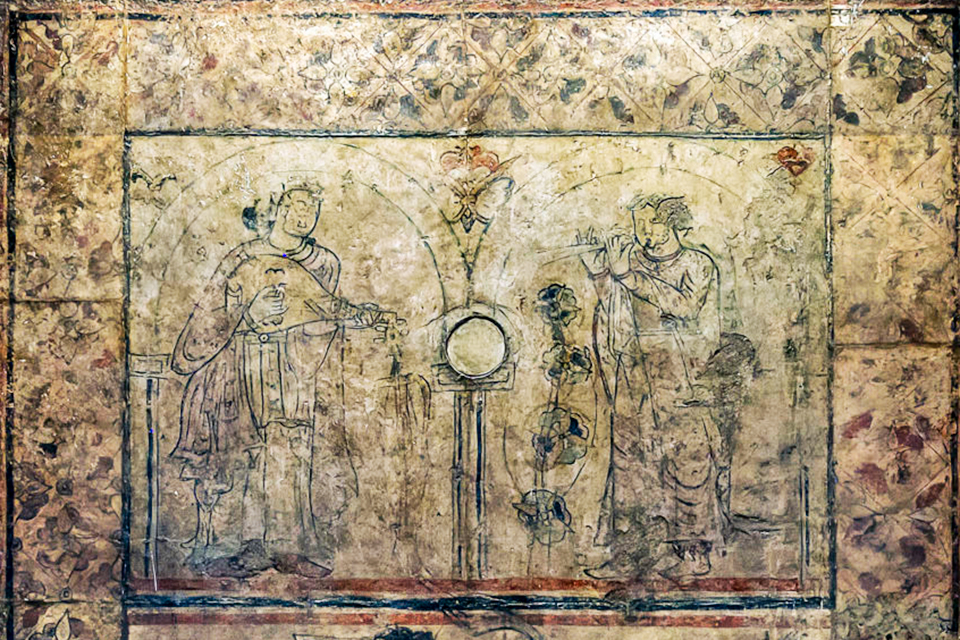
Painted floor at Qasr al-Hayr al-Gharbi, built by the Umayyad caliph Hisham ibn Abd al-Malik in AD 727 at the site of a Byzantine Monastery in present-day Syria. © Daniel Waugh (Smarthistory/Open Source). Displayed in the National Museum, Damascus
SOURCE:
Cædmun and Muhammad revisited
By Richard North
In: Early medieval England and its Neighbours (2026) vol 52, e6, 1 – 36


