


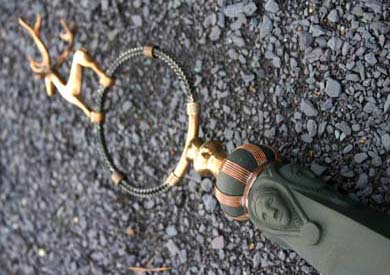
Three different interpretations of the stone from Sutton Hoo is usually pushed forward. Might it be a royal sceptre, a whetstone or a pagan stele? New research queries whether it was perhaps something quite different, namely an elaborate touchstone
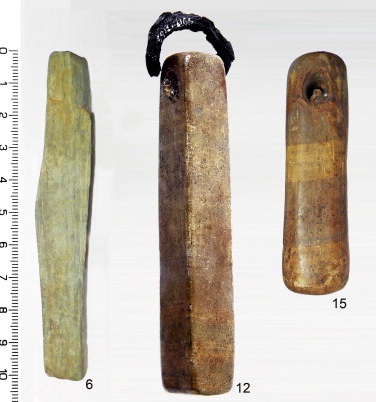
European archaeological collections record hundreds of thousands of stone artefacts from the Early Middle Ages described as whetstones. However, according to new research by Martin Ježek traces of non-ferrous metals, including precious metals have been preserved on a large number of such artefacts, which leads to the conclusion that many of these finds probably served as touchstones – tools to test the quality of a particular metal rather than whetstones.
These artefacts are concentrated mainly in Vendel and Viking Age and in Slavic coastal settlements and trade centres in the Baltic Sea basin, the coast and islands of North Western Europe and at Central and Eastern European fortresses and suburbia. Many finds, though, also stem from rural settings.
© Martin Jezek
In early medieval graves the touchstones join balance scales and weights as a sign of the buried individual’s access to precious metals. Especially the rural finds with traces of precious metal provide a strong reason for a revision of present views on the social stratification of the early medieval society in Europe.
Chemical microanalysis allows identifying the composition of the alloys. Besides new perspectives on the fields of the social history and the circulation of precious metals, the method also provides new information for the field of archaeometallurgy, writes Martin Ježek.
According to him touchstones were very common in high prestige burials and many of them had been elaborately worked into elegant forms and were much larger than the functional uses required (18 – 28 cm). One characteristic feature was the lack of “wear” on touchstones. Whenever they had been used, they were cleaned with wax and polish in order for them to be ready for next time. Thus they present themselves with remarkable pristine and polished surfaces (as opposed to whetstones, used for sharpening swords or knifes).
One such stone, which merits an archaeo-metallurgical analysis is the so-called “whetstone” or “sceptre” from Sutton Hoo. It is a well-known fact that other artefacts from the grave have near-correspondents in Swedish graves from the Vendel period, foremost the helmet. What is less well-known is the fact that the graves in Valsgärde in Uppland contained a number of large “whetstones” with significant traces of metal – thus to be understood exactly as touchstones. It is tantalizing that the whetstone from Sutton Hoo shows discolouration, which seems not to have been analysed.
So far the “whetstone” from Sutton Hoo has not been analysed; however it might be done with an electron microscope such as are available now-a-days for even large objects.
Touchstones of archaeology
Journal of Anthropological Archaeology, In Press, Corrected Proof, Available online 2 June 2013
By Martin Ježek, Institute of Archaeology, Czech Academy of Sciences, Letenská 4, CZ-118 01 Prague, Czech Republic


