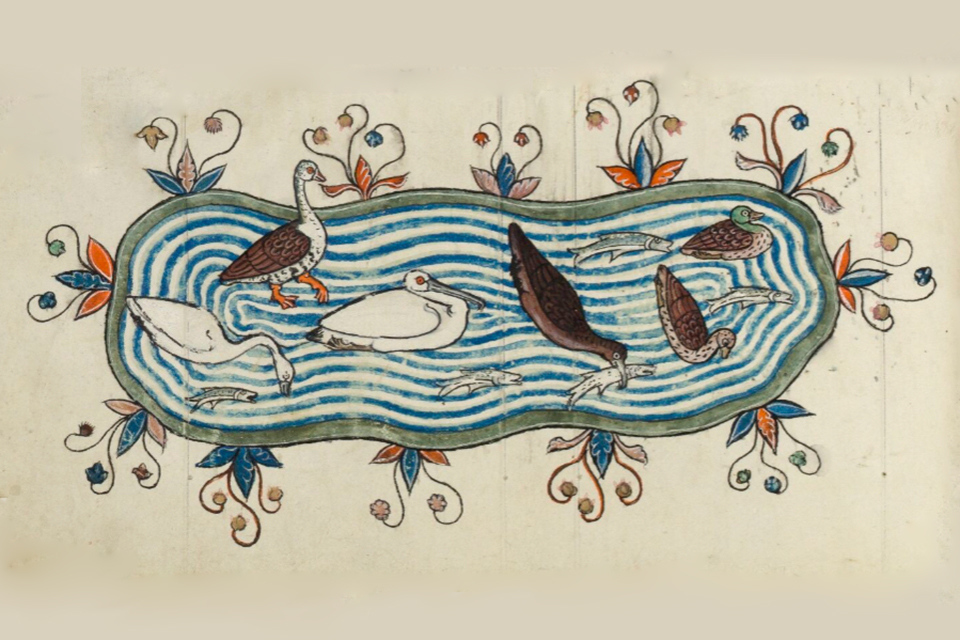
Treatise on hunting by Don Juan Manuel (1282–1348) presents us with a contemporary reading of a medieval landscape reflecting deeply felt perception and experience
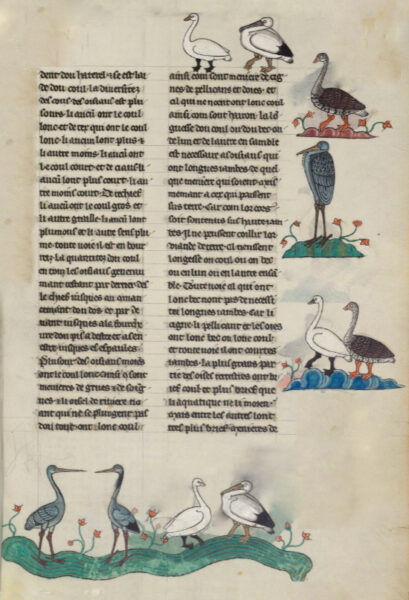
Don Juan Manuel (1282–1348) was one of the most remarkable – and politically troublesome – aristocrats of fourteenth-century Castile. A prince by descent, a territorial lord, a military commander, a diplomat and a prolific author, he belonged to the generation that transformed the intellectual legacy of Alfonso X, “the Wise”, into a new kind of aristocratic literature.
Born at Escalona in 1282, Juan Manuel was the son of Infante Manuel of Castile, grandson of King Ferdinand III and nephew of Alfonso X el Sabio. Strictly speaking, Juan Manuel was not himself an infante, since his father, rather than he, was a king’s son. Nevertheless that designation has often been applied to him.
He inherited substantial lordships, notably Escalona and Peñafiel, to the west and north of Toledo, and Villena near Alicante. He became one of the wealthiest and most powerful men in the kingdom.
His career unfolded during a period of extraordinary political instability. Royal minorities, aristocratic factions, disputed inheritances and struggles with the neighbouring kingdoms of Aragon, Portugal and Granada provided ambitious noblemen with considerable opportunities. Juan Manuel exploited those opportunities relentlessly. He held the important office of adelantado mayor of Murcia, a position combining royal authority, military responsibility and regional administration in the kingdom of Murcia. Reino de Murcia was a territorial jurisdiction of the Crown of Castile after 1266. He was also one of the guardians of the young Alfonso XI during the king’s minority.
When Alfonso XI assumed personal power in 1325, however, Juan Manuel’s influence was threatened. The king had promised to marry Manuel’s daughter Constanza but subsequently abandoned the marriage arrangement, precipitating a bitter confrontation. Juan Manuel even took up arms against his own sovereign. Their relationship alternated between open hostility and uneasy reconciliation for years.
Yet this was precisely the period when Juan Manuel was becoming an author of considerable originality. He was writing not as a cloistered scholar but as a powerful aristocrat attempting to define the knowledge, conduct, responsibilities and political standing of his own class.
Juan Manuel’s writing belonged to a remarkably ambitious literary enterprise. Like his uncle Alfonso X, he believed that knowledge should be collected, organised and transmitted in Castilian rather than confined to Latin. As a significant part of this intellectual endeavour, Alfonso X had established a University in Murcia devoted to further the amalgamation of knowledge of both Arabic and Latin origin.
Juan Manuel’s surviving works [1] reveal the breadth of that ambition.
- Crónica abreviada Before 1325. History of Spain
- Libro de la caza, c. 1325–1329. Falconry, natural knowledge and hunting geography
- Libro del cavallero et del escudero, 1326–1328. Chivalry, education and noble conduct
- Libro de los estados, c. 1330. Society, political order and Christian duties
- El conde Lucanor, 1335. Moral instruction through exemplary stories
- Libro enfenido, c. 1336–1337. Advice to his son concerning life, power and good government
- Libro de las tres razones, After 1337. Family history, ancestry and dynastic legitimacy
- The Tratado de la Asunción de la Virgen María. Between 1342 and 1348. Defending the belief that the Virgin Mary was assumed into heaven in both body and soul
These were not unrelated literary amusements. Together, they reflect a sustained preoccupation with what a great lord ought to know, how he should behave, what constituted legitimate authority, and how knowledge could be passed from one generation to the next. In view of this, Juan Manuel became unusually concerned about the integrity of his writings. He arranged for a collection of his works to be deposited at the Dominican monastery of Peñafiel, where readers could consult an authoritative copy rather than corrupted transcripts. (Unfortunately, this manuscript is no longer in existence)
Hunting as practical science
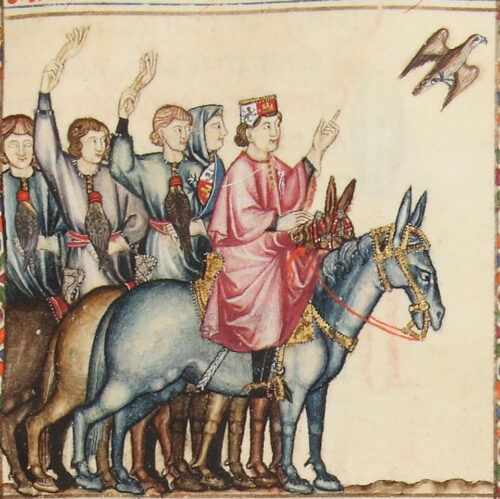
Hunting fitted naturally into this programme. It was an aristocratic accomplishment, a form of military training, a demonstration of wealth but also and importantly, a field of specialised knowledge on how to read a landscape, conquering its wilder inhabitants while caring for the troops. In minuscule, we get this sense from the description of Murcia in Manuel’s Libro de la Caza. Composed around 1325–1329, it is particularly interesting because it combines practical knowledge of falconry with observations of the natural environment, geography and the hunting landscapes of Castile, including Murcia. In other words, it is both a manual of aristocratic expertise and an unusually valuable record of the landscape as experienced by someone who knew it intimately.
Juan Manuel’s book belonged to the European tradition of technical treatises on hunting and falconry. Its most important predecessor was the De arte venandi cum avibus by Frederick II, Holy Roman Emperor. This connection is substantial. Thus the philologist, José Manuel Fradejas Rueda [2] has demonstrated important textual relationships between Juan Manuel’s book and Frederick’s treatise. Yet Juan Manuel also explicitly admired Alfonso X’s hunting literature and drew upon conversations with experienced falconers, together with his own considerable practical experience.
Don Juan Manuel tells us in the prologue to his own Libro de la caza that his uncle had ordered the preparation of numerous excellent books covering hunting with birds, hunting on land and fishing, and inspired by Alfonso’s youth spent in the landscapes around Toledo, where Manuel was at home and ruled vast estates. The principal hunting texts associated with Alfonso X are his Libro de los animales que cazan (also Libro de las animalias que caçan or Libro de Moamín) 1250, a Castilian translation from Arabic, associated with the young Alfonso’s patronage. This book covers the selection and training of birds of prey, techniques of hunting, their diseases and treatment, and the conditions under which hunting might succeed. The celebrated Libro de la montería, generally associated with Alfonso XI (1311–1350), is a later compilation, although its origins and authorship have been debated for centuries.
Juan Manuel originally envisaged describing hunting opportunities across an extensive series of ecclesiastical territories. Unfortunately, the surviving manuscript is incomplete. We possess descriptions covering only the bishoprics of Cartagena, Cuenca and Sigüenza.
The hunter as explorer and adventurer
Juan Manuel knew the region as a territorial lord and military administrator, but also as a hunter moving through its river valleys, marshes, irrigation channels and open countryside. Reading his text, it becomes apparent that his method was very modern. [3] Instead of merely listing places, he followed rivers, identified the birds found along them, commented on the seasons and explained the practical difficulties of hunting in particular landscapes, such as the marshy and wet surroundings around the Castle of Monteagudo. Together with the famous poem by Ḥāzim al-Qarṭājannī, his account provides a perspective that archaeology and palynology cannot as easily supply: a description of the landscape in use, with its birds, its obstacles and its possibilities.
The recent archaeological study of Monteagudo-Cabezo de Torres, makes direct use of his descriptions of the almarjal, including the abundance of herons and cranes and the difficulties caused by dense vegetation and numerous channels.
Extract from Libro de la caza, c. 1325–1329 by Don Juan Manuel concerning the Kingdom of Murcia
The land of Chinchilla has many lagoons containing numerous ducks, and in some of them there are flamingos. Generally speaking, with the exception of Villena, there is no place in the kingdom of Murcia offering such good hunting with falcons as the district of Chinchilla, although not the town itself.
Neither in Jorquera nor in its district, nor in Ves or Alcalá, is there anywhere suitable for hunting waterbirds. There are some herons on the River Júcar, but not in places where they can readily be killed with falcons. At Aluorem, at Fuente Alviella, there are said to be ducks. Don Juan Manuel says, however, that he has never hunted in these places.
At Alpera there are herons, cranes and ducks, but the terrain beside the water is very bad for riding, because there are many marshes and extremely difficult crossings.
At Almansa there is no hunting of waterbirds, except perhaps along the stream. Villena, however, offers better hunting of every kind than anywhere else in the kingdom of Murcia. Indeed, Don Juan Manuel says that he has seldom seen a place so excellent for every kind of hunting.
From the top of the castle one can watch herons, ducks and cranes being hunted with falcons and goshawks, as well as partridges and quails. There are also birds called flamingos, which are beautiful birds and very easy to hunt, except that they are extremely difficult to retrieve from the water, since they are always found in a very large saltwater lagoon. There are also hares and rabbits.
From the same castle one can also watch hunts for wild boar, deer and wild goats. Don Juan Manuel says that he has participated in all these kinds of hunting within sight of the castle. Indeed, he says that the wild boar were killed so close to it that those watching from the castle could easily recognise the face of the person who first reached the animal.
He says that, were it not for the many eagles and the extremely difficult crossings in some parts of the irrigated countryside, he would consider Villena the finest hunting ground he had ever seen.
At Yecla and Sax there is no other watercourse suitable for hunting than the one coming from Villena, and this is neither very good nor easy to cross. Nevertheless, between Villena and Sax, herons and ducks are found in certain places. In the lagoon of Las Salinas there are herons and flamingos, but the lagoon is very large.
From Sax to Elda runs the stream coming from Villena, passing through very narrow places between hills and mountains. It is not a good place for hunting with falcons, and below Elda, as far as the irrigated lands of Novelda, there are no suitable hunting grounds for falcons.
From Novelda to Aspe there may occasionally be some ducks and a heron. At Nepod, herons and ducks are sometimes found at the spring.
At Elche, herons sometimes come to the water, and there are some ducks. There are also many cranes, and excellent places for hunting them.
At Aluente there is no other waterside hunting ground than the sea. In the marshes and lagoons near the harbour of Santa Pola there are many herons and bitterns, but they are extremely difficult to take. They cannot be caught with falcons except by the method that Don Juan Manuel will describe later, when explaining how he hunts herons at sea near the harbour of Cartagena.
In the lagoons and marshes of Los Barcos, Caral, Almuradí and Ladaxa, in those of the Cabayuelos known as Don Manuel’s, in the irrigation channel that Don Manuel ordered to be constructed, and at Albadera, there are many herons and bitterns. In all these places, however, they are exceedingly difficult to take with falcons.
Along the edges of these marshes, towards Crevillente, ducks can sometimes be found in places where they can be hunted with falcons. Throughout this countryside there are also many cranes, with good places for hunting them.
At Guardamar there is no other waterside hunting ground than the sea and the River Segura, and the herons are extremely difficult to hunt with falcons. There are neither cranes nor ducks in places where they can be hunted.
At Orihuela there are many herons on the River Segura. Sometimes one may also find one in an irrigation channel outside the town, near the gate on the road towards Murcia.
Don Juan Manuel says that he once found a heron there, and that it cost him dearly, for while attempting to come to the assistance of his falcons, he fell together with a mule, in an accident that nearly killed him.
From Orihuela upstream towards Murcia, there are many herons along the River Segura, but they are extremely difficult to kill with falcons because the river is very large, there are no crossings, its banks are heavily wooded, and there are many irrigation channels.
In the marshland of Monteagudo there are many herons and bitterns, but they are very difficult to kill with falcons. Along the edges of the marsh, however, ducks may occasionally be found in places where they can be hunted with falcons.
In Murcia there are many herons along the River Segura, but they are very difficult to kill with falcons. They are also sometimes found in the lagoon by the gate of the Minorite nuns.
Likewise, they may occasionally be found in the irrigation channels on either side of the town, both towards the Tower of the Washerwomen, towards Churra, and towards the Real del Pino. They are also found beyond the river, in the irrigation channels between the town and the Sierra de Yelo.
There are also many cranes, but they are very difficult to hunt because of the numerous irrigation channels. As for ducks, there are not many good opportunities for hunting them with falcons, except for a few that may be found in the Campo de Sangonera or occasionally in certain irrigation channels where they can be hunted.
At Cartagena there is no other waterside hunting ground than the sea and the irrigation channel that waters the cultivated lands. Herons are sometimes found in this channel, and where it enters the sea there are very many herons indeed.
Those found in the irrigation channel are easier to kill with falcons. But those found at sea, or where the channel enters the sea, cannot be hunted with falcons unless a strong wind is blowing in from the sea.
When this happens, drums should be placed in boats and the herons driven up with the wind behind them, towards the land. Once they have risen a little, a falcon should be released to make them climb higher.
Because herons have very abundant and very soft feathers, they cannot rise against the wind, and therefore always climb with the wind behind them. After they have made two or three turns, if the wind is sufficiently strong, it drives them so far out from the sea that they cannot return to it.
When they have risen as high as the falconer considers suitable for his falcon to kill them, according to its flying ability and speed, he releases it.
The heron, attempting to escape the falcon, will move farther and farther away from the sea with the wind behind it, until it can be killed on dry land.
In this way, herons may be hunted with falcons at Cartagena, but in no other manner. There is also a lagoon near the town of Cartagena which does not always contain water. When it does, many herons and sometimes numerous flamingos are found there. When they are in the lagoon, they are easier to hunt by the method described above than when they are at sea.
The River Sangonera comes from Lorca and enters the irrigated countryside of Murcia. Where it enters these cultivated lands, there are many herons and bitterns, but there are very few crossings, and those are exceedingly difficult. The whole river runs through marshland.
As far as Libriella there are still more herons. Farther upstream, towards Alhama, Totana and El Sorrajo, and as far as the irrigated lands of Lorca, the terrain beside the river becomes progressively worse for hunting. There is more game, but it is increasingly difficult to hunt.
At Lorca there is no other watercourse suitable for hunting than the one called the Rambla. This is not a good place for hunting, nor is there much game. Nevertheless, a heron occasionally comes there, together with a few ducks and a few teal. In the lower part of the area known as the Huerta, cranes also appear occasionally.
Don Juan Manuel says that hunting partridges and hares is neither as noble nor as elegant as hunting waterbirds, and for that reason he has not wished to mention in this book the places where these animals may be hunted.
Nevertheless, he says that throughout the kingdom of Murcia there is an abundance of this game, and wherever the country is suitable for searching for it, hunters will find plenty.
There is also another kind of hunting, which is not as elegant as hunting waterbirds but is better than hunting partridges and hares. This is the hunting of little bustards and stone-curlews, both of which are numerous.
Don Juan Manuel says that, for a falcon which kills them well, hunting little bustards is scarcely inferior to hunting ducks.
Because stone-curlews are more migratory birds, many of them are found in the kingdom of Murcia during the winter. They offer good hunting for falcons, whether flown directly from the arm or in the high-flying manner.
Little bustards, however, once the waters have passed, should only be hunted with falcons flying high.
From: Don Juan Manuel, Libro de la caza, Chapter XII, c. 1325–1326. Translated from: Gottfried Baist (Hrsg.): Juan Manuel, El libro de la caza, Halle a.S. 1880, Hildesheim 1984 pp. 68–73. The translation covers the complete Murcia/Cartagena geographical section, beginning with Chinchilla on p. 68 and ending with the discussion of little bustards on p. 73.
Notes on Translation:
– Ribera refers here to places suitable for hunting waterbirds, rather than merely a riverbank. I have generally translated it as “waterside hunting ground” or “terrain beside the water”.
– Armajal/almarjal refers to marshland or waterlogged ground. This is particularly important for understanding Monteagudo. – – Flamenques are flamingos; bitores are bitterns; sisones are little bustards; and alcarauanes are stone-curlews.
– Braço torpicado is a specialised falconry expression provisionally rendered as flying directly from the arm. A later transcription also reads altaneros (“high-flying”) where Baist prints abaneros.
– Some medieval place names have been retained where identification is uncertain, particularly Aluorem, Nepod and Aluente.
– The final expression concerning the little bustards, literally “after the water has passed”, remains somewhat ambiguous.
FEATURED PHOTO:
From De arte venandi cum avibus. French translation BnF, français 12400, fol 68v
NOTES
[1] The literature is vast. Recently Brill published a new companion summing up the last 50 years of scholarship. A Companion to Don Juan Manuel. Ed. by Mario Cossío Olavide, Daniela Santonocito and Anita Savo
Series: Brill’s Companions to Medieval Literatures and Cultures, Volume: 4
Brill 2026
[2] José Manuel Fradejas Rueda. Los libros de caza medievales y su interés para la historia natural. Arbor (2017) Vol 193, no 786.
[3] Jonathan Burgoyne. The forest laboratory: the science and space of the royal hunt in fourteenth-century Iberia. . Journal of Medieval Iberian Studies Volume 18, 2026 – Issue 1, Pages 107-127