In the thirteenth century, the Andalusi poet Ḥāzim al-Qarṭājannī recalled the landscape of Monteagudo, near Murcia, with its palaces, gardens, marshes and winding rivers. His verses offer a remarkable glimpse of a vanished world – here presented in Arabic alongside two English translations.
Born in Cartagena in 1211 or 1212, Ḥāzim al-Qarṭājannī (d. 1285) grew up in the southeastern corner of al-Andalus. His father was a judge in Cartagena, and the young Ḥāzim received an extensive education, studying in Murcia, Granada and Seville. Before 1242, however, he left the Iberian Peninsula, eventually settling in Tunis, where he became associated with the literary and intellectual circles of the Hafsid court.
It was in exile that he composed his celebrated Qaṣīda Maqṣūra, a lengthy poem addressed to the Hafsid ruler al-Mustanṣir. Intended, among other things, to encourage support for the Muslims of al-Andalus in the face of Christian expansion, the poem also offers a remarkable evocation of the countryside around Murcia, where the poet had spent part of his youth.
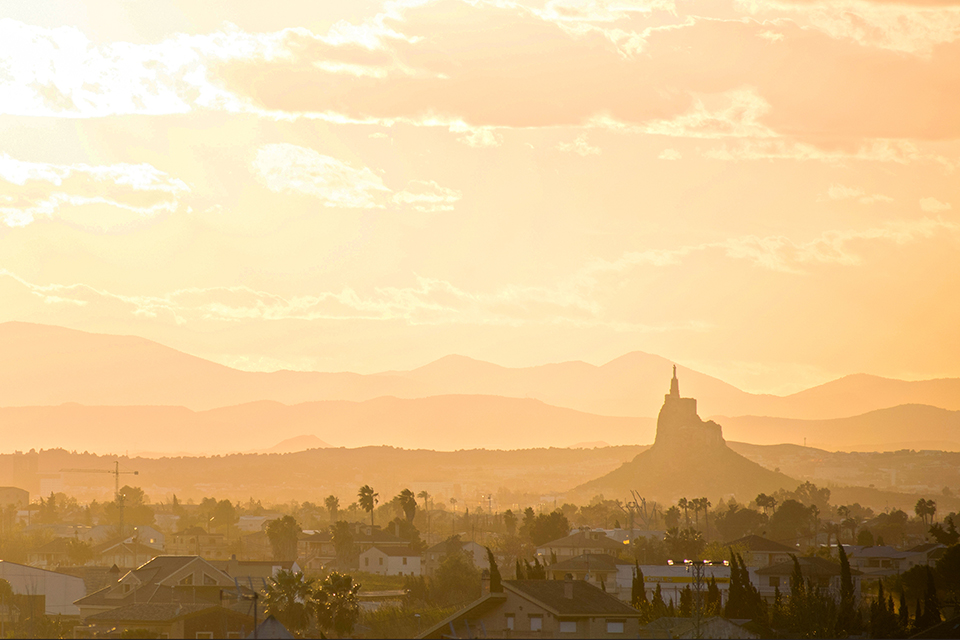
Among the places he recalled was Monteagudo, some five kilometres northeast of Murcia, where the emir Ibn Mardanīsh, known to Christian chroniclers as the Wolf King, had established an extensive royal estate during the twelfth century. Its fortified palaces, pleasure gardens, orchards, agricultural lands and hunting grounds formed a carefully organised landscape stretching from the dry foothills towards the irrigated plain and the marshlands beyond.
By the time Ḥāzim knew the region, parts of this palatial complex had already fallen into ruin, following the Almohad campaigns of 1165 and 1171. His descriptions therefore belong to a later landscape, in which the remains of royal splendour stood alongside places still used for walking, hunting, social gatherings and agricultural production.
The poem is particularly evocative because it is filled with movement. The poet remembers climbing hills, wandering among friends, pausing beside rivers and visiting places whose names have partly survived in the local topography. Elsewhere, he describes clouds passing over the countryside, bringing rain to towers, meadows, gardens and pools. These are not straightforward geographical observations – they are memories transformed into poetry, shaped by the conventions of Arabic literature and the experience of exile.
Nevertheless, the verses offer an exceptional starting point for exploring how the medieval landscape of Murcia was experienced and remembered. Recent archaeological investigations of the royal estate at Monteagudo have given renewed significance to many of the places and landscape features mentioned by the poet.
Below, two passages from the Qaṣīda Maqṣūra are presented in the original Arabic, followed by a close English translation and a freer literary rendering. The intention is to preserve both the distinctive imagery of the original and something of the atmosphere of the landscape that Ḥāzim remembered.
Notes on Translating the Poem
Translating medieval Arabic poetry presents difficulties beyond finding suitable English equivalents for individual words. Meaning is frequently conveyed through repetition, wordplay, sound patterns and metaphors, while the grammatical structure allows expressions to carry several associations simultaneously. These features are particularly prominent in Ḥāzim al-Qarṭājannī’s poem. Note also that the poem uses a sustained rhyme in an -ā sound. This is an organising feature of the original verse that neither English translation attempts to reproduce.
The two English versions presented here illustrate different approaches. The close translation attempts to preserve the structure and imagery of the Arabic, even at the expense of natural English. The literary rendering gives priority to rhythm, readability and the evocation of the remembered landscape. Neither can reproduce every aspect of the original. Thus, the close version preserves more of its structure, imagery and unfamiliar expressions. The literary version offers a more immediate experience of its remembered landscape. Yet every improvement in fluency potentially removes something distinctive from the original. Perhaps the most useful approach is therefore not to choose one translation over the other, but to read them together – using the differences to discover how the poet created meaning through language. The translations have been provided by ChatGpT Pro
The first passage – remembering the landscape
| Verse | Arabic text | Close English | Literary rendering |
|---|---|---|---|
| 289 | وَكَم حديثٍ كَنثيرٍ الزهرِ في تلكَ المباني قد حَكاهُ مَن حَكَى | And how many conversations, like scattered flowers, were recounted in those buildings by those who told them! | How many stories passed from voice to voice in those halls, as plentiful as flowers scattered in a garden! |
| 290 | وَكَم بَدَت لي بِمُنيرٍ أوجُه / مُنِيرَةٌ سَلَّينَ هَمِّي فانسَلَى | And how many radiant faces appeared to me at Munīr, soothing my sorrow until it disappeared! | At Munīr, how often bright faces greeted me, dispelling my cares until no trace of sadness remained. |
| 291 | وكم بحصن الفَرَجِ السامي لَنَا / مِن فُرَجٍ سَرَّين وَجدي فانسَرَى | And how many delights we enjoyed at lofty Ḥiṣn al-Faraj, easing my longing until it passed away! | At the lofty Fortress of Solace, our excursions brought such pleasure that even the ache of longing slipped away. |
| 292 | وَكَم بِمُنتَقُودَ وَالمَرجِ لَنَا مِن / نُزَهٍ تَنَزَّهت عَنِ الخَنَا | And how many excursions we enjoyed at Muntaqūd and al-Marj, free from indecency and baseness! | How often we wandered through Monteagudo and the marshy meadows, enjoying innocent pleasures, far removed from anything coarse or dishonourable. |
| 293 | وكم قَصَرنا زَمَنًا للسَّعدِ في / قَصر ابنِ سَعدٍ بالسُّرُورِ وَالهَنَا | And how often we set aside time for happiness at the Palace of Ibn Saʿd, amid joy and contentment! | At Ibn Saʿd's palace, we devoted our hours to happiness, filling them with pleasure and delight. |
| 294 | نَجُولُ في هالاتِ أَقمارٍ عَفَا / مِن حُسنِها صَرفُ الزَّمانِ ما عَفَا | We wandered among haloes of moons, of whose beauty the passage of time has erased what it has erased. | We wandered among faces radiant as moons, though the passing years have since dimmed their beauty. |
| 295 | وَنَقصُرُ اللحظَ عَلى قَصرٍ بِهِ / أَبقى الزَمَانُ عِبرَةً لِمَن بَقَا | And we fixed our gaze upon a palace in which time had preserved a lesson for those who remained. | And there before us stood the palace, marked by time – a warning left for those who would come after us. |
| 296 | كَالحِيرَةِ البَيضاءِ إِن ناسَبَها / وَناسَبتَهُ بَهجَةً فَبِالحَرى | Like White al-Ḥīra: if it resembles her, and she resembles it in splendour, the comparison is surely fitting. | In splendour, it was worthy of comparison with White al-Ḥīra, that celebrated palace of an earlier age. |
| 297 | وَكُديَةُ الرَشيدِ ما أَكدَى بِهَا / مِن قَنَصِ الأُنسِ الشَريدِ مَن سَمَا | And on Rashīd's Hill, none who climbed in pursuit of elusive delight came away empty-handed. | On Rashīd's Hill, no one climbed in search of fleeting pleasures and came away disappointed. |
| 298 | كَم قَد سَعِدنا إذ صَعِدنا حَولَها / مِن سَرحَةٍ لِصَرحَةٍ وَمُستَوى | How happy we were when we climbed around it, from tall tree to open terrace and level ground! | How happily we climbed its slopes, passing among the trees, across open terraces and up towards the level ground above. |
| 299 | وَكَم إلى القَنطَرَةِ البَيضاءِ قَد / مَشى بنا الأُنسُ رُوَيدًا وَرَها | And how often companionship led us slowly towards the White Bridge! | How often we wandered at leisure towards the White Bridge, enjoying the slow progress of a walk among friends. |
| 300 | وكَم لَنا بالزَنَقَاتِ وَقفَةٌ / حَيثُ استَدارَ النَهرُ مِنها وَانحنَى | And how often we stopped at al-Zanaqāt, where the river turned and curved around! | At al-Zanaqāt we would pause again and again, where the river swept round in a broad, winding bend. |
1. Repetition and memory (vv. 289–293, 299–300)
The Arabic repeatedly employs wa-kam, meaning “and how many” or “how often”. This repetition gives the passage its cumulative rhythm, as one recollection follows another. The words are exclamatory rather than requests for numerical information. Both translations retain something of this structure, although the literary version varies the phrasing to avoid monotony. Students might consider whether this variation improves the English at the expense of the original rhythm.
2. The language of light (v. 290)
The poet brings together Munīr, the name of a place, and munīra, meaning “radiant” or “illuminating”. The close translation retains the name and the description of radiant faces, but their verbal relationship disappears in English. The literary version preserves the image of brightness while sacrificing the wordplay. This is an example of a meaning that cannot easily be recovered without explanatory notes.
3. Pleasure, relief and consolation (v. 291)
Another verbal association occurs between al-Faraj, the name of the fortress, and furaj, referring here to pleasurable outings or excursions. The name also evokes relief or consolation. The poet thus creates a relationship between a particular place, the pleasures enjoyed there and the disappearance of sorrow. Translating the name as “Fortress of Solace” recovers one association but cannot reproduce the full range of meanings.
4. Recreation and propriety (v. 292)
The Arabic associates nuzah, excursions or pleasurable outings, with tanazzahat, an expression suggesting freedom from something improper. The words share a linguistic root. The close translation preserves the explicit reference to indecency, whereas the literary version presents these outings as innocent pleasures. The difference illustrates how a translator may choose between preserving the moral vocabulary of the original and conveying its general meaning in more familiar English.
5. The palace and the passing of time (vv. 293–295)
The poet repeatedly plays with forms associated with qaṣr, meaning “palace”, and qaṣara, meaning “to shorten” or “to limit”. The relationship between the palace and the brevity of happiness is thus expressed through the sound of the Arabic itself. In verse 295, the palace becomes a reminder of the passage of time. English can reproduce the contrast between pleasure and loss, but not the interlocking verbal patterns that connect the verses.
6. The moons and their beauty (v. 294)
The poet describes beautiful people through the conventional Arabic metaphor of moons. A close translation preserves the unfamiliar image of wandering among “haloes of moons”. The literary version interprets the metaphor as a reference to radiant faces. The latter is easier for a modern reader to understand, but it also removes some of the imaginative distance between the medieval poem and its English translation.
7. The lost splendour of the palace (vv. 295–296)
The palace is both a place of remembered pleasure and a monument to the destructive power of time. The comparison with White al-Ḥīra, a celebrated symbol of vanished splendour in Arabic literature, deepens this contrast. The passage also demonstrates the difficulties of comparative expressions: the exact relationship between the two palaces has been rendered differently by translators. Robert Pocklington and Abigail Krasner Balbale interpret the comparison with White al-Ḥīra as emphasising Monteagudo’s superior splendour, while our close translation reads it more cautiously.
8. The sound of happiness (vv. 297–299)
In verse 298, the Arabic brings together words meaning “we were happy” and “we climbed”, creating an audible relationship between physical movement and pleasure. Verse 299 personifies companionship, making it the agent that leads the walkers towards the bridge. In literary English, this can be rendered more naturally as a leisurely walk among friends, but the personification is then weakened. The translator must decide whether to preserve the poet’s unusual expression or communicate its emotional effect.
The second passage – clouds and rain
| Verse | Arabic original | Close English | Literary rendering |
|---|---|---|---|
| 478 | وأَسعَدَت قصرَ ابنِ سَعدٍ سُحُبٌ / تَصعَدُ مِن مُنحَدَرٍ لِمُستَمى | And clouds brought happiness to the Palace of Ibn Saʿd, rising from low ground towards the heights. | Clouds climbed from the lowlands towards the palace of Ibn Saʿd, bringing their welcome rain as they rose above the slopes. |
| 479 | واجتَلَبَ النَسيمُ أَخلاف الحيا / على البُروجِ والمُرُوجِ وامتَرَى | And the breeze brought forth the udders of rain and milked them over al-Burūj and al-Murūj – the Towers and the Meadows. | The breeze drew rain from the clouds, pouring it over the towers and the meadows below. |
| 480 | وظَللت راياتُهُ الدَوسَ الذي / قد أَشبَهَ الفِردَوسَ حُسنًا وحَكى | And its banners cast their shade over al-Daws, which resembled Paradise in beauty. | The clouds spread their banners of shade across al-Daws, a place whose beauty recalled the gardens of Paradise. |
| 481 | وَصُهِرَ الجَوُّ بِبَرقٍ ساهِرٍ / على الصُهيريجِ المُنيرِ المُجتَلى | And the air was melted by sleepless lightning above the bright, shining al-Ṣuhayrij. | Restless lightning seemed to melt the sky above the shining pool of al-Ṣuhayrij. |
| 482 | وساوَرَت بَني سِوارٍ حَيَّةٌ / مِن بَرقِهِ تحيى ولا تُعيي الرُقى | And a serpent of lightning sprang upon Banū Siwār, alive and not exhausted by incantations. | Over Banū Siwār, lightning writhed like a living serpent, its restless movements beyond the power of charms to subdue. |
| 483 | وجَلَّلَ الشَطَّ الجَنُوبيَّ حَيًا / لا يَنجلي إلا إذا الجَدبُ انجَلى | And rain enveloped the southern bank, not clearing until the drought itself had cleared. | Rain settled over the southern riverbank and remained until the last traces of drought had disappeared. |
9. Clouds as living creatures (vv. 478–479)
The poet treats the clouds as active participants in the landscape. They bring happiness to the palace, while the breeze draws rain from them as though milking the udders of animals. This metaphor is retained in the close translation but simplified into falling rain in the literary rendering. The difference raises a central question: when does replacing an unfamiliar metaphor with a familiar expression become an interpretation rather than a translation?
10. Paradise and sound (v. 480)
The name al-Daws is linked by sound to al-Firdaws, Paradise. The connection depends upon the Arabic words and is largely lost in English. The literary version retains the reference to Paradise, but the relationship between the two words requires an explanation. Here, the translation can preserve the meaning while losing the verbal technique through which the poet communicates it.
11. Lightning, serpents and incantations (vv. 481–482)
Lightning is presented first as something capable of melting the sky and then as a living serpent. These images combine physical observation with imaginative transformation. Verse 482 is particularly difficult because its reference to incantations can be understood in different ways. Pocklington’s published translation differs substantially from the English versions printed here. This is therefore an instance where the readings must remain provisional.
12. The rhythm of departure (v. 483)
In the final verse, the rain does not depart until the drought has departed. The close translation retains the repetition, while the literary version smooths the construction into more conventional English. Something of the original verbal pattern is lost, but the movement of the rain becomes easier to follow.
FEATURED PHOTO:
Monteagudo seen through an early morning mist from Murcia. © David Moreno Hernandez/Dreamstime ID 175511183
SOURCES:
Ḥāzim al-Qarṭājannī, Qaṣīda Maqṣūra. Arabic text, available online.
Robert Pocklington, “La descripción de la vega de Murcia en la Qaṣīda Maqṣūra de Ḥāzim al-Qarṭāŷannī”. Estudios sobre Patrimonio, Cultura y Ciencias Medievales 18 (2016), pp. 1021–1050. An annotated Spanish translation of the verses describing the Murcia countryside, with extensive discussion of place names and their geographical identification.
Emilio García Gómez, “Observaciones sobre la ‘qasida maqsura’ de Abu-l-Hasan Hazim al-Qartayanni”. Al-Andalus 1 (1933), pp. 81–104. An early scholarly study of the poem.
Abigail Krasner Balbale, The Wolf King: Ibn Mardanish and the Construction of Power in al-Andalus. Cornell University Press, 2022. See especially pp. 87–88 and 169–180 for the poem, Monteagudo and the architecture of Ibn Mardanīsh.
Julio Navarro-Palazón and Pedro Jiménez-Castillo, “The Wolf King’s Leisure Estate: An Andalusi Agricultural and Palatine Project (Murcia, 12th Century)”. Arts 12 (2023), article 162. An archaeological reconstruction of the royal estate and its gardens, buildings and hydraulic systems.
“Multisecular Landscape Dynamics of a Medieval Islamic Royal Estate: Land-Use Change in Monteagudo-Cabezo de Torres (Murcia, Spain)”. Land 15 (2026), article 2115. A recent interdisciplinary study integrating landscape archaeology, archaeobotany, historical texts and geographical modelling.