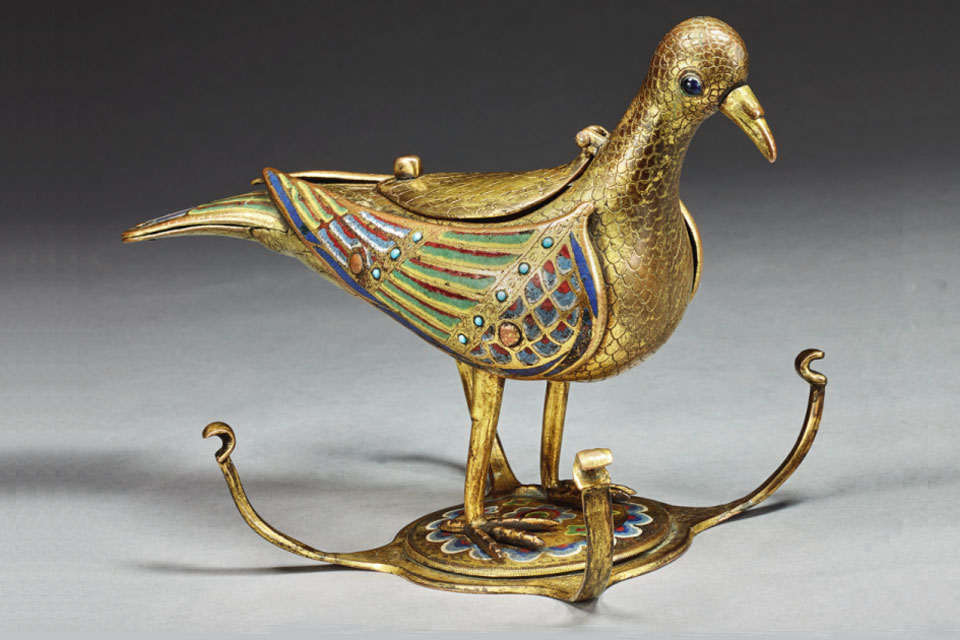
The price went soaring when Sotheby’s sold a Eucharistic Dove from 13th century Limoges
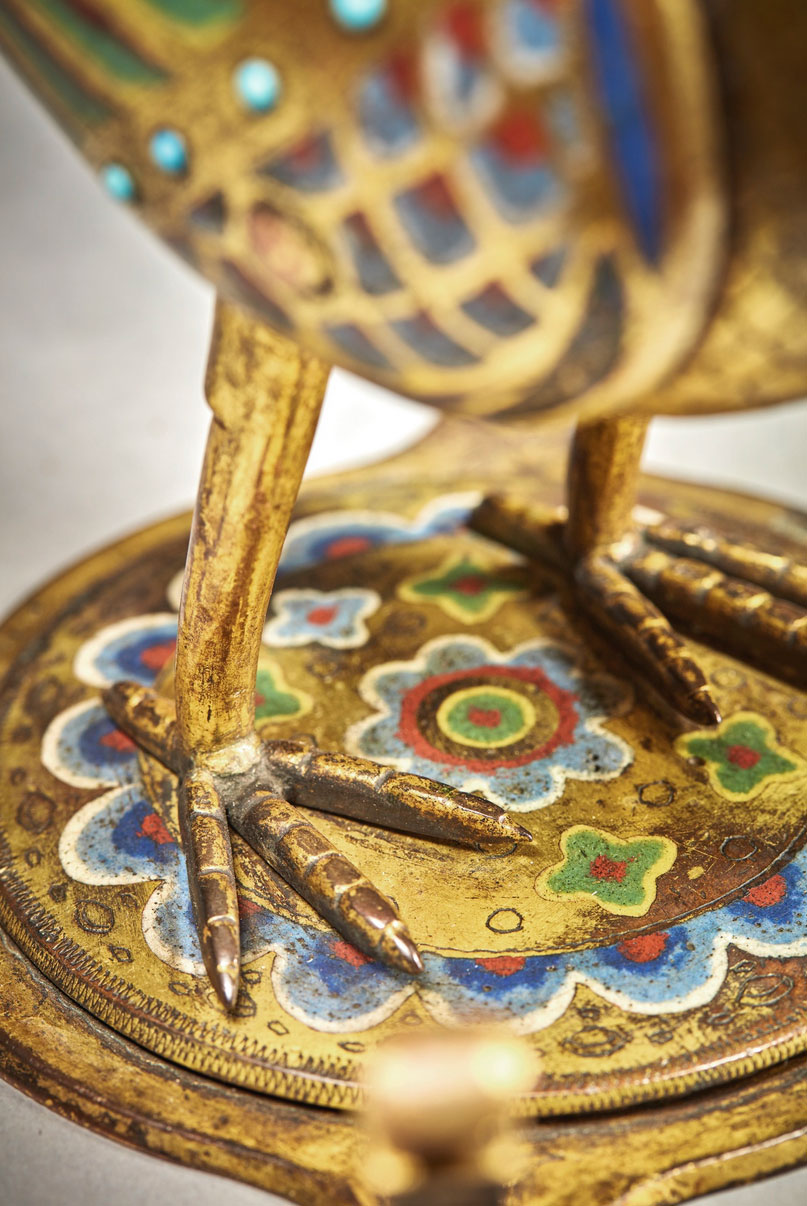
When Sotheby’s estimated the price of the Eucharistic Dove from Limoges to $ 200,000 – 300,000, they got the price all wrong. It went for $ 792,500, but then such doves are extremely seldom guests at international auctions.
Many such Eucharistic Doves or Peristeria are known to have been made at Limoges in the early 13th century. These doves were widely exported and approximately fifty can still be found in collections in both private and public collections. Such doves functioned as portable tabernacles containing the consecrated host. Suspended above the altar, they sent a clear message of the dogmatic fusion between the Holy Spirit and the Incarnated Christ. They also served to keep the consecrated host safe for mice, notoriously able to crawl into any small opening.
Made of champlevé enamel and partly gilt copper, the life-size dove would add considerably to the visual sense of mystery encapsulating the priests and acolytes, celebrating mass. In the back, a tear-shaped flap gives access to a small cavity, which would hold the consecrated bread. Exactly how they were suspended is debated as 19th-century jewellers excelled in repairing the doves. One in the National Gallery of Art in Washington is standing in the centre of a walled or crenellated city, the Heavenly Jerusalem. This is also the case with the dove in the Rijksmuseum in Amsterdam. The chains might be suspended from a crown, above the dove; small holes in the crown might make it possible to suspend a cloth from it, resembling the biblical Tabernacle. This would veil the dove.
In 1973, the art historian Marie-Madeleine Gauthier recorded 42 known enamelled doves, which she dated according to specific designs of the plumes, as either made between 1200 and 1220 or alternatively 1215 – 1235. The later doves are more simple in the decoration than the earlier ones. Especially, the plumage of the wings might be divided by a more simple band. The present dove belongs to the last period.
Other such doves can be found in the Museum of Fine Arts in Boston, The Metropolitan Museum of Art, The Walters Art Museum and the Burrell Collection in Glasgow. Other fine examples may be found in the British Museum and the Victoria & Albert Museum in London.
SEE MORE
Eucharistic Doves
By Christine Descatoire (Curator – Museum of the Middle Ages, Cluny)
READ MORE:

In: The Liturgy of the Medieval Church, edited by Thomas J. Heffernan, and E. Ann Matter. Consortium for the Teaching of the Middle Ages. Kalamazoo, Michigan: Western Michigan University, 2005. pp. 398-399, fig. 6.

Enamels of Limoges, 1100-1350.
Boehm, Barbara Drake, and Elisabeth Taburet-Delahaye, ed.
New York: The Metropolitan Museum of Art, 1996. no. 105, pp. 318–19.