


From bodily performance to sacred image: how the living Francis of Assisi was transformed after his death through memory, hagiography and visual culture.

What did St Francis of Assisi actually look like? This question sounds simple, but it is not. Within decades of his death, Francis had acquired the visual attributes by which he is still recognised: the tonsure, the stigmata, the rough habit, the book and the blessing hand. Yet the earliest descriptions and images are far less settled. Some show no tonsure. Some omit the stigmata. Some present not an ascetic cleric, but a small, animated and rather unimpressive man whose force lay in his voice, gestures and bodily performance.
The problem, then, is not merely whether Francis wore his hair in one way or another. It is how the historical Francis – preacher, performer, penitent and sometime jongleur – was gradually transformed into the stable visual and textual sign of “St Francis”.
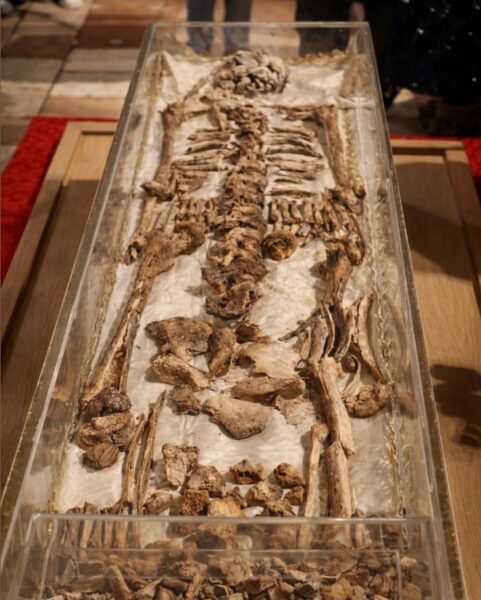
As part of the celebration of the 800th anniversary of his death, the faithful were invited to look upon and venerate the bodily remains of the saint, which reveal a man who stood no more than 152 cm tall. Unfortunately, the cranium was so fragmented that a proper reconstruction was not possible.
However, we do know something more about the stature and physical appearance of the saint from a description provided by Thomas of Celano, who was commissioned in 1228 to write the first vita:
“Of moderate stature, tending rather towards shortness; his head was of medium size and rounded; his face somewhat long and extended; his forehead smooth and small; his eyes of medium size, black and straightforward; his hair dark; his eyebrows straight; his nose symmetrical, slender and straight; his ears prominent but small; his temples smooth. His tongue was gentle, fiery and incisive; his voice strong, sweet, clear and resonant; his teeth close-set, even and white; his lips moderate and thin; his beard black, but not thickly covered with hair. His neck was slender, his shoulders straight, his arms short, his hands slender, his fingers long, his nails projecting; his legs slender, his feet small, his skin fine, his flesh very scant. His clothing was rough, his sleep exceedingly brief, his hand exceedingly generous.” (1)
Not much, perhaps, from which to form a firm notion of the man. Luckily, though, we have endless descriptions of his many escapades, both before and after his epiphany and conversion around 1205 at the church of San Damiano, and he left many traces of how he thought about his mission and its bodily performance.

Thus, there is no doubt that Francis of Assisi, during his short ministry (1208–1226), used his body to perform a Christlike life. From his famous stripping in the piazza in front of the cathedral, discarding the luxurious clothes provided by his father, Pietro Bernardone, to his personal investment in feeding lepers, his body became the playground for his very physical enactment of the Gospel. Culminating in the story of the stigmatisation, his was a lifelong embodied performance, filled with singing, preaching and dancing.
No wonder G. K. Chesterton, in his famous biography of the saint, called the little man “Le Jongleur de Dieu”, echoing stories told by his friends about how he called his brethren the “Joculatores Domini” – God’s Minstrels – whose task was to lift people’s hearts towards spiritual joy.
This vignette of Francis and his merry band of brothers dancing and singing their way through first the Umbrian countryside and later the rest of Europe derives from traditions written down by Leo, Rufino and Angelo. Even if we do not know whether Francis really described his brothers as a performing troupe, we must agree with Chesterton that this is how we see them weaving in and out of the many small stories of their lives. (2) And, arguably, this was how Francis gave meaning to his own endeavour, leading up to the final bodily performance of the stigmatisation. Finally, we have a precious report from a travelling scholar who experienced exactly this side of him in Bologna in 1222:
“In the same year, on the Feast of the Assumption of the Mother of God, while I was studying at Bologna, I saw Saint Francis preaching in the square before the public palace, where almost the entire city had gathered. The opening of his sermon was: ‘Angels, men, demons.’ Concerning these three rational spirits he spoke so well and so eloquently that the words of this unlearned man caused no little wonder among the many learned men who were present. Yet he did not adopt the manner of a preacher, but spoke rather as one addressing a public assembly. The entire substance of his words was directed towards extinguishing enmities and renewing bonds of peace. His habit was dirty and shabby, his person unimpressive, and his face unattractive. Yet God granted such efficacy to his words that many noble families, among whom the savage fury of long-standing enmities had raged with much shedding of blood, were brought to seek peace. So great, indeed, was the reverence and devotion which people felt towards him that men and women rushed towards him in crowds, striving either to touch the hem of his garment or to carry away some small piece of his clothing.” (3)
Death, Memory and the Making of a Saint

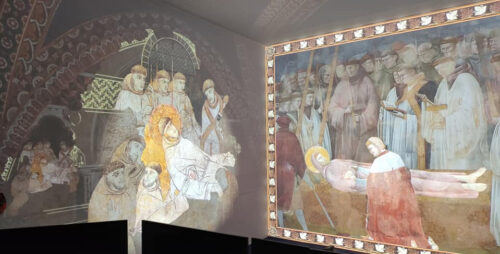
This was a charismatic man. No wonder the death of the saint in October 1226 caused something approaching a collective frenzy among the early Franciscans, who sought to preserve his physically embedded memories, their recollections of him and his relics. At the centre were his bodily remains, which, after his death on 4 October 1226, were carried the following morning from the Porziuncola towards their future resting place within the walls of Assisi.
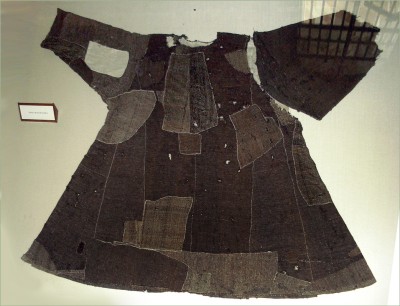
At the same time, Elias wrote a letter to the many brethren proclaiming the scandalous event of the stigmatisation. Later, the Poor Clares became curators of a growing collection of relics – scraps of parchment bearing his autograph writings, patched tunics, his breviary and, of course, not least his sayings. Recollections of his numerous “performances” were also assiduously gathered and later transformed into pictorial series of small paintings and larger frescoes. Often called “fiori”, these small vignettes and miracles – their ordering, interpretation and veracity – have occupied endless numbers of Franciscans, theologians and scholars of religion. Trying to fathom the truth of it all remains a Sisyphean task.
St Bonaventure

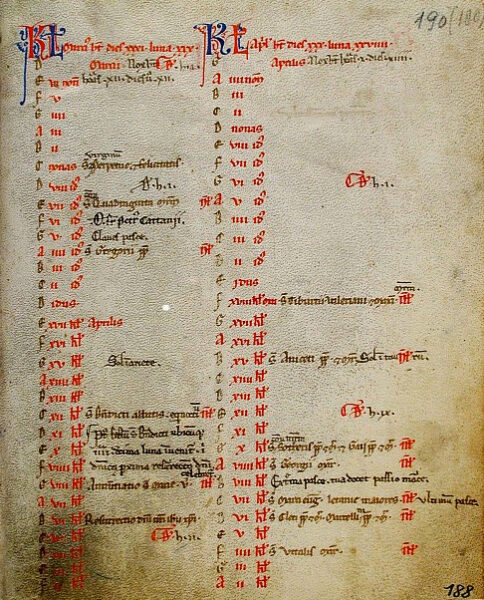
Part of this complexity, however, also had to do with a simmering conflict which arose almost immediately after the saint’s death and his official canonisation two years later. Who had the right to hone his message and his legacy? Which texts should be regarded as official and read as part of the celebration of the offices? And, not least, how should his spiritual heirs understand the stigmatisation, publicly announced in a letter by Elias only days after his death, yet regarded with considerable hesitation in parts of the clerical establishment?
Another issue concerned the continuing conflicts between those who sought to preserve the Poverello’s call for poverty and those engaged in the theological formation of an increasingly intellectual Franciscan Order at home in thirteenth-century universities and scholastic debate.
In the end, the General Chapter led by Bonaventure, the Minister General, decided in 1260 to push aside these unruly recollections as well as the earlier lives by Celano, making room for a serious re-editing of the life and works of St Francis. As part of this process, something approaching a formal damnatio memoriae was called for, followed by the virtual eradication of the earlier texts. As witnessed by several breviaries now in the Vatican, this was on occasion carried out through the physical erasure from parchment of readings supplied by the early biographer Thomas of Celano.
Celano’s continuing work between 1228 and the 1250s to create a formal Franciscan hagiography has recently received renewed attention through the work of Jacques Dalarun and others, not least in connection with the rediscovery of another abridged biography belonging to the early period of Franciscan codification and professionalisation. (4)
The Professionalisation of a Saint and the Dispute about the Tonsure
One of the challenges facing the Franciscan movement in the first half of the thirteenth century was undoubtedly the lack of any straightforward clerical status for its founder and his closest companions. Although Francis was at some point ordained a deacon, his early companions did not necessarily follow in his footsteps. Famously, Elias, who later took over the fledgling movement, had no comparable clerical status, although he was a trained administrator and notary who had studied in Bologna. Arguably, this was one of the many contentious issues contributing to Elias’s downfall in 1239.
Reviewing the sources, it is apparent that this non-clerical status became a thorn in the flesh of the professionals who took over during the mid-thirteenth century. Part of the problem was the apparent lack of any desire among the early brethren to look “properly outfitted” when preaching and witnessing.
We know that this was already a contentious issue at the beginning of the thirteenth century. From a text concerning another lay preaching movement – the Waldensians – we hear:
“They also believe that it is wrong to say that the Roman Church provides them with the spiritual viaticum any more than any man or woman among their own people does, without ecclesiastical vestments and without tonsure; and that such a person may consecrate the Body of Christ.” (5)
The text dates from around 1200–1210. The decisive point, however, is the Waldensian conviction that they, as lay people, might consecrate the “Body of Christ”. This was never an issue among the early Franciscans, who, led by Francis, accepted the sacramental monopoly of the Church.
The question which later surfaced was whether “preaching” itself called for clericalisation. Based on the sources, this does not appear to have been the case at first. Matters changed, though, as witnessed by the story of the “tonsure” – or lack thereof – which crops up in the 1240s.
There are numerous representations of what might be regarded as portraits of St Francis in which we are accustomed to seeing Francis tonsured. The sources, however, are enigmatic as to when – if at all – he accepted and carried this sign of special status.
In Celano’s first biography, the Vita prima, completed in 1229, the question of tonsure does not arise. (4) Describing the journey to Rome to acquire Innocent III’s approval of the primitive Rule, Celano tells us that when Francis went to Rome with his brothers, Innocent examined their proposal, approved it, blessed them and authorised them to preach penance. Yet there is no mention in this text of tonsure or other clerical vestments.
Only later do we get the impression that the question had entered into debate. In the text generally known as Celano’s Second Life, written in 1246–1247 and also known as The Remembrance of the Desire of the Soul, the issue now surfaces in a paragraph of its own, entitled “How the Saint Wanted to Be Shaved”. In this retelling, Francis is being given a haircut and says before the actual tonsuring: “Take care not to give me a large crown! For I wish my simple brothers to have a part in my head.” The text continues: “Indeed, he wanted the Order to be held in common by the poor and illiterate, and not only by the rich and learned.” (6)
Finally, in Bonaventure’s Major Legend, we hear how the brethren, while in Rome, were treated to a proper haircut and received a small crown:
“He approved the Rule, gave them a mandate to preach penance, and had small tonsures given to all the lay brothers who had accompanied the servant of God, so that they could freely preach the word of God.” (7)
As we know that one of the divisive issues within the Franciscan movement during the middle decades of the thirteenth century concerned the increasingly professional and clerical status of the brethren, we may perhaps conclude that Bonaventure either adopted or formalised a tradition according to which St Francis had indeed been tonsured. Tracing the texts, however, tells us that the tradition developed over time.
The Artistic Dispute Concerning the Saintly Legacy

At the same time as all these texts – one after another – sought to define how the man, his work and his legacy should be understood, painters and other artists tried to present images of Francis and the world in which he had lived.
And just as his heirs eventually divided into competing tendencies, commonly associated with the Spirituals and the Conventuals, so too did the artistic representations diverge. In much the same way as the “winners” sought to suppress memories of the charismatic and challenging Poverello and substitute their own more polished version of a professional saint, the artistic legacy appears to split into two traditions, with some of the earliest paintings differing markedly from those that followed.
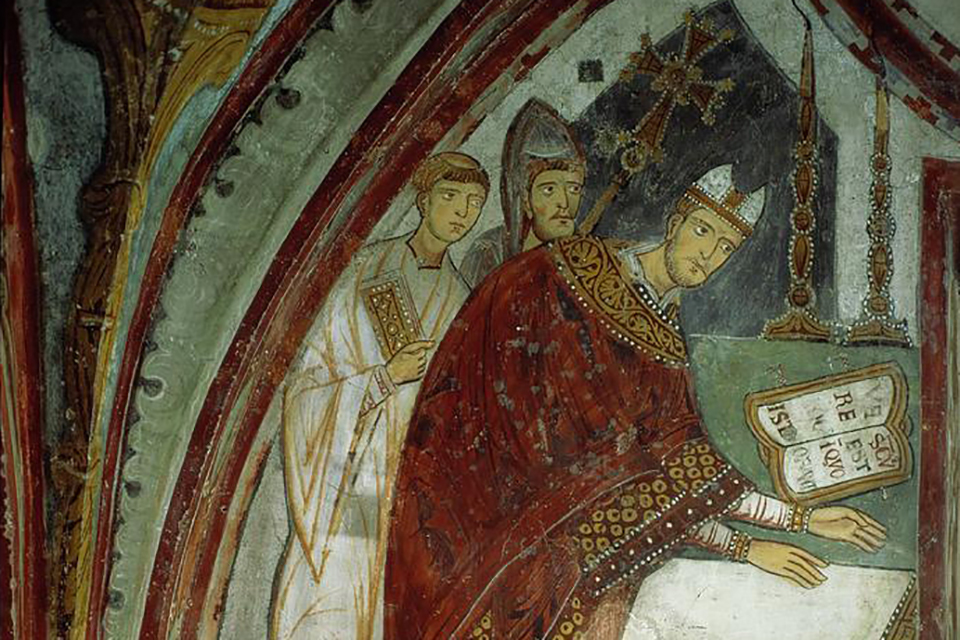
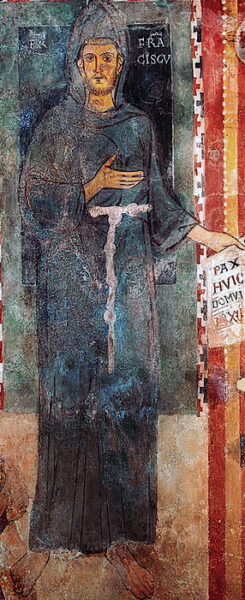
The oldest portrait of St Francis is believed by some to be found at Subiaco, in the chapel of San Gregorio at the Sacro Speco. Two representations of Francis belong to this complex. One is an oblong fresco depicting St Francis in his grey tunic, belt and cowl, but without the stigmata, a visible tonsure or a halo. The other depicts St Francis as present at the consecration of the chapel, carried out by his protector Ugolino of Ostia, later Pope Gregory IX. According to an inscription, this fresco was painted between 1228 and 1229.
Unfortunately, the identification has been questioned. Might this be a Benedictine monk subsequently repainted as a Franciscan? Klaus Krüger has noted, among other things, that the Franciscan cord appears strangely superimposed upon the drapery rather than structurally integrated into it. He therefore suggested that an existing Benedictine monk might have been transformed into Francis simply by adding the cord and identifying inscription. (8) The question has continued to be debated. (9)

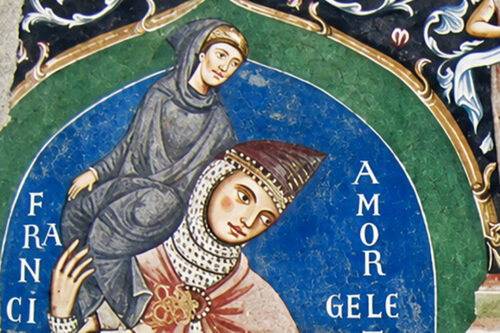
However, the restoration and study of the frescoes in the Aula Gotica of SS. Quattro Coronati in Rome, generally dated to the middle of the thirteenth century, have provided important comparative material. The small figure of St Francis featured there, sitting on the shoulder of “Love”, belongs to a closely related Roman and papal artistic milieu. (10)
Thus, the painting of St Francis reclining on Love’s shoulder in the Aula Gotica is certainly an authentic thirteenth-century representation of Francis and belongs to the Roman and papal artistic environment associated with Gregory IX and his successors. This makes the unusual appearance of the Subiaco Francis more interesting, rather than less.
There is therefore no compelling reason at present simply to dismiss the Subiaco portrait as a Benedictine image subsequently converted into Francis. Its “Benedictine” appearance may instead belong to an early conception of Francis within this milieu. Whether the cord and inscription are entirely contemporary with the underlying figure remains a technical question. Further conservation and technical investigation may eventually provide the evidence needed to determine the precise status and date of the Subiaco “portrait”, with its decidedly different appearance from the later codified altarpieces to which we now turn.
Until then, however, we are at least allowed to note that, in the decades following his death, there existed an artistic tradition in which Francis could be portrayed very differently from the polished saint of later Franciscan iconography.
The Cleansing of the Image

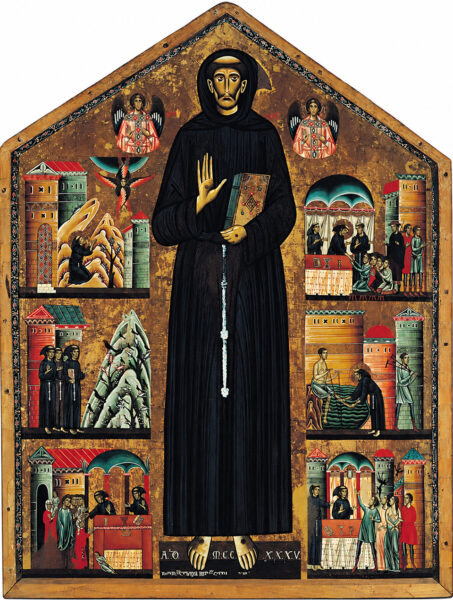
As opposed to this artistic rendition of the warm and loving brother in Christ, artists were soon commissioned to create another idea of the man, presented through a series of very different representations in the form of painted panels and altarpieces organised as vita panels.
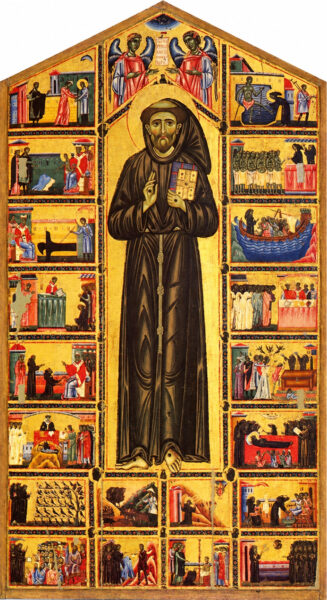
At the centre would stand a life-size, full-length presentation of the saint with a prominent tonsure and corona, sporting an ascetic appearance and the stigmata, and dressed in his rough tunic with its knotted cord. In one hand he would carry a book, while the other would be raised in benediction.
The first of these, from San Miniato near Pisa, is unfortunately now lost. Next in line, and currently dated to around 1235, is the panel preserved in Pescia. Painted by Bonaventura Berlinghieri, a painter from Lucca, it already possesses all the later hallmarks – tonsure, halo, breviary, stigmata and so forth. Other examples include the painted panels from Pisa (1253–1254), Pistoia (1250–1255), Florence (1250–1260), Assisi (1250–1260), Orte (1282), Siena (1288), and the later fourteenth-century altarpiece preserved in the Louvre. Krüger provides the list and dates. (8)

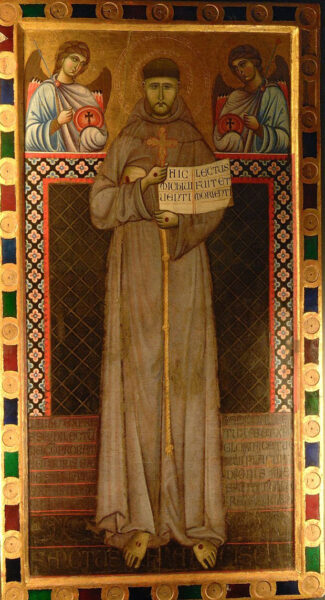
To this list should be added the painting preserved at the Porziuncola by the Master of St Francis, St Francis between Two Angels. The panel, made in tempera and gold with stained glass, is considered the oldest image of St Francis preserved at the Porziuncola.
At its centre stands the saint, dressed in the habit of humility, holding a crucifix in his right hand and an open book in his left. The signs of the miracle of the stigmata are clearly visible, including – exceptionally – the wound in his side, from which blood emerges through an opening in the garment. The painting, dated to around the middle of the thirteenth century, is traditionally said to have been made from the wooden board which Francis used as a bed and on which he was carried into the city for burial. On the cover of the book is the inscription: “This was my bed, both living and dying.” (11)
Accordingly, it is venerated not only as a painting by the anonymous Master of St Francis, but also as a precious relic. Although lacking vita panels, it belongs to this family of painted panels, providing another version of the formal icon through which the custodians and curators wished to present an official saintly image of their messy hero.
Preaching to the Birds – or Back to the Tonsure
On a final note, one of the interesting features of the painting called St Francis between Two Angels is the depiction of the saint’s hair. Is he fitted with a calotte – as we know Elias was – or is he simply sporting short, curly hair? Apparently, this has attracted remarkably little discussion in the literature.
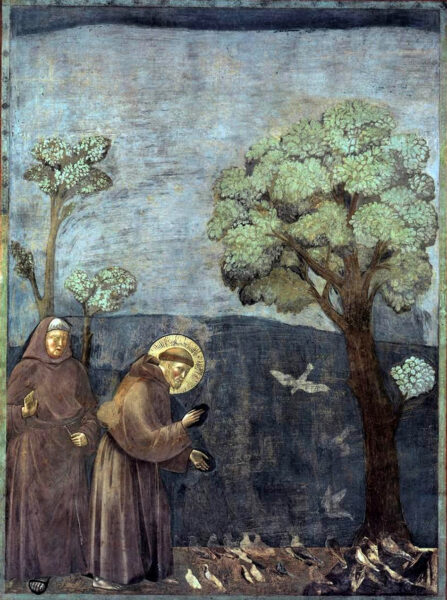
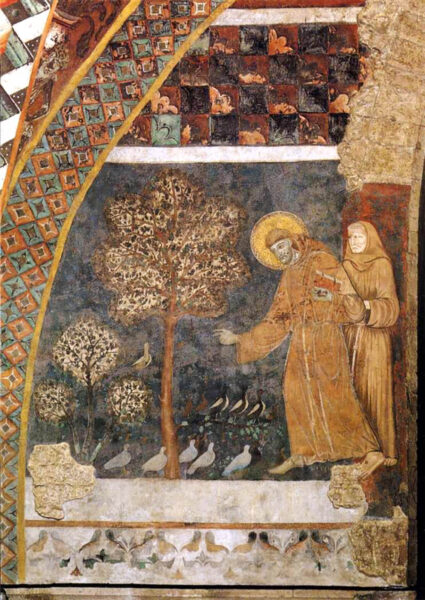
Some additional information may be found in one of the frescoes by the same artistic circle in the Lower Church at Assisi. Here we see the saint preaching to the birds with cropped hair. In contrast, in Giotto’s later treatment the saint is properly tonsured.
It appears that the question of the clerical status of the saint was still visually unstable during the middle decades of the thirteenth century, before Bonaventure’s Major Legend had fully established itself as the authorised account. By the time the later Assisi cycles were painted, however, the matter had been decisively settled. Here we are presented with the image of a proper saint sporting the clerical symbol par excellence.
Finally, St Francis had become a well-modulated icon. Whether the image was historically accurate appears by then to have become a detail of little importance to the broader communicative effort.


Thinking Through the Image?
One little detail seems worth pondering. It appears that the signification of “Francis” passed through three phases, each commented upon by the principal players.
In the beginning, the signification was built upon a very conscious effort organised around the principle: show it, don’t tell. From the stripping in the main square of Assisi to the revelation of the stigmatisation at his death, Francis was involved in a cycle of visual sign production – the making of “Francis” through a deeply embodied performance pointing towards Christ. This we know from countless preserved recollections of his life and times.
However, what we may also know is that Francis himself, to some extent, reflected upon this process of signification. In the recollections deriving from his three comrades-in-arms, Leo, Angelo and Rufino, Francis at one point comments upon the need to understand what was at stake:
“St Francis said: In pictures of God and the Blessed Virgin painted on wood, God and the Blessed Virgin are honoured and God and the Blessed Virgin are held in mind, yet the wood and the painting ascribe nothing to themselves, because they are just wood and paint; so the servant of God is a kind of painting, that is, a creature of God in which God is honoured for the sake of his benefits. But he ought to ascribe nothing to himself, just like the wood of the painting, but should render honour and glory to God alone.” (12)
The saying belongs to a collection preserved in the fourteenth-century Assisi/Perugia manuscript MS 1046, containing vignettes and sayings deriving from the reminiscences which proliferated after the saint’s death. Thus, although the saying is, like so much else, disputed, it presents itself as a comment upon how those who sought to preserve the memory of the early Franciscan movement understood the integrity of his personal endeavour.
His effort, they claimed, was not to stage himself as a spectacular artist, but rather to act as a gifted scenographer, while vigorously taking part in the debates of the 1220s–1260s about who had the right to proffer which idea of what St Francis was all about – and which images might properly serve which communicative endeavour.
As documented above, those who wished to preserve this unrulier Francis lost out in the long run, when administrators and intellectuals set to work in the middle of the century to clean up the mess left by a charismatic yet untidy jester and minstrel who had become someone they could neither live without nor entirely live with.
However, even in the relatively clean – and, dare one say, somewhat boring – Major Legend, which Bonaventure wrote in order to get a firm grip on how posterity should engage with Francis’s legacy, doubt is occasionally voiced. One question which preoccupied Bonaventure was how far an image could stand in relation to reality while at the same time possessing beauty and goodness in itself.
To answer this question, we may profitably consult another work by Bonaventure – more precisely, his Commentary on Peter Lombard’s Sentences, written during the 1250s. Lombard had commented upon Hilary of Poitiers’s Trinitarian formula, which Bonaventure turned into the following question: “Why is eternity appropriated to the Father, beauty to the Image [the Son], and use to the Gift [the Holy Spirit]?” (13)
Both Bonaventure and Thomas Aquinas discussed this formula at length while grappling with the way in which the three persons of the Trinity could at one and the same time be different and yet fully equal. At stake was the problem of acknowledging three coequal yet distinct persons. It is all very convoluted, and anyone in need of serious theological gymnastics may let themselves loose among the conundrums of what “coeternal” and “coequal” might mean. (13)
Here, however, we may abstain and simply note that, when explaining how to understand the relationship between Image [Son] and Prototype [Father], the two theologians take somewhat different routes.
On the one hand, Thomas explains the relationship through perfect consonance and clarity, perfect proportion or correspondence, and radiance. According to Thomas, the Son has perfect consonantia with the Father because he is his equal and adorned with perfect likeness; and perfect claritas because, as the Word, he manifests the Father and contains the exemplary reasons of created things.

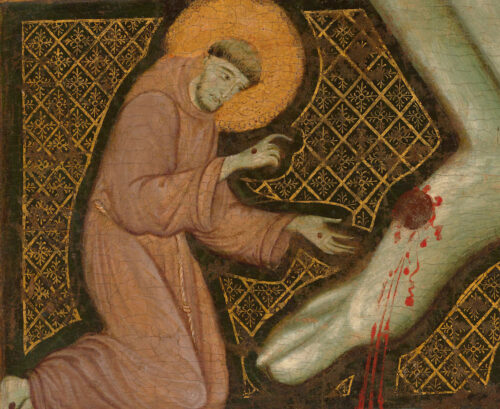
Bonaventure agrees that the Son is beautiful because he is the perfect and expressed likeness of the Father and because, as the divine exemplar, he contains the rationes of created beauty. Bonaventure writes:
“Therefore, insofar as the Son emanates by way of nature, he possesses the character of perfect and expressed likeness; insofar as he possesses the character of perfect likeness, he possesses the character of cognition; and by reason of both, he possesses the character of beauty. Since, therefore, the term species implies likeness, implies a principle of cognition, and also implies beauty – as when it is said, ‘the beauty [species] of Priam is worthy of empire’ – it is most fittingly appropriated to the Son.” (13)

But then Bonaventure does something Thomas does not do in his answer to this particular question. He stops to analyse what happens in an ordinary painted image. He writes:
“To the objection that the beauty of an image is referred to its prototype, it must be said that this is true. But honour is referred to the prototype in one way, and beauty in another. For the honour of an image or painting is referred to the prototype in such a way that there is no honour in the image itself, considered in itself – as is clear if an image of Saint Nicholas is honoured. Beauty, however, is referred to the prototype in such a way that beauty nevertheless exists in the image itself, and not only in that of which it is the image. Indeed, a twofold character of beauty can be found in the image, although in that of which it is the image only one is found. This is clear because an image is called beautiful when it is well executed; it is also called beautiful when it represents well that to which it refers. And that these are two different kinds of beauty is clear because one can exist without the other. Thus an image of the devil is called beautiful when it represents the ugliness of the devil well, although the image itself is then ugly.” (13)
What we may be reading here is Bonaventure’s contribution to a highly charged dispute concerning the status of the stigmata, which caused considerable controversy among theologians and within the clerical establishment. Was St Francis simply a saint, albeit an unusually spectacular one? Or did the stigmata establish an unprecedented degree of likeness between Francis and Christ?
One can almost hear the theological sparring between Franciscans and their critics: on the one hand, attempts to rob the Franciscans of the singularity of their saint by questioning the stigmata; on the other, the danger that an excessive claim for Francis’s likeness to Christ might itself become theologically problematic. We may also hear an echo of the reticence towards the stigmata present within sections of the papal court and vividly described by Chiara Frugoni. (14)
As an answer to such questions, we hear Bonaventure arguing that, yes, images can possess full beauty and likeness. And yet, in terms of honour, they float within a communicative world in which honour passes through the image towards its prototype.
Perhaps the alleged saying attributed to Francis and preserved by his spiritual friends, commenting upon his endeavour to live a Christlike life, was another echo of the ongoing debate among the brethren about how to counter such critical questions.
Yes, Bonaventure seems to say, Francis might in one sense be an “image”, beautiful insofar as he was endowed with the Christlike signum of the stigmata. Yet he was not identical with Christ, because the honour accorded to the prototype does not reside in the image as image, however beautiful or faithful that image may be.


Conclusion

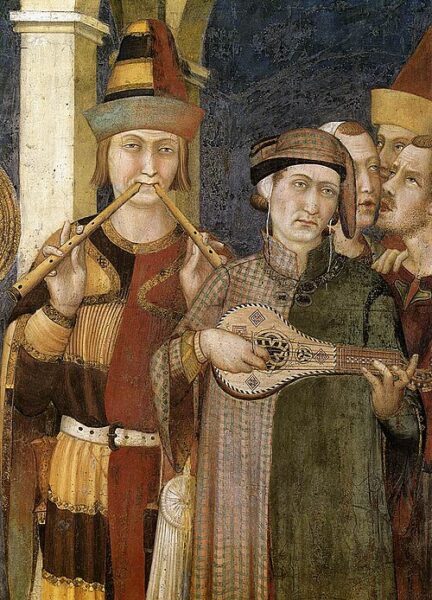
Francis was a charismatic and very bright young man with a theatrical talent which, according to the early stories, made him popular among his friends. In 1202, however, he joined the military forces of his home town, Assisi, which had become embroiled in war with Perugia. After a defeat, he was taken prisoner and spent roughly a year in captivity before being ransomed.
Exactly what happened next is difficult to ascertain. What the sources do show is a period of illness, withdrawal and profound religious reorientation. Modern readers might recognise in these accounts symptoms resembling those associated with psychological trauma; medieval commentators instead understood the episode in moral and religious terms. In the Middle Ages commentators considered it as a kind of moral and religious disorientation. Around 1205–1206, Francis experienced the encounters associated with San Damiano which helped turn him into the singular preacher about whom numerous stories were told both before and after his death.
From these stories, he appears almost obsessed with a communicative project characterised by a “show it, don’t tell” pedagogy, performing his way through a Christlike existence. In the end, bodily suffering itself became incorporated into the signs through which Francis and his followers understood that existence, culminating in the story of the stigmatisation reported immediately after his death.
After his interment in Assisi, the brethren – his spiritual heirs – fought over his legacy. One tendency sought to preserve his memory through relics: his bodily remains, his artefacts and the stories through which they remembered his physical performances as an otherworldly gifted joculator and minstrel. Another sought increasingly to sanitise and codify him by dressing him up as a proper saint: an emaciated cleric sporting the correct signs – the tonsure, the book, the benedictory posture and, finally, the stigmata, which somehow survived the internal conflicts.
As part of this microhistory, the image of Francis was continually reworked – in texts, paintings, relics, architecture and ritual. The process did not simply preserve a memory of Francis; it transformed him.
Francis himself had already understood something of the mechanism. He lived through signs: dress, gesture, performance, poverty, wounds. His companions remembered and transmitted those signs. Rival groups then interpreted them, selected among them and fought over their meaning. Finally, the Order and its theologians stabilised them into a recognisable system: the tonsured friar, the stigmatised saint, the alter Christus, the icon.
Seen in these terms, Umberto Eco (15) in his semiotic studies did not provide a modern theory which happened to fit the story after the event. Rather, his distinction between sign production, communication and signification gives us a vocabulary for recognising what the Franciscans themselves were doing. Francis produced signs through his body and actions; his followers communicated and contested them; and the institutional Church and Franciscan Order gradually fixed their signification.
The result was not merely an image of Francis. It was “St Francis” as a sign – sufficiently stable to be recognised across Europe, yet powerful precisely because traces of the unruly, performing man remained embedded within it.
Karen Schousboe
FEATURED PHOTO:
Pope Gregory consecrates chapel in Subiaco ca. 1228 accompanied by Francis of Assisi Source: Wikipedia
NOTES
(1) Thomas of Celano, Vita prima S. Francisci, ch. 29, §83. The physical description begins: “Statura mediocris parvitati vicinior …”
(2) Peter V. Loewen, “Francis the Musician and the Mission of the ‘Joculatores Domini’ in the Medieval German Lands”, Franciscan Studies 60 (2002), pp. 251–290.
(3) Thomas the Archdeacon, Historia Salonitanorum atque Spalatinorum pontificum, ed. Olga Perić, in Toma Arhiđakon, Historia Salonitana: Povijest salonitanskih i splitskih prvosvećenika (Split: Književni krug, 2003), pp. 152–154.
(4) Jacques Dalarun, The Rediscovered Life of St. Francis of Assisi by Thomas of Celano (Franciscan Institute Publications, 2016).
(5) Manifestatio haeresis Albigensium et Lugdunensium, ed. Antoine Dondaine, in “Durand de Huesca et la polémique anti-cathare”, Archivum Fratrum Praedicatorum 29 (1959), pp. 268–271, at p. 271, ll. 107–126.
(6) “Quando radebatur sanctus Franciscus, saepe rasori dicebat: ‘Cave, ne mihi magnam coronam facias! Volo enim, quod fratres mei simplices partem habeant in capite meo. Volebat denique religionem pauperibus et illiteratis, non solum divitibus et sapientibus esse communem.’” Thomas of Celano, Vita secunda S. Francisci, II, ch. CXLV, §193.
(7) “Approbavit regulam, dedit de poenitentia praedicanda mandatum et laicis fratribus omnibus, qui servum Dei fuerant comitati, fecit coronas parvulas fieri, ut verbum Dei libere praedicarent.” Bonaventure, Legenda maior III.10. English translation in Regis J. Armstrong, J. A. Wayne Hellmann and William J. Short (eds), Francis of Assisi: Early Documents, vol. II: The Founder (New York: New City Press, 2000), pp. 548–549.
(8) Klaus Krüger, Der frühe Bildkult des Franziskus in Italien: Gestalt- und Funktionswandel des Tafelbildes im 13. und 14. Jahrhundert (Berlin: Gebr. Mann Verlag, 1992).
(9) Lorenzo Cappelletti, “Alcuni rilievi sulla vexata quaestio dell’immagine di F(RATE)R FRA(N)CISCV al Sacro Speco di Subiaco”, Theologica Leoniana 12 (2023), pp. 107–133.
(10) Marius B. Hauknes, “The Painting of Knowledge in Thirteenth-Century Rome”, Gesta 55, no. 1 (2016), pp. 19–47.
(11) Elvio Lunghi, Il Crocefisso di Giunta Pisano e l’icona del Maestro di San Francesco alla Porziuncola (Santa Maria degli Angeli, Assisi: Porziuncola, 1995).
(12) “Dicebat etiam: ‘Sicut in pictura Domini et beatae Virginis in ligno depicta memoratur et honoratur Deus et beata Virgo, et lignum et pictura nihil sibi attribuunt, quia non sunt nisi lignum et pictura; sic servus Dei non est nisi quaedam pictura, videlicet creatura Dei, in qua Deus honoratur propter beneficia sua. Homo autem, sicut lignum et pictura, nihil sibi debet appropriare. Soli Deo honor et gloria; homini vero, dum vivit, verecundia et confusio, quia, dum vivit, carnem secum portat, quae contraria est gratiae Dei.’” Marino Bigaroni (ed.), Compilatio Assisiensis dagli scritti di fra Leone e compagni su S. Francesco d’Assisi: dal ms. 1046 di Perugia, 2nd rev. edn (Assisi: Edizioni Porziuncola, 1992), p. 28.
(13) Bonaventure, Commentaria in quatuor libros Sententiarum, I, dist. XXXI, pars II, art. I, q. III, “Quare aeternitas approprietur Patri, species Imagini, et usus Muneri”. A more literal rendering is: “Why eternity is appropriated to the Father, species to the Image, and use to the Gift.” Thomas Aquinas discusses Hilary’s formula in Summa theologiae I, q. 39, art. 8. On the general difference between Bonaventure and Thomas Aquinas, see Randall B. Smith, Aquinas, Bonaventure, and the Scholastic Culture of Medieval Paris: Preaching, Prologues, and Biblical Commentary (Cambridge University Press, 2021).
(14) Chiara Frugoni, Francis of Assisi: A Life (London/New York: Continuum, 1998).
(15) Umberto Eco, A Theory of Semiotics, Advances in Semiotics (Bloomington: Indiana University Press, 1976).
READ MORE:


