


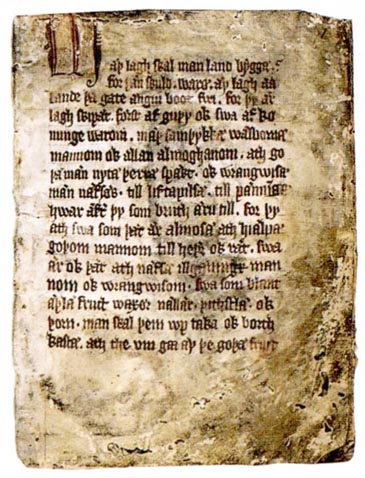
The creation of a Scandinavian provincial law: how was it done?
Stefan Brink, University of Aberdeen
DOI: 10.1111/1468-2281.12006
ABSTRACT:
It is well known that lawmaking was inseparable from kingship in England and on the continent. Therefore, there has also been a predominant tendency to see the Medieval Scandinavian provincial laws in a regal context. In this light, the initiators of laws were kings and men belonging to the upper stratum of society, and the laws themselves are seen as reflecting the societal situation, in which they were written down. This article focuses on ‘peripheral’ or ‘provincial’ laws, such as the Icelandic Grágás, the main Svea Law, the Uppland Law and not least the Hälsinge Law. It attempts to show that such laws were not inventions of any one person or group in the thirteenth or fourteenth century, and that they cannot only be mirroring the time, in which they were written down. Rather there are complex layers in the versions of these laws which survive: some old customary law, some probably newly composed law, some having their roots in Roman legal tradition and some in canon law. The picture which emerges is much less clear-cut than has been supposed, showing many regional differences and peculiarities. A key witness to this is the Law of the Hälsinger. In medieval Hälsingland a king or king-like person was very seldom present and no archaeological or historical sources witness to the presence of an aristocracy. The Land-owning class consisted of free farmers, says Stefan Brink, and goes on to argue how the law was the result of a rewriting of another provincial law, the Uppland Law, but with significant adjustments derived from local customs and inspired by Norwegian legal tradition. The conclusion is that careful shifting may uncover such complex layers in the wider spectrum of Medieval Scandinavian Laws.
The article is part of a collection of papers presented at a conference in Copenhagen in 2011 organised in collaboration between three digitisation projects: “Early English Law“, “Nordic Medieval Laws” and “Relmin”.
READ MORE:
Read also about the context of the article in “Medieval Law”


