When Pernelle, the wife of Nicolas Flamel, died on 11 September 1397, she left behind a substantial estate, a complicated testament and a family dispute that would occupy the Parisian courts for months. The surviving documents offer an unusually intimate glimpse into the affairs of a prosperous bourgeois household in late medieval Paris.
In the late summer of 1397, Pernelle, the wife of the Parisian scribe and property owner Nicolas Flamel, was approaching the end of her life. She had been married to Nicolas since 1368, and together they had accumulated houses, rents and other investments in Paris. Their property included the residence at the corner of rue Marivaux and rue des Écrivains, opposite Saint-Jacques-de-la-Boucherie, as well as two writing stalls adjoining the church.
Pernelle had previously been married twice, and her third marriage to Nicolas had brought thus brought together three sets of property and financial interests. Although the precise extent of her contribution remains difficult to establish, she was evidently more than the passive wife of a prosperous businessman. The documents repeatedly refer to property acquired jointly by the couple, while the arrangements made for its eventual disposition suggest that both spouses had a considerable interest in determining what would happen after their deaths.
They had no children together. Instead, they had arranged their affairs through a mutual donation, intended to secure the position of whichever spouse survived the other. The agreement to this effect had been drawn up early in their marriage and subsequently reaffirmed, most recently in August 1396. Such arrangements and agreements were both common and straightforward in principle. Rather than dividing their jointly held assets immediately between surviving relatives, the remaining spouse would continue to benefit from them. Only later would the property be distributed according to the arrangements made for its eventual destination. However, this agreement created a potential conflict with Pernelle’s own family. A conflict, she substantially contributed to according to her last will.
The testament of August 1397
On 25 August 1397, Pernelle made her testament. Like many late medieval wills, it was concerned with much more than the distribution of property. It provided for her burial, religious services, charitable gifts, and bequests to relatives and other individuals who had formed part of her social world. In the Middle Ages, preparing for death was both a spiritual and a practical undertaking. The dying person was expected to settle outstanding obligations, provide for dependants, remember relatives and benefactors, and secure prayers for the salvation of the soul. A testament was therefore simultaneously an expression of religious devotion and a document governing the future relationships between the living.
Pernelle’s provisions followed this pattern. She made gifts to religious institutions, the poor and members of her household and family. Among the smaller charitable bequests were ten sous tournois to the poor of Sainte-Avoye and another ten sous for the poor associated with the chapel of Étienne Hauldry. Such gifts were modest individually, but together they reveal the network of neighbourhood charities and religious institutions within which Pernelle understood her obligations. Other bequests concerned clothing and personal possessions. These are particularly revealing because garments were valuable objects in medieval households. They could be transferred between generations, distributed to servants or relatives, or given away as acts of charity. The testament thus offers occasional glimpses of a material world largely absent from the couple’s surviving property deeds.
Yet its most consequential provisions concerned the disposition of Pernelle’s estate. Her sister Isabelle, married to Jean Perrier, and their children had an obvious interest in the inheritance. The testament of 25 August appears to have favoured the claims of her relatives at the expense of the earlier arrangements between Pernelle and Nicolas. Whether this reflected a genuine change in her wishes, pressure from her family, or an attempt to reconcile competing obligations cannot be determined with certainty.
A last-minute change of mind
What is clear is that the arrangements did not remain unchanged and unchallenged. On 4 September 1397, only ten days after making her testament, Pernelle added a codicil. This supplementary document was intended to alter the balance between her husband and her relatives. against her testament, the codicil reaffirmed the earlier mutual donation and secured Nicolas’s position as surviving spouse. He was also now included among the executors responsible for carrying out her wishes. Apparently someone had spelled out the law to the dying woman.
Although her sister Isabelle was not forgotten, her expectations were now restricted to a payment of 300 livres tournois, a not insignificant amount. Nevertheless, it was a defined cash settlement rather than an open-ended claim upon the property accumulated by Pernelle and Nicolas and to be paid out at his death. The codicil also addressed Pernelle’s commemoration. She provided for four weekly Requiem masses at Saint-Jacques-de-la-Boucherie for her soul and those of her relatives, friends and benefactors. Her wishes thus embraced both the immediate household and the wider circle of people whose remembrance she considered important.
Later writers turned this sequence into a story of family intrigue, portraying Pernelle’s relatives as attempting to influence a dying woman before she recovered her judgment and restored her husband’s rights. Such an interpretation may contain an element of truth, but the documents themselves are less explicit about motives. They demonstrate disagreement over the inheritance. They do not permit us to reconstruct the conversations that took place around Pernelle’s sickbed. Seven days after signing the codicil, on 11 September 1397, Pernelle died.
The burial and the struggle over the inheritance
Following Pernelle’s death the disagreement was transformed into a conflict and a legal dispute, as her sister Isabelle and brother-in-law Jean Perrier challenged the arrangements governing the succession. Their objections concerned the rights created by the mutual donation, the provisions of the testament and codicil, and the administration of the estate.
The executors began the process of identifying and valuing the property. An inventory was undertaken, and officials became involved in establishing which assets belonged to the succession and which remained under Nicolas’s control. The proceedings quickly became contentious. The inventory was interrupted, and the estate became subject to legal action. The parties sought decisions through the institutions of Parisian justice, including those available at the Châtelet.
For Nicolas, the dispute threatened more than a portion of his deceased wife’s movable possessions. The property accumulated during their marriage comprised an interconnected collection of houses, rents and investments. An unfavourable judgment might have disrupted the economic arrangements upon which his livelihood and future religious foundations depended. Also, he might have married again and fostered children. For Isabelle and her family, however, the question was equally substantial. The mutual donation had effectively restricted their expectation of inheriting from Pernelle at a later stage. They had reason to challenge a settlement that left much of the accumulated wealth in Nicolas’s hands.
During October 1397, the Châtelet issued decisions which upheld the essential rights arising from the mutual donation while requiring arrangements to secure the claims of Pernelle’s relatives. Isabelle’s settlement of 300 livres was maintained, while provision was also made for her children. The nephews’ entitlement was eventually established at forty gold écus, with payment deferred until Nicolas’s death. The proceedings were therefore not simply a victory for one side. They produced a negotiated and legally enforceable distribution of obligations, preserving Nicolas’s position without entirely excluding Pernelle’s kin. The final payments and adjustments continued into January 1398, but they continued to reverberate in his testament 20 years later.
What did Pernelle leave behind?
The litigation generated one of the most valuable bodies of evidence for the economic circumstances of Nicolas and Pernelle. Following her death, the household’s movable goods were appraised, while the executors documented rents, property interests, debts and payments connected with the estate.
Unfortunately, the complete itemised inventory has not survived in an accessible original. Much of what we know comes instead from the account prepared by Pernelle’s executors and subsequently transcribed by the eighteenth-century antiquarian Étienne-François Villain. That account was formally presented in June 1399, nearly two years after her death. It identifies the couple’s residence, their writing stalls and numerous financial interests. It also records outstanding payments connected with their household and business affairs, including money owed for children attending school and boarding in their home. The evidence thus reveals a household sustained by several activities. Nicolas was an escripvain, but the family economy was not confined to the production of written documents. It included real estate, rental income, credit relationships and possibly the accommodation or instruction of pupils.
The account of the testamentary execution records receipts of approximately 816 livres 13 sous 8 deniers and expenditure of approximately 829 livres 3 sous 6 deniers. These figures represent the financial administration of the succession, not a simple valuation of the couple’s total wealth. They also illustrate the difficulty of fulfilling the obligations created by an ambitious late medieval testament. Burial expenses, commemorative services, payments to relatives, charitable gifts, legal proceedings and administrative costs could consume considerable sums.
Indeed, some relatively small legacies remained outstanding when the accounts were prepared. This should not necessarily be interpreted as evidence that Pernelle and Nicolas lacked substantial resources. Much of their wealth was invested in property and rents rather than held as immediately available cash. This difference was important. A prosperous household could own valuable income-producing assets while still experiencing difficulties in meeting numerous simultaneous financial demands.
The afterlife of Pernelle’s testament
One of Pernelle’s principal concerns had been the continued remembrance of her soul. Apart from her lavish plans for her burial, she also provided for four weekly masses at Saint-Jacques-de-la-Boucherie as well as several other commemorative and pious acts, such as the provision for a pilgrim. They were intended to establish a regular pattern of commemoration, incorporating her into the continuing religious life of the parish.
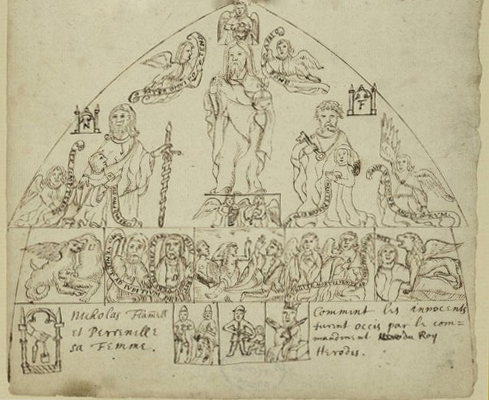
By 1419, these observances associated with her foundation were connected with the chapel of St Leu and St Gilles, situated within Saint-Jacques-de-la-Boucherie. Pernelle thus acquired her own place within the devotional landscape that she and Nicolas had helped to create. Across the street from their residence, the church contained the setting in which prayers for her soul would continue. Above one of its entrances, she and her husband were depicted kneeling before the Virgin, presented by their patron saints. Nonetheless, while Flamel was buried inside the church, her burial was associated with the cemetery of the Holy Innocents, where Nicolas also sponsored religious and commemorative works.
A woman behind the documents
It is tempting to regard Pernelle primarily as the wealthy widow whose marriage helped Nicolas Flamel establish his fortune. Yet her testament suggests a more interesting figure. She belonged to a network of relatives, servants, neighbours, religious institutions and charitable beneficiaries. She possessed property interests significant enough to provoke litigation. She exercised the right to dispose of her possessions and to revise those arrangements shortly before her death. Above all, she sought to shape how she would be remembered.
The quarrel over her inheritance, however, reminds us that late medieval marriage involved several competing claims. Spouses might wish to protect one another, while blood relatives expected a share in family wealth. Meanwhile, religious institutions claimed their place through gifts and commemorative foundations, and rervants, dependants and the poor could also be remembered through testamentary bequests. And perhaps that is the most revealing aspect of Pernelle’s testament: it shows us how a woman who had spent much of her life acquiring and managing property attempted, in her final days, to transform that wealth into security for the living and prayers for the dead. Unfortubately, her husband needed the wealth to continue living in style.
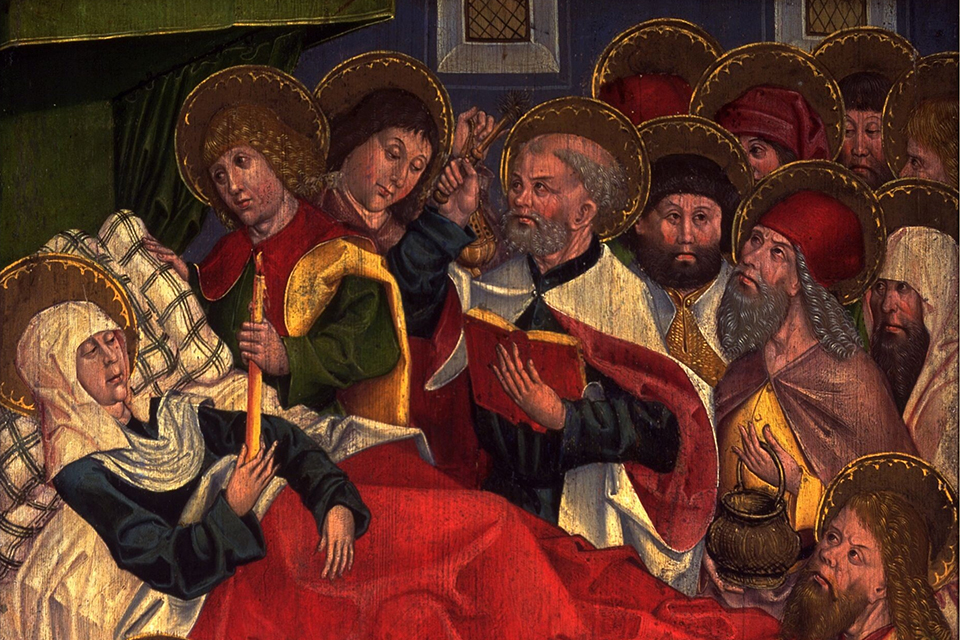
FEATURED PHOTO:
Detail of: The Death of the Virgin c. 1450-1500. Unknown Tyrolean Master. In: Fine Arts Museums of San Francisco, San Francisco. Source: Wikipedia
SOURCES
Étienne-François Villain, Histoire critique de Nicolas Flamel et de Pernelle sa femme (Paris, 1761), especially pp. 65–100 (death, dispute and execution), 290–313 (mutual donation, testament, codicil and associated documents), and 314–328 (executors’ account of 1399).
Étienne-François Villain, Essai d’une histoire de la paroisse de Saint-Jacques de la Boucherie (Paris, 1758), especially pp. 148–162 (commemorative monuments and foundations).
Richard H. Rouse and Mary A. Rouse, “Archives in the Service of Manuscript Study: The Well-Known Nicolas Flamel”, in Bound Fast with Letters: Medieval Writers, Readers, and Texts (Notre Dame, 2013), pp. 525–542.