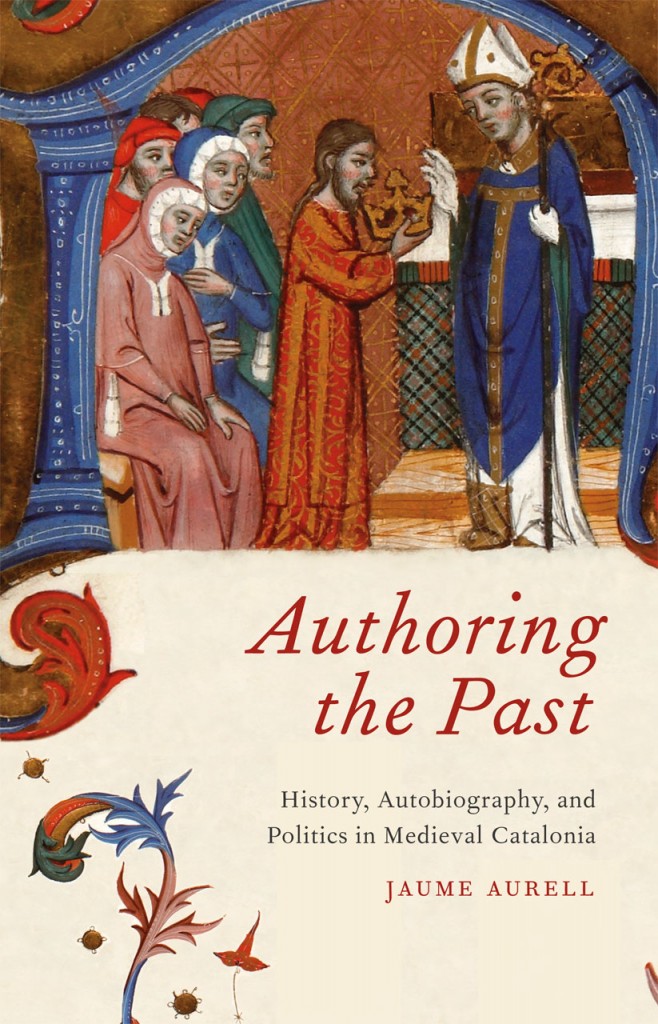
Authoring the Past. History, Autobiography, and Politics in Medieval Catalonia. by Jaume Aurell. University of Chicago Press 2012
Lineage, chivalry, hegemony, heroic deeds and political supremacy – all are ways in which diverse Catalonian counts and later Aragonese kings tried to validate their rights as rulers. At least this is, according to a fascinating new book, how these counts and kings wished to present their case to their contemporaries as well as posterity through the historical writings, which they initiated and took more or less active part in writing and editing.
The book – Authoring the Past – is written by the historian Jaume Aurell. In it he examines five central texts from the Catalonian Middle Ages – the Latin Gesta Comitum Barcinonesium and four histories in Catalan: the Llibre dels fets by James I, the Crònica of Bernat Desclot, the Crònica of Ramon Muntaner, and the Crònica of Peter the Ceremonious
Master Fictions
All political authority requires what the anthropologist Clifford Geertz famously called “a cultural frame” or a “master fiction”.
According to Jaume Aurell it is exactly this, which these Catalonian genealogies, chronicles and autobiographies from the late 12th to the late 14th century tried to establish through manipulation of genres, sources and narrative strategies. As such these precious Catalonian texts represent special ways of framing their respective proponents or “heroes”. Each in their own way shows how the counts and later kings anchored their rights to rule.
As such each text primarily represents a relic of the diverse ways in which these rulers (or their servants) thought of themselves and their rights to rule – whether this right was founded in their lineage, their chivalric competence, their military prowess and heroic deeds or finally their political proficiency.
At the same time, however, each text represent specific genres – chronicles, autobiographies etc. – which are extensively discussed in order to show the interrelationship between them.
Without prior recognition of this, historians should keep away from naively using these texts as sources. This is one of the obvious conclusions of this erudite exposé.
In this sense, however, the book is also an invitation. The reason is that we get small glimpses of exactly the kind of historical anthropological insights, which might be gleaned from these texts after their genre and intentions have been laid bare.
For instance this is demonstrated in the presentation of a number of coronation vignettes, where we learn how the later kings of Aragon established self-sufficient gestures, like the practice of Self-Coronation as opposed to the earlier sacralisation, which was instituted by the church and where the climax consisted in the officiating Archbishop crowning the king.
One must ardently hope that the book on “Authoring the Past” will not only invite scholars to continue in performing the same kind of penetrating analysis of other historical chronicles of the Middle Ages in order to establish a proper comparative perspective; a work which is in progress all around Europe. But also that historical Anthropologists per se will find plentiful inspiration here to delve into these quite remarkable Catalonian histories.
Although only some of the texts discussed in the new book may be found in adequate editions and translations, it is of great value that Jaume Aurell has presented future historians and students with an overall grid, whereby it becomes possible to read these texts anew and – not the least – between the lines, so to speak.
Jaume Aurell
Jaume Aurell is associate professor of History and dean of the College of Humanities and Social Sciences at the University of Navarra. He is the author of La escritura de la memoria. De los positivismos a los postmodernismos and La cultura del mercader en la Barcelona del siglo XV. He is also editor of the series: Rewriting the Middle Ages in the Twentieth Century (Brepols). Articles and essays have appeared in Annales, Biography, Rethinking History: Journal of Theory and Practice, the Journal of English and German Philology, and the Journal of Medieval History.
Read more about Medieval Catalonia in Medieval Histories 2012 4 : 2