New research proves beyond doubt the importance of the heavy plough for economic development between AD 900 -1300.
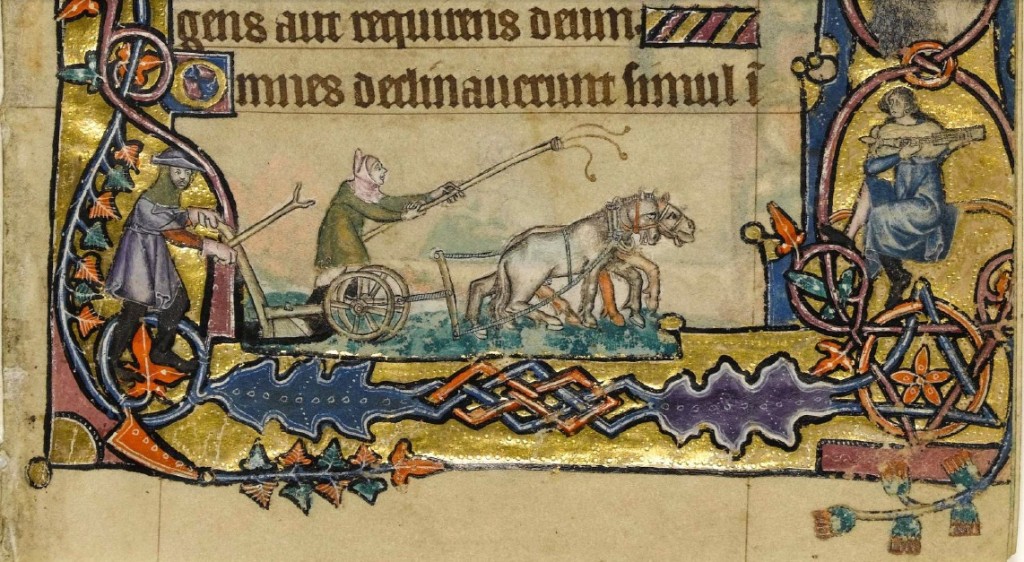
New research proves beyond doubt the importance of the heavy plough for economic development between AD 900 -1300.

The Medieval Settlement Research Group
The Medieval Settlement Research Group (MSRG) is a long established, widely recognised and open multi-disciplinary group that facilitates collaboration between archaeologists, historians, geographers and other interested parties.
The Group is dedicated to developing understanding of rural landscapes and settlements including villages, hamlets and farmsteads between the 5th and 16th centuries AD. For information about membership, conferences, grants and other activities, please see the MSRG website.
The MSRG’s journal, Medieval Settlement Research (MSR), is published each year in the autumn. The journal is an internationally recognised publication, containing peer-reviewed research papers, fieldwork reports and news, reviews and an annual bibliography. Although the Group’s interests are concentrated on British and Irish medieval landscapes between the 5th and 16th centuries AD, it actively encourages wider chronological and pan-European perspectives. Medieval Settlement Research therefore welcomes papers on Britain, Ireland and Europe that help us to improve our understanding of medieval settlements and landscapes from the level of individual sites to the international scale.
A digitisation project is currently near completion and back issues of the MSR and its predecessor the MSRG Annual Report are now available to users free of charge via the Archaeology Data Service (ADS). Other bibliographic details of past content can be found on the British and Irish Archaeological Bibliography (BIAB).
Can you talk about sustainability in the middle ages? This is the theme for a special session at the 49. Deutsche Historikertag
We all know by now that the earth is flat, hot and crowded. And that it will get worse the more we become. Might we learn from past techniques – and even medieval technologies – in order to find ways of living more sustainable lives? This is the overriding theme at the 49. Deutsche Historikertag, where “conflicts about resources” is the overriding theme.
As with all huge Conferences a number of sessions and papers tend to disregard this framework. However, one medieval session has tackled this question head-on.
According to the primary organiser of this session, Prof. Dr. Oliver Auge, sustainable development is a key paradigm in the global debate about our future. However, the question for medievalists is of course whether it makes sense to talk about this in a medieval historical context? Were medieval people ever voluntarily frugal in the sense that we use this concept? It is to this currently rather lively debate in scientific circles, which the session wishes to contribute – presenting a number of papers originating from historical subfields like environmental and technological history, archaeology and archaeobotany.
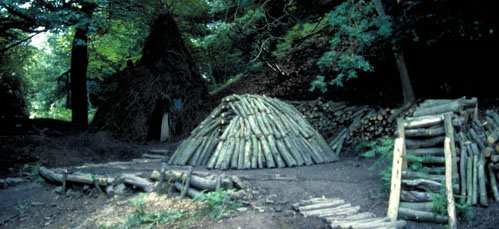
 One point of perspective in the debate will be a reevaluation of the widespread medieval practice of charcoal production. Charcoal is usually produced by slow pyrolysis, where the heating of wood or other substances takes place in the absence of oxygen. To produce charcoal the collier pile billets of wood on their ends in order to form a conical pile. At the bottom an opening lets in air while a central shaft lets the smoke escape. The pile is then covered with turf and moistened clay. The firing – which is a special craft – begins at the bottom and gradually spreads outwards and upwards
The massive production of charcoal in the Middle Ages was a major cause of deforestation. However all over Europe woods were managed as coppices, which were cut and regrew cyclically, so that a steady supply of charcoal would be available.
Archaeologists have shown how the production of charcoal usually was part of the peasant economy in forested areas; but hornbeam coppice wood as well as alder and birch swamps were systematically forested in order to feed these kilns. The use of fast growing coppiced woods was a common sustainable technique among medieval peasants. However, studies by the archaeologist, Arne Paysen, have shown that when charcoal production was instigated by the large landowners, the production was not sustainable. Here old trees were used ending in a massive and non-sustainable deforestation. Several papers will report on these aspects of medieval forest-management, more specifically in the region of Schleswig-Holstein.
It is the University of Kiel, which is active in the broad field of research into historical ecosystems.
Sustainable energy consumption in the Middle Ages and Early Modern Europe
Medieval charcoal burning is practiced at the Open-Air Museum in Schleswig-Holstein
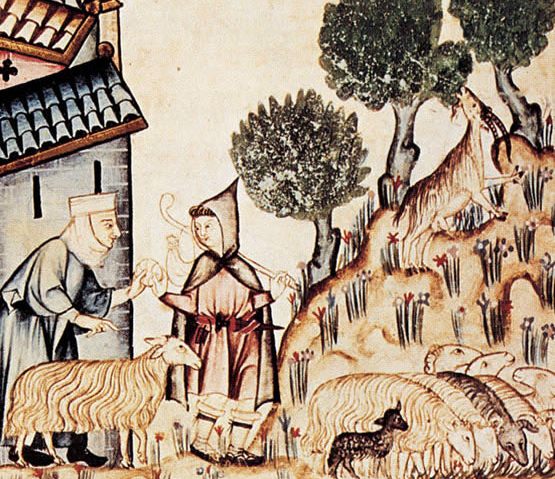
Early Medieval Archaeology of farming and husbandry is lifted...