Hugo d'Oigniers Crozier is showcased in a new book...
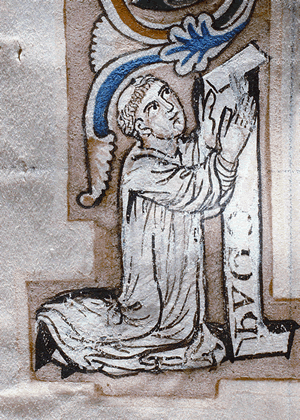
Hugo d'Oigniers Crozier is showcased in a new book...
 Anglo-Saxon Art. A New History.
Leslie Webster
The British Museum Press 2012
One of the very puzzling things about the more prominent pieces of Anglo-Saxon Art – the jewellery, the weapons, the manuscripts etc. – are their intricate character and their invitation to close-up inspection.
The Anglo-Saxons – not least the early bands of warriors of the 5th century and their ancestors up until mid 9th century – must have presented themselves as close-knit elites, bands of brothers. How else explain the fact that you nearly would have had to sit on the lap of a chieftain or a kinglet to get a glimpse of his brooches; or stand close to the altar at mass to get a glimpse of the book-craft and miniatures.
Of course there were stone sculptures to entice the public to enter the churches and marvel at the wall-paintings, the glittering textiles and the tabernacles of shrines and imported icons. And we might believe that at some point there existed a carved wooden sculpture-tradition, now completely lost except for a few fragments. In general though, the art of the Anglo-Saxons was best consumed close up.
Accordingly the art of the Anglo-Saxons is no easy matter to tackle head on, as is very well documented by a new introduction to the various art forms, written by archaeologist and art-historian, Leslie Webster.
Following this insight – that each piece of art – must be read carefully, the book very appropriately opens with an introductory chapter, which shows what might be gained from a close reading of the images, and seeing the text.
One of the more fascinating examples of this is a silver gilt pommel from the Woodeaton area in Oxfordshire. Seen from the wearer’s point of view it has the form of a horned animal. Seen from the enemy’s point of view it looks like a stinging bee or a winged bird, where the blade might have presented the sting or the beak. Indeed, very cheeky… (seen on page 36).
Having “learned” to read the artistic language, we are treated to a numer of well-written chapters outlining the heavy Roman influence, both the ancient and Christian. The final chapters present a more secular perspective and introduce the reader to the connections between “Art and Power” and the “Viking Impact”. Illustrated with more than 200 colour and black-and-white illustrations the book gives us ample opportunity to get close to this very close-knit social world, its mentality and world-view.
If one wishes to explain the entangled and obviously complex mythic stories of fabulous birds or crouching dogs, twisting in shaman-like transcendence, this is a good start. And where else learn to properly appreciate the artistic merits of the miniatures in the manuscripts?
There is always room for some quibble. Does it make sense to publish an introduction to Anglo-Saxon Art and leaving out an introduction to another of the major art-forms, poetry? Especially as the deep layers of storytelling found in many of the art-pieces seem to be echoed in literature and poetry – as may be witnessed by the visual program of Franks Casket, which is discussed in some detail in the book, while the inscriptions are only cursorily touched upon.
Maybe, however, this will be remedied in the next publication from the pen of Leslie Webster: a monograph of the said casket and to be published in the autumn.
Until then we have to be content with this fascinating and tho-roughly enjoyable introduction; as with all good reads it invites us to further explorations, museum visits and detailed examination of the many pieces of arts presented here.
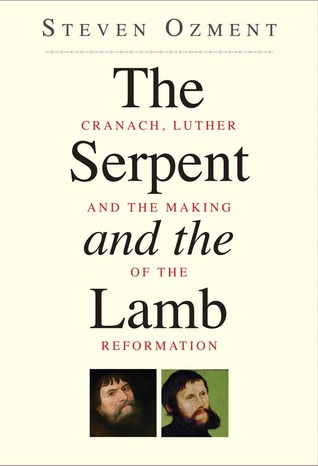
The Serpent and the Lamb. Cranach, Luther, and the Making of the Reformation
Steven Ozment
Yale University Press 2011
Lucas Cranach the Elder (1472 – 1553) belonged – next to Albrecht Dürer, Hans Holbein the Younger and Hans Memling – to the most important artists of his time. He spent his youth in Kronach, where his father lived as a painter. Around 1500 he left for Nürnberg (to learn from Dürer) and later Wien. In 1505 he was appointed court-painter to the ducal household of Saxony and set up shop in Wittenberg. At first he followed the duke around having bed and board at the different castles in Wittenberg, Torgau and Coburg. In 1512, however, he married Barbara Brengbier and bought a huge house in Wittenberg, where he sat up shop as a painter, printer and designer.
This brought him in close contact with Martin Luther, who started teaching at the University of Wittenberg in 1508. Soon they were fast friends and later collaborators in the dissemination of the reformation. Especially his work as a publisher and printer was indispensible in the years after 1517, when Luther published his 95 theses and began his work as a reformer.
A recent book by professor Steven Ozment – known for his fascinating stories about life in late medieval and early modern Germany – tells the story of how the fates of the “Serpent” (Cranach) and the “Lamb” (Luther) were intertwined as were their very early use of their coats of arms and their emblems as ways of enforcing some sort of copyright on their combined works as author and publisher. Although somewhat “weak” on the latest scholarship on Martin Luther, the book is fascinating because it explains in an original way, how Cranach albeit heavily investing in the reformation was able to move effortlessly amongst both reformers and Catholics.
Naked virtue
At the same time as he painted powerful people in both worlds, he created the series of beautiful naked “mothers” nursing their children, thus showing how Eros and the body should no longer be considered hellish; quite the opposite: The naked woman was the fountain of precisely that God-given love and nourishment, which graced the new life in the new church.
The book makes the claim that the reformation had never succeeded without Cranach’s visualization of the new theology. That may very well be. Whether he was the second most important reformer next to Luther, as the author claims is however less certain. Maybe it is more accurate to claim that the reformation was a result of the actions and efforts of a number of people, who simply happened to converge in the same place at an opportune moment in history.
Open database
Cranach the Elder was compared to his contemporaries a prolific artist. A “fast hand”, he was called by people, who marvelled at the vast production capacities of the man and his workshop – paintings, portraits, altarpieces, woodcuts, drawings, set pieces for hunts and tournaments and even wallpapers are just some of the results of a life long working career and business enterprise of the renaissance painter.
Now 400 paintings, 5000 drawings and woodcuts plus 2000 pages of research are available for in-depth perusal at the official “Digital Cranach Archive”, which recently opened some of its collections up for the public eye. Here it is possible to get detailed information of dates provenience etc. as well as access to a large part of the research hitherto hidden in obscure corners of scientific journals. As this is only the first installment, more is yet to come. The database is financed by the Andrew Mellon Foundation and a joint venture of institutions from all over the world. Undoubtedly the plan is to finish the work around 2015, which is named as Cranach-year as part of the Luther-Dekade leading up to the 500 – year reformation jubilee in 2017. Maybe at that time the three planned exhibitions in Weimar, Eisenach and Gotha will be superfluous as all the works of Cranach can be studied at home in high resolution and copiously documented.
www.lucascranach.org – not to be mistaken for www.cranach.net, which is an exclusive database, fenced off for anyone who is not a registered researcher.
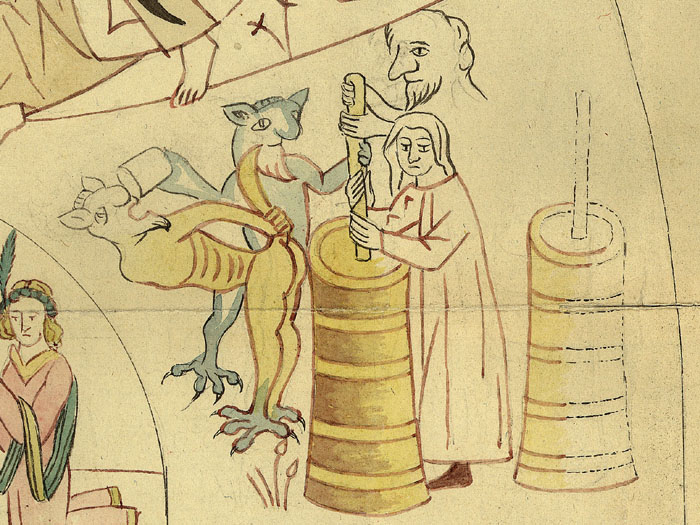
The Spiritus Sanctus imparted this creation to me on this cloaca…